
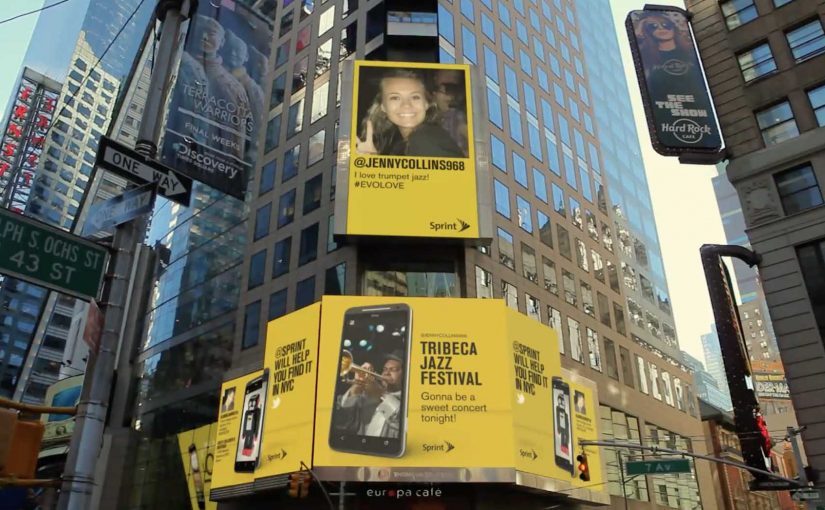
Sprint: Unlimited Love Billboard in Times Square

You are in Times Square and a billboard asks a simple question. What do you love. You tweet your answer with #EVOLOVE to @sprint, and the screen answers back with places in New York City where you can find it.

Sprint in the USA created an integrated advertising campaign for the launch of the HTC EVO 4G LTE phone on their network. To launch EVO in New York City they set up an interactive billboard in Times Square that encouraged visitors to tweet things they love with #EVOLOVE to @sprint. Then, with the help of local experts, the billboard re-tweeted locations of where these things of love could be discovered in New York City.

Why the mechanic works

The mechanism is a clean exchange. You give the brand a public signal. A tweet about something you love. The brand gives you an immediate, useful response. A location you can act on right now. That “reply with value” is what turns a hashtag prompt into participation.

Extractable takeaway: Interactive OOH works best when the public input reliably triggers a fast, specific reply that helps someone decide what to do next.

It also creates a visible social proof layer. The billboard is not only showing Sprint’s message. It is showing other people’s messages, which makes the campaign feel alive and current while you are standing there.

In consumer technology launches and telco marketing, a social-to-DOOH loop, where a social post immediately changes what the screen shows, turns a landmark screen into a real-time recommendation engine that people can influence from their own phones.

What Sprint is really buying

This is a launch tactic that behaves like service. It positions the EVO as a device you use to discover the city, not just a phone with specs. At the same time, it lets Sprint demonstrate “unlimited” as a lived experience. Always on, always connected, always responding in real time.

The real question is whether you can keep the reply layer fast, relevant, and brand-safe in public.

If you cannot operationalize that reliably, a simpler DOOH idea will outperform an “interactive” one that feels slow or generic.

Steal this reply-with-value billboard pattern

  • Make the input obvious. One hashtag. One handle. One sentence prompt.
  • Return something concrete. Maps, directions, a nearby place, a clear next action.
  • Curate the response layer. “Local expert” guidance beats generic automation for relevance and trust.
  • Design for the crowd and the clip. The street moment should be fun to watch. The video should still work without being there.

A few fast answers before you act

What is the Sprint #EVOLOVE Times Square billboard?

A digital billboard that invites people to tweet what they love with #EVOLOVE to @sprint, then responds by showing where in New York City they can find that thing.

Why connect Twitter to a billboard instead of running a normal DOOH spot?

Because participation becomes the content. The screen stays fresh, people feel seen, and the interaction creates a public spectacle that attracts more participants.

What is the “value exchange” in this campaign?

The user provides a public message and attention. The brand provides a timely, useful recommendation and makes the user visible on a high-profile screen.

What makes this different from simply displaying tweets on a screen?

The reply layer. The billboard does not only mirror tweets. It answers them with specific places and directions, which turns social chatter into utility.

What is the biggest execution risk?

If the responses feel slow, generic, or off-topic, people stop playing. The campaign only works when the replies feel genuinely relevant in the moment.
Misereor: The Power of a Coin

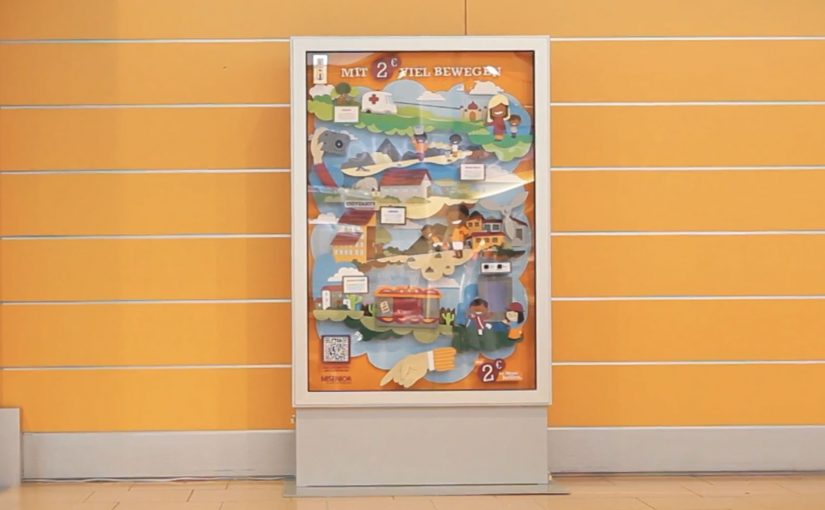
A billboard at Hamburg Airport does not just ask for money. It takes a 2-euro donation and immediately shows what that coin can do.

Misereor has been committed to fighting poverty in Africa, Asia and Latin America for over 50 years. To drive more donations, they install a billboard with a donation box built into it. When people put in 2 euros, the billboard brings to life how that coin can help across Misereor’s aid projects.

The billboard also links the offline act to an online conversation. It takes a photo of the donor and posts it to the campaign’s Facebook app. A QR code on the billboard lets donors share the promotion on their own Facebook page.

How the interaction is designed to convert

The mechanism is a tight, three-step loop. Physical donation triggers an immediate visual payoff. The payoff translates “impact” from an abstract promise into a concrete scene. The scene then becomes shareable proof through an automatic photo post and a QR-driven sharing prompt.

In high-traffic public spaces where attention is fragmented and dwell time is unpredictable, donation design wins when it minimizes steps and makes impact visible immediately.

Why it lands

This works because it replaces guilt with clarity. You do not just hear that your money helps. You see a specific outcome the moment you give, which makes the decision feel both meaningful and finished.

Extractable takeaway: If you want more donations, build a “give. see. share.” loop where the act of giving triggers instant, legible impact, and the sharing step is optional but effortless.

The real goal behind the 2-euro choice

The real question is whether a donation ask can feel immediate, visible, and worth doing before the traveler walks away. A 2-euro ask is small enough to feel impulse-safe, especially in an airport moment where people already make small purchases without overthinking. The campaign then uses the experience to recruit advocates, not just donors, by turning each donor into a visible participant online.

What this donation design gets right

  • Make the donation amount frictionless. Small, fixed amounts reduce decision paralysis.
  • Show impact instantly. The payoff must happen before the donor walks away.
  • Bridge offline to online. Capture a shareable artifact, but keep it consent-friendly.
  • Keep the interface obvious. A slot, a prompt, a clear result. No instructions required.

A few fast answers before you act

What is “The Power of a Coin”?

An interactive airport billboard for Misereor where a 2-euro donation triggers an animation that shows how the money helps, and then offers easy sharing via photo and Facebook.

What is the core mechanism?

Donate a fixed amount, get an immediate visual “impact reveal”, then optionally share via an automatically posted donor photo and a QR-enabled share prompt.

Why is the instant animation important?

It turns “trust us” into “watch this”. Immediate feedback reduces skepticism and increases the chance of giving in-the-moment.

What is the biggest risk with the social layer?

Consent and platform drift. If posting feels automatic in a way donors did not expect, or if platform permissions change, the sharing layer can backfire or break.

What is the transferable lesson for other causes?

Design the donation moment like a product demo. One action triggers a clear result, then the donor can share proof without extra effort.

Navarro Correas: Wine Art Project

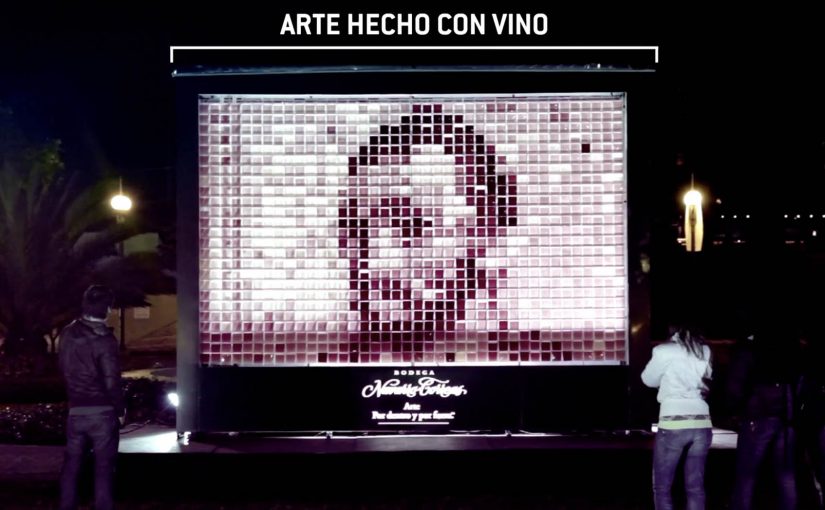
Navarro Correas creates a 13 x 8.2 meter structure in Bogotá, Colombia. It consists of 1,000 acrylic cells and an automated robotic mechanism that fills each cell with six different shades of wine.

How the installation works

People activate the robotic mechanism by sending a text message with the acrylic cell number they want filled. Over time, 1,000 text messages build the full image, described as recreating Van Gogh’s self-portrait. A masterpiece made with Navarro Correas’ own wines.

An SMS-controlled installation is a public artwork where participants trigger physical changes by texting simple commands, turning the audience into the “interface”.

In large-scale city activations, participation gets dramatically stronger when the crowd can see their input change a shared object in real time.

The real question is not whether people will send one text, but whether each text feels like a visible personal contribution to something bigger.

Why it lands: it turns contribution into ownership

This works because it makes participation concrete. You are not “liking” or “voting”. You are choosing a specific cell and watching a physical outcome appear. The growing picture becomes a public scoreboard of collective effort.

Extractable takeaway: If you want mass participation, design a mechanic where each small action is visible, additive, and irrevocably part of the final outcome. People engage longer when they can point to “their piece” of the whole.

The stronger idea here is the visible build, not the SMS channel by itself.

The wine-as-paint choice also earns attention twice: first as a spectacle (liquid filling the grid), and then as a reveal (the final portrait). The mechanism creates suspense, and suspense keeps people texting.

What the brand is really doing here

The installation positions the wine as a maker’s material, not just a drink. It borrows the credibility of craft and art, then backs it with a participatory system that feels modern and social without needing a social network.

What to steal for your next interactive public piece

  • Make the input trivial: one action, one identifier, no learning curve.
  • Make the effect observable: people should immediately see change after they act.
  • Use “additive progress”: partial completion should still look interesting, so the build phase has its own payoff.
  • Design for attribution: let participants feel “I contributed”, even if the contribution is small.
  • Pick a reveal that rewards patience: the final image should be worth waiting for.

A few fast answers before you act

What is the Navarro Correas Wine Art Project?

It is a public installation made of 1,000 acrylic cells that are filled by a robotic mechanism with different shades of wine. People participate by texting a cell number to trigger a fill, gradually revealing a final portrait image.

Why use SMS for interactivity?

SMS is frictionless and universal. It requires no app download, works on basic phones, and is fast enough for impulse participation in a public space.

What makes this different from a normal billboard stunt?

The audience directly controls the build. Each message produces a visible change, so the piece becomes a collective construction rather than a one-way display.

What is the key behavioral driver?

Ownership through contribution. People engage more when they can claim a specific part of the outcome and see the shared progress accumulate.

What should you measure for a campaign like this?

Participation volume, unique participants, repeat participation, time-to-completion of the full artwork, dwell time around the installation, and any earned media or social mentions driven by the live build.