
Carlsberg: Bikers in cinema experiment

Carlsberg: Bikers in cinema experiment

In a Belgian cinema, an “easy night out” turns into a small test of nerve. A couple walks in with tickets in hand. The room looks full. The only two empty seats are in the middle. The twist is that the audience is packed with intimidating bikers.

Carlsberg and Duval Guillaume Modem set this up as an experiment to reinforce the brand’s association with making the right choices. Reactions were recorded and edited into a viral film that rewards the people who stay seated rather than turn around.

The mechanism that makes it work

The mechanics are simple and deliberate. Fill the room. Leave two seats. Let unsuspecting pairs make a binary decision in public. Stay or leave. The tension is real because the setting is real, and the social pressure is visible to everyone watching.

Once a couple commits and sits down, the room flips from threat to approval. The bikers applaud, and the moment turns into a reward scene that makes the brand feel like it “saw” the better choice.

In crowded FMCG categories, social experiments work when they dramatize a value claim in a single, easy-to-retell moment.

The real question is whether you can borrow social risk to create attention without breaking participant trust.

Why it lands: social risk, then social proof

The audience experiences the same internal dialogue as the couples. Do I trust my instincts. Do I judge by appearance. Do I avoid discomfort. That tension is the hook. The applause is the release. Here, “social risk” is the fear of being judged in public, and “social proof” is the crowd signalling approval once the choice is made.

Extractable takeaway: When you borrow social pressure as the hook, you must also design visible approval as the proof, so the value claim is retellable in one line.

It also produces a clean moral without preaching. The brave are rewarded. The crowd is not actually hostile. The viewer walks away with a feeling that maps neatly onto the brand’s “good decision” positioning.

What Carlsberg is buying with this stunt

This is not about product attributes. It is about emotional territory. Confidence. Decency under pressure. And the idea that choosing Carlsberg is the grown-up, correct move when there are multiple options. This is a smart brand play because it turns “making the right choice” into observable behaviour, but it only works when the participants are treated carefully.

It is also engineered for sharing. The setup can be explained in one sentence, and the payoff is satisfying even if you only watch the last third of the video.

Design rules for your own brand experiments

  • Make the choice binary. The story works because there is a clear yes or no moment.
  • Stage tension, then earn release. If you create discomfort, you must repay it with warmth or justice.
  • Keep the “why” instantly readable. Viewers should understand what is being tested without narration.
  • Reward the behaviour you want to own. The applause is not decoration. It is the message.
  • Protect trust. If participants feel tricked or harmed, the brand loses the moral high ground.

A few fast answers before you act

What is the Carlsberg “bikers in cinema” experiment?

It is a filmed cinema stunt where unsuspecting couples enter a theatre filled with bikers and find only two seats left among them. Their decision to stay or leave becomes the story, and the people who stay are rewarded.

Why is this more shareable than a typical ad?

Because the premise is instantly understandable and the emotional arc is clean. Tension, decision, payoff. That structure travels well as a short video.

What brand message does the stunt communicate?

That “making the right choice” is a real behaviour under pressure, not a slogan. The brand borrows credibility by rewarding the choice on camera.

What is the biggest risk with social-experiment advertising?

Breaking trust. If the situation feels unsafe, humiliating, or coercive, the audience will side with the participants, not the brand.

How do you adapt this pattern without copying the stunt?

Create a public moment with a clear decision, then design a surprising but positive reward that proves your positioning. Keep the stakes emotional, not harmful.
Prigat: Smile Stations

Prigat: Smile Stations

Publicis Israel and e-dologic are back with a new campaign for Prigat, a leading company in the Israeli fruit juice market.

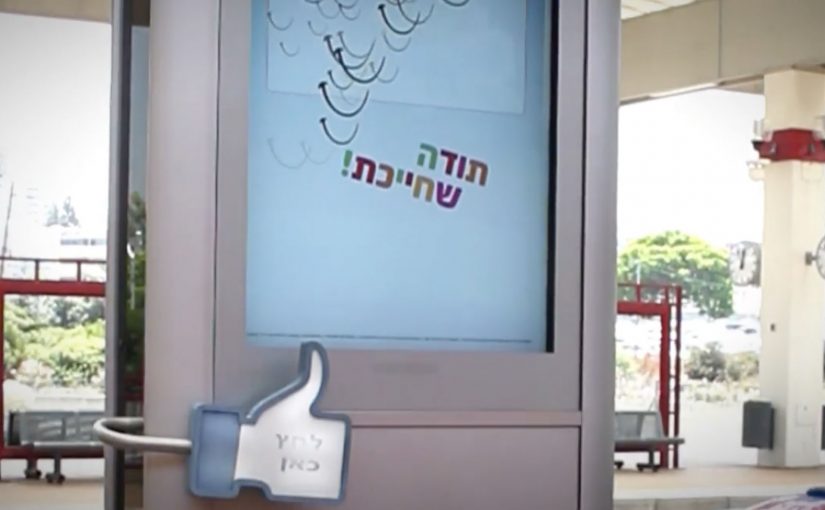
This time they use innovative digital billboards called “Smile Stations” to send real-time messages at various train stations. The aim is to get passers-by to smile, and “like” the moment.

The mechanic: turn a Facebook message into a station moment

It starts on the Prigat Facebook Page. People send messages that are pushed to screens at train stations. Commuters walking by can approach the screen and press a physical “Like” button.

That button press triggers a simple payoff. The billboard captures the moment, then broadcasts the video back to the person who sent the message. Users who generate the most smiles win a prize.

In busy public transit environments, interactive out-of-home works best when the action is obvious, the feedback is immediate, and the reward is shareable.

Why it lands: it makes public emotion measurable

Most out-of-home asks for attention. Smile Stations asks for a reaction, then turns that reaction into proof you can send back to the originator.

Extractable takeaway: If you want participation at scale, close the loop. Let a remote user trigger a real-world moment, let a passer-by respond with one physical action, then send that response back as a personal artifact the originator can keep and share.

Reported figures put this at over 10,000 messages sent to station screens, with thousands of people responding by hitting the Like button.

What the brand gets from this

The real question is whether a public display can turn a remote social prompt into a personal moment worth sharing.

This is stronger than passive digital out-of-home because the physical Like button reduces effort and the returned video turns a fleeting reaction into a personal memory both sides can own.

The campaign does not just generate impressions. It creates a two-sided interaction where both parties feel like they caused something to happen. That is a stronger memory structure than “I saw an ad”, especially in a context as repetitive as commuting.

What to steal for your own social-plus-out-of-home activation

  • Design a one-step physical interaction: one big button beats a complicated interface in public space.
  • Make the response visible: the passer-by should understand instantly that their action “counts”.
  • Return a personal artifact: sending the video back is what turns participation into sharing.
  • Gamify without friction: “most smiles wins” is a clean mechanic with no explanation overhead.
  • Pick locations with dwell time: stations work because people pause, look up, and wait.

A few fast answers before you act

What is a “Smile Station”?

It is an interactive digital billboard at a train station that displays user-submitted messages and invites passers-by to respond by smiling and pressing a physical Like button.

What makes this different from a normal digital billboard?

It is two-way. Remote users trigger messages, commuters respond physically, and the response is captured and sent back as video, creating a closed feedback loop.

Why include a physical Like button?

Because it removes friction. A single, tangible action is faster and more intuitive than asking people to pull out a phone, scan, or type.

How do you measure success for an activation like this?

Message volume, unique senders, Like-button presses, response rate per message, video shares by originators, and dwell time around the screen locations.

What is the main execution risk?

Latency and unclear feedback. If the system feels slow or people are unsure what their button press did, participation drops quickly in a commuter setting.

NikeID Loop: Sneaker Customization Concept

NikeID Loop: Sneaker Customization Concept

Here is another interesting concept coming out of Miami Ad School, this time for Nike.

Since Nike has a huge range of sneakers, it’s next to impossible to try each one of them at the store. In fact, it’s not even possible to find them all at the store.

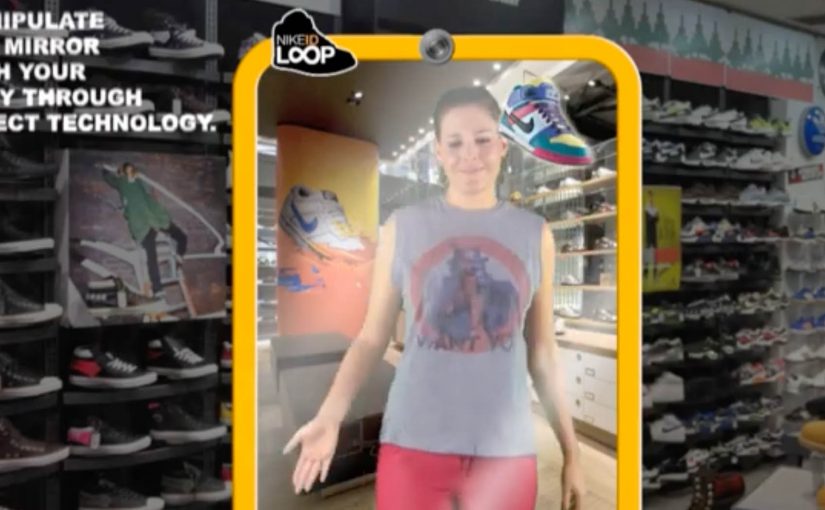
So a unique interactive mirror using Microsoft’s Kinect technology was created to customize the sneakers on the user’s feet. This way, one could try on every pair of Nike sneakers ever made in record time.

The core problem this concept tackles

Retail has a physical constraint. Shelf space. Inventory. Time. Nike’s catalog depth makes “try everything” impossible, even in flagship stores.

This concept flips the constraint by moving variety from physical inventory into a digital layer, while keeping the try-on moment anchored in the body. By “digital layer” here, I mean a live overlay that swaps variants in the mirror without needing physical stock. Your feet. Your stance. Your movement.

The real question is how you let shoppers explore more options without turning the store into a warehouse or the decision into homework.

Why the mirror mechanic is powerful

Because the mirror tracks movement and renders variants instantly, it keeps the try-on believable in motion, which is what makes fast switching persuasive instead of gimmicky.

Extractable takeaway: When you can add choice in software while preserving an embodied try-on moment, you reduce assortment friction without reducing confidence.

  • It keeps context real. You see the shoe on you, not on a product page.
  • It compresses decision time. Rapid switching creates a new kind of “browsing”.
  • It turns discovery into play. The experience is inherently interactive, which increases dwell time.
  • It reduces inventory friction. The store can showcase breadth without stocking breadth.

In retail environments where shoppers want high-confidence fit and style decisions in minutes, embodied digital try-on can expand perceived assortment without expanding stock.

What this implies for customization and personalization

NikeID is already about making a product feel personal. A Kinect-style mirror extends that by making customization immediate and visual, which can increase confidence before purchase.

This kind of embodied customization is worth betting on, because it makes breadth feel real without demanding more shelf space.

The concept also suggests a future where “catalog” becomes a service layer. The physical store is the stage for decision-making, not a warehouse for options.

What to take from this if you run retail CX

  1. Start with the constraint. Space and assortment are physical limits. Digital can expand them.
  2. Keep the experience embodied. Seeing a product on yourself is stronger than seeing it on a screen.
  3. Design for speed. Rapid iteration can become a feature, not a compromise.
  4. Make the output actionable. The experience should flow naturally into saving, sharing, or ordering.

A few fast answers before you act

What is the NikeID Loop concept?

It is a Miami Ad School concept for Nike that uses an interactive mirror and Microsoft Kinect technology to let users customize and “try” different Nike sneakers on their feet digitally.

What problem does it solve in stores?

It addresses the fact that Nike’s full range of sneakers cannot be stocked or tried in one location, by shifting variety into a digital interface.

Why use Kinect or motion tracking?

Motion tracking lets the system align the visual shoe to the user’s feet in real time, keeping the experience believable as people move.

Is this a product or a concept?

In this case, it is presented as a concept coming out of Miami Ad School, showing a possible direction for interactive retail.

What is the transferable lesson?

If you can remove physical constraints through an embodied digital layer, you can increase choice, speed, and confidence without expanding inventory.