
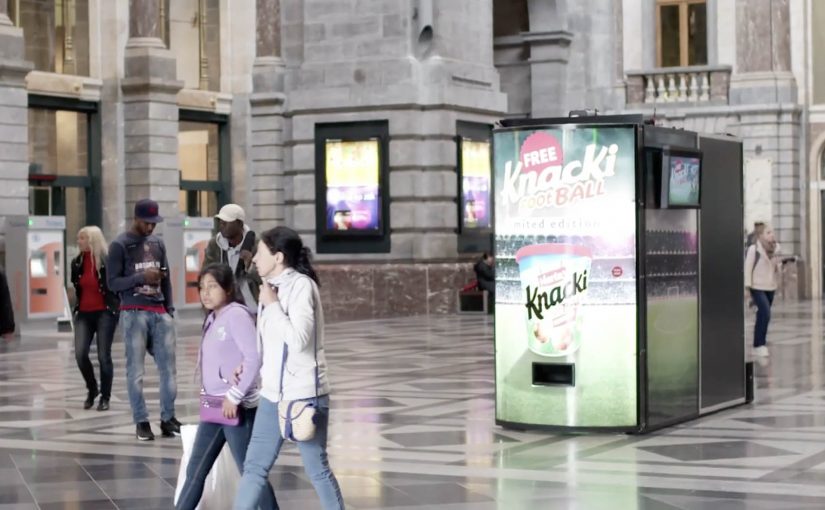
Herta Knacki FootBall: The Football Machine

Herta, described as a Nestlé brand in Belgium, launched Knacki FootBall. Small meatballs designed to look like footballs. Instead of relying on standard sampling, the brand and BBDO Brussels turned a train-station moment into a game people could not ignore.

At Antwerp Central Station, a vending machine offered the product for free. Then came the twist. Press the button and the machine opened into a miniature football pitch, with Belgian football legend Leo Van Der Elst waiting inside. To walk away with the snack, you had to score.

Free is easy. Earning it is memorable.

The mechanic is deliberately unfair in the right way. People approach expecting a quick handout. The reveal forces a choice. Walk away, or step in and play. That decision point creates tension, and tension creates attention. In high-traffic commuter environments, the best sampling ideas turn “free” into a short challenge with a story-worthy payoff. The real question is whether your sampling moment earns attention before it earns a bite.

Extractable takeaway: Sampling gets retold when it includes a moment of risk or effort. The product becomes a trophy, not a giveaway.

A vending machine that behaves like a stadium

The physical design does most of the communication. The moment the door opens, everyone nearby understands what is happening. It becomes a spectator event, which is crucial in a station setting where most people do not want to stop unless something is already happening.

Why the celebrity opponent matters

Leo Van Der Elst is not a generic “host.” He is the difficulty setting. His presence turns the activation into a genuine duel, and that makes the outcome feel earned whether you win or lose. It also gives the content a built-in headline when the story travels online.

What the brand is really reinforcing

Knacki FootBall is a novelty product, so the job is not deep education. It is instant association. Football. Fun. A quick bite. The machine makes those associations physical, then anchors them to a specific place and moment people remember.

How to copy The Football Machine

  • Build a single, obvious action. Press the button. The rest happens to you.
  • Make the reveal legible from 10 meters away. If bystanders cannot decode it fast, you lose the crowd effect.
  • Turn sampling into a challenge. Effort increases perceived value and shareability.
  • Use a real “difficulty signal.” A credible opponent or constraint makes the game feel legitimate.
  • Design the exit. Winning should end with a clear reward and a clean photo moment.

A few fast answers before you act

What is Herta Knacki FootBall “The Football Machine”?

It is a vending machine activation where commuters expecting a free sample discover a miniature football pitch inside, and must score a goal to win Knacki FootBall.

Where did the activation run?

It is described as being installed at Antwerp Central Station in Belgium.

Why use a vending machine for a food launch?

Because it creates a familiar expectation. Then you can subvert it. That contrast generates surprise, crowd attention, and strong word of mouth while still delivering the product sample.

What makes this work in a train station specifically?

Stations are full of people who are time-poor. A reveal that is instantly understandable, plus a short game loop, one attempt that takes seconds, can stop people without requiring explanation.

What is the biggest operational risk with this kind of live activation?

Throughput and safety. If the game takes too long, queues become friction. If the experience feels unsafe or embarrassing, people avoid participation and the crowd effect collapses.
Coca-Cola: Give a Coke, Be Santa

A vending machine that asked you to choose who you are

The strongest holiday ideas turn seasonal sentiment into a simple action people can take in public. Coca-Cola’s holiday vending machine is a clean example of that move.

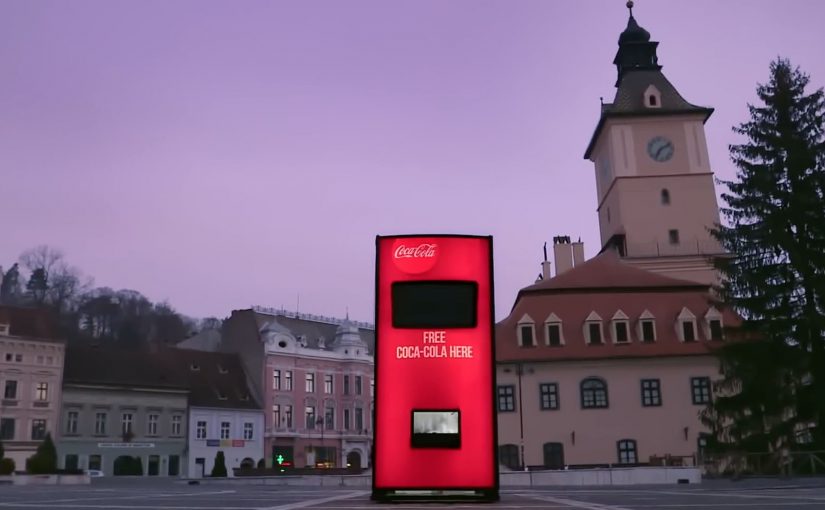
Coca-Cola wanted to bring out the Santa in everyone. So for the 2013 holiday season, they created a special vending machine that prompted users to either get a free Coke or give a free Coke.

The two-button mechanic that made sharing the story

If the user chose a free Coke, the machine quickly dispensed the drink for the user to enjoy.

However, if the user decided to share, then the machine did something a little more special. Watch the video below to find out.

In high-traffic FMCG retail settings, a binary choice lets a brand value show up as behavior in seconds.

Why “give” feels better than “get” in December

The psychology here is straightforward. A free product is nice, but it is forgettable. A choice that reflects identity is sticky.

Extractable takeaway: If you want a value like generosity to travel, put it into a visible choice where the “better self” option is easy to pick and easy to witness.

By putting “give” and “get” side by side, the machine turns a small decision into a moment of self-image and social proof, meaning other people can see the choice and validate it. During the holidays, people want to see themselves as generous, and they want to be seen that way by others.

The business intent behind bringing out the Santa

The intent is not simply distribution.

The real question is whether your brand promise can be expressed as a choice people are proud to make in public.

This is a stronger holiday move than a message-only campaign because it makes the value legible and repeatable at the point of interaction.

Coca-Cola uses the vending machine to translate a brand promise into behavior. The brand is associated with warmth and sharing because the consumer enacts it, not because the brand claims it.

How to reuse this give-or-get choice design

  • Turn values into a choice. Make the brand idea something people can do, not just hear.
  • Reward the “better” behavior. If sharing is the story, make sharing the more memorable path.
  • Keep the interaction instantly legible. Two clear options beat complex instructions in public spaces.
  • Design for a public moment. When others can witness the decision, the story travels faster.

A few fast answers before you act

What did Coca-Cola build for the 2013 holiday season?

A special vending machine that offered users a choice: take a free Coke or give a free Coke.

What was the core mechanism?

A simple two-option prompt. Choosing “get” dispensed a Coke immediately. Choosing “give” triggered a more special outcome.

Why does the “give” option matter so much?

Because it turns a freebie into an identity moment. People remember what they chose, and others can witness it.

What business goal did this support?

Making Coca-Cola’s holiday positioning feel real by linking the brand to a visible act of sharing, not just a message about sharing.

What is the main takeaway for brands?

If you want to own a value like generosity, design an interaction where people can demonstrate that value in the moment.

Sony: The Bottled Walkman

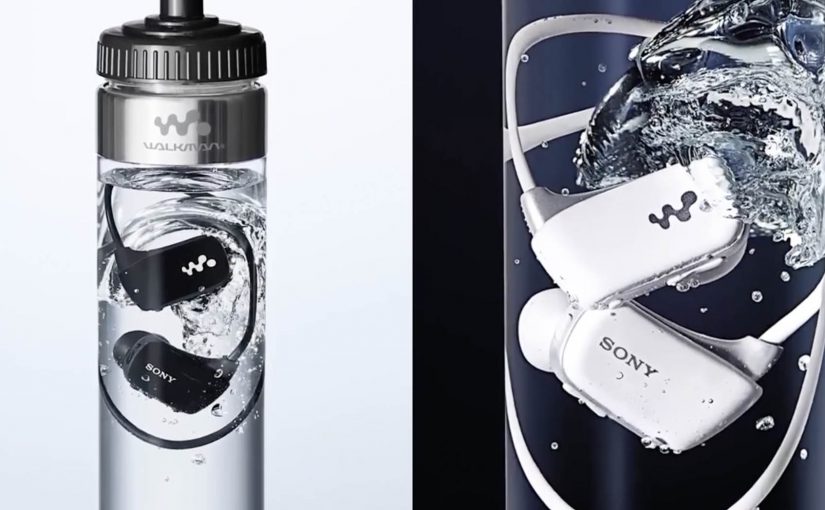
To promote Sony’s NWZ-W270 MP3 waterproof Walkman, DraftFCB Auckland packaged it inside bottles full of water. The bottles were then placed in special vending machines at pools and gyms across New Zealand.

The idea turns packaging into proof. The product sits submerged in plain sight, so the waterproof benefit is demonstrated before you even consider buying it.

Packaging that performs the demo

The mechanism is as literal as it is effective. Take a promise that people doubt. “Waterproof”. Then make the product live inside the condition that normally destroys electronics. The bottle becomes both display unit and credibility device. Here, a credibility device means packaging that makes the claim feel true before any copy has to explain it. That works because the same object that holds the product also removes the shopper’s main doubt at the point of purchase, and the vending machine puts it exactly where the need is strongest.

In consumer electronics marketing, the fastest way to overcome skepticism is to replace explanation with visible proof at the point of decision.

Why it lands

It works because it collapses three steps into one moment. Awareness, belief, and purchase happen in the same place, with the same object. Instead of asking people to trust a spec, the packaging forces a simple conclusion. If it can sit in water all day, it can survive your swim or workout.

Extractable takeaway: When your key benefit is hard to believe, design a retail experience where the product is shown living inside the benefit. Let the environment do the persuading, then make purchase frictionless.

What Sony is really optimizing

The real question is how to make a doubtful product claim feel true before a shopper has to trust the copy.

The vending placement is not just a media choice. It is distribution strategy. Pools and gyms are the exact contexts where “waterproof audio” feels immediately relevant, and where a vending machine purchase is already normalized as an impulse decision.

What to steal from the retail proof

  • Make the proof the packaging. If the box can demonstrate the claim, you do not need to over-argue it.
  • Sell where the benefit matters most. Context does half the persuasion if the product solves a live problem.
  • Reduce steps to purchase. Vending machines convert curiosity into action while attention is still high.
  • Keep the message one-beat simple. One look should be enough to understand the point.

A few fast answers before you act

What is “The Bottled Walkman”?

It is a Sony retail and packaging activation where the NWZ-W270 waterproof Walkman is sold sealed inside a bottle filled with water to demonstrate the product’s core benefit instantly.

Why use vending machines at pools and gyms?

Because that is where the waterproof use case is most obvious, and where a quick, impulse-style purchase fits the setting.

What problem does this solve versus a standard box on a shelf?

It removes doubt. The customer sees the product surviving in water before they ever read a claim.

Is this more “packaging innovation” or “experiential marketing”?

It is both. The packaging is the experience, and the experience is built to drive retail conversion.

How can another brand apply the same principle?

Identify the most doubted benefit, then engineer a display or pack that lets the product visibly live inside that benefit in the buying moment.