
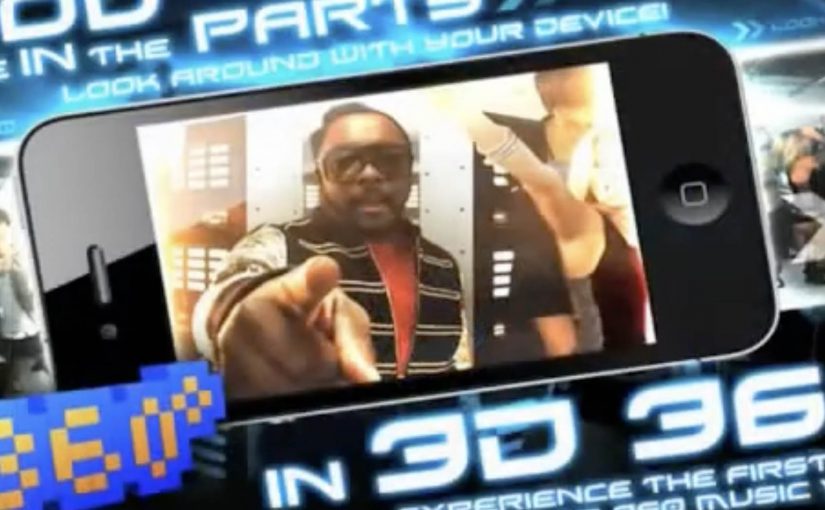
Black Eyed Peas: BEP360 AR music video

In 2011, the smartest artists are starting to behave like brands. Not only by releasing content, but by building experiences around it that fans can actually play with.

BEP360 is a strong example of that thinking. It packages a 360-degree, motion-controlled music video experience around The Black Eyed Peas, designed for iPhone, iPad, and iPod touch.

The core mechanic is simple. You move your device, and the camera view moves with you, giving you viewer control inside the scene. On top of that, BEP360 includes an augmented reality layer triggered by pointing the iPhone camera at the album cover for The Beginning, plus a virtual photo session feature that lets fans stage shots with the band and share them.

In global entertainment marketing, app-based experiences are becoming a practical way to deepen fandom between releases and justify paid content with participation.

It is also an early signal of where “music video” can go when it is treated as a product experience rather than a clip you watch once. The app is billed as a first-of-its-kind 360-degree mobile music video, built under will.i.am’s will.i.apps banner, with augmented reality support via Metaio and 3D360 video technology referenced in early coverage.

Why this is more than a promo gimmick

The best part is the shift from passive viewing to participation. A 360-degree experience creates a reason to replay, because you cannot see everything at once. That replay value is what standard video launches rarely earn.

What the AR layer adds, and what it does not

The AR trigger is not the main event. It is a novelty layer that extends the universe into the physical world, using the album cover as the marker. The real value is the combination of interactive video plus social output. Fans can create something and share it, which keeps the campaign alive without requiring more media spend.

What to steal for your own fan-first experience

  • Give people viewer control. Control creates replay value.
  • Bundle features around one hero action. Here the hero action is “step inside the video”. Everything else supports that.
  • Use AR as an on-ramp, not the whole product. A quick wow moment is fine, but the experience must hold attention afterwards.
  • Design for sharing outputs. Photo sessions and remixable moments extend reach organically.

A few fast answers before you act

What is BEP360?

BEP360 is a Black Eyed Peas iOS app that turns a music video into an interactive 360-degree experience controlled by moving your device, with an added augmented reality layer triggered by the album cover.

What makes the music video “360-degree” in this case?

The camera perspective changes as you rotate or swing the phone, giving you control over where you look inside the scene while the track continues.

How does the augmented reality part work?

You point your iPhone camera at the The Beginning album cover, and the app overlays animated BEP characters and related content on screen.

Why does an app make sense for music marketing?

Because it can bundle interaction, social sharing, and ongoing fan content into one place. It gives people a reason to pay for the experience, not only consume a free clip.

What is the main risk with app-based fan experiences?

Friction. If downloads, device compatibility, or onboarding are annoying, the idea collapses. The experience has to deliver value within seconds.

Dentsu: iButterfly Location-Based Coupons

Coupons with wings: iButterfly turns deals into a mobile hunt

Here is a great example of Online, Mobile and Shopper Marketing converging with Augmented Reality (AR). Integrated Marketing literally put into the hands of the people.

Japanese ad agency Dentsu has started this experimental coupon download platform called iButterfly on the iPhone. The free iPhone app transforms the habit of collecting coupons into a fun little game using AR and the device’s GPS.

The mechanic: catch a butterfly, unlock a coupon

The app tasks its users with catching virtual butterflies that are flying around, each representing one or more coupons. You can even share “butterflies” with your friends via Bluetooth.

Augmented reality in this context means the phone camera view becomes the backdrop, while digital objects. Here, butterflies. are overlaid and tied to location signals like GPS.

In retail and FMCG shopper marketing, the value of this approach is that promotions become a location-linked experience, not a passive download.

Why this format works for targeted promotions

The key shift is motivation. People are not “clipping” coupons. They are playing a simple collecting game, and the reward is a deal that feels earned.

Because butterflies can be placed around specific areas, the mechanic supports targeting by place and moment. That makes the coupon feel context-aware rather than generic.

What Dentsu is really prototyping here

This is less about novelty AR and more about a new distribution behavior. Turning offers into collectible objects changes how often users open the app, how long they stay in it, and how naturally they talk about it with friends.

It is also a rare example where “share with a friend” is not a marketing CTA. It is a gameplay action that carries the promotion with it.

What to steal for your own shopper activation

  • Make the reward immediate. Catch. Unlock. Redeem. Long funnels kill the game loop.
  • Use location as a story, not a filter. Place rewards where people already go, so the map feels meaningful.
  • Let sharing be part of the mechanic. A tradable object beats a generic “share this” button.
  • Keep the collection simple. If users need a manual, they will not hunt.

A few fast answers before you act

What is iButterfly?

iButterfly is a mobile coupon platform that turns deal collection into a location-based AR game. Users catch virtual butterflies on their phone and unlock coupons as rewards.

How does the AR coupon mechanic work?

Users view the real world through the phone camera. Virtual butterflies appear and can be “caught”. Each butterfly contains one or more offers, which unlock after capture.

Why is this relevant for shopper marketing?

It shifts promotions from passive browsing to active discovery. Location and gameplay increase attention, repeat usage, and the likelihood of in-the-moment redemption.

What makes it feel targeted rather than random?

Butterflies can be tied to locations and contexts via GPS. That links the offer to where the shopper is, not just who they are.

What is the biggest execution risk?

If redemption is hard or the rewards feel weak, the novelty wears off fast. The game loop only survives when the payoff is clear and friction stays low.

Durex: Baby App

Making the consequence tangible, not the lecture louder

In consumer health marketing, the hardest problems are rarely about information. They are about motivation in the moment. This Durex idea is a clean example of turning a behavior barrier into an experience.

Condoms are a downer. So how does one convince guys to put it on, and make Durex the favored choice.

Using the iPhone, Nicolai Villads, Peter Ammentorp and Raul Montenegro created what is called the Durex Baby application for the iPhone.

How the Durex Baby app worked as a behavioral nudge

The mechanism was simple. If the barrier is that protection feels like a mood killer, shift attention to what happens without it.

The app simulated the realities of having a baby, using the phone as a constant companion device. It turned an abstract risk into a persistent, personal experience that could be felt rather than explained.

Why simulation can change decisions faster than persuasion

Most messaging about safe sex competes with optimism bias. People assume consequences happen to someone else.

A simulation reduces that distance. It makes “later” feel like “now,” and it reframes the trade-off. Short-term inconvenience versus long-term responsibility. When the consequence feels immediate and specific, the decision calculus changes.

The intent behind building it for Future Lions

The app was created for the Future Lions 2010 competition organized by digital agency AKQA and the Cannes Lions Advertising festival.

The business intent is clear. Use mobile to translate a sensitive topic into a playful but pointed interaction that can travel socially and be discussed without heavy moralizing, while keeping the brand associated with the responsible choice.

What to steal from this idea

  • Turn abstract risk into felt experience. Simulation can outperform warnings when the audience tunes out lectures.
  • Use the device people always carry. Mobile is effective when the behavior change depends on everyday moments.
  • Reframe the trade-off. Move attention from short-term friction to long-term consequence in a way people can grasp instantly.
  • Make it discussable. Playful interaction can open conversation on topics people avoid in direct language.

A few fast answers before you act

What is the Durex Baby app?

An iPhone app concept that simulates the realities of having a baby to encourage safer choices and reduce resistance to using condoms.

What was the core mechanism?

Behavioral reframing through simulation. The phone delivers an ongoing experience that makes the consequence of not using protection feel immediate.

Why does this approach work better than a warning for some audiences?

Because it reduces optimism bias. People are more likely to change behavior when the consequence feels personal and present, not distant and theoretical.

What business goal does it serve for Durex?

Positioning the brand as the responsible default choice by shifting the decision from mood-based resistance to consequence-based clarity.

What is the main takeaway for marketers?

If persuasion is failing, design an experience that makes the outcome feel real, then let the audience reach the conclusion themselves.