
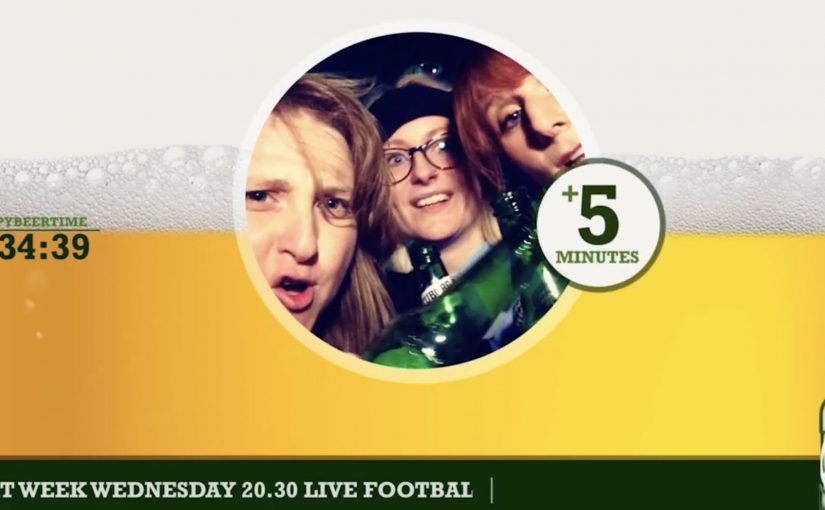
Carlsberg: Happy Beer Time

Nowadays people like to go out, take photos, and share them on Instagram. Carlsberg, together with the Danish agency Konstellation, puts a social twist on the well-known concept of happy hour by turning every post into more discounted time for the whole bar.

A happy hour that gets longer when the bar posts together

The mechanic is simple and highly visible. Guests snap an Instagram photo and tag it with the venue name and #HappyBeerTime. Each successfully tagged photo extends a shared countdown on the bar’s screen, which keeps discounted beer available for everyone while the clock keeps moving.

In on-trade environments, meaning bars and restaurants, the strongest promotions convert shared participation into a shared, immediate reward that the whole room can see.

What makes the mechanism work in a real bar

  • One clear lever. Post with the right tags. Add time.
  • Progress is public. A live countdown on a screen turns the promotion into a collective game.
  • Reward is communal. Everyone benefits from every post, so the behaviour spreads naturally.
  • Distribution is built in. The bar gains organic visibility through guests’ own feeds.

The real question is whether your incentive creates a room-level feedback loop fast enough that people feel their action changes the moment.

Why it lands

This activation aligns with what people already do on a night out. Take photos. Share moments. The difference is that the sharing changes the environment in real time. That makes the incentive feel playful rather than purely transactional.

Extractable takeaway: If you want participation at scale inside a venue, use a reward the entire room experiences together, and make the progress visible so the crowd recruits itself.

What the brand is really buying

On the surface, it is discounted beer for longer. Underneath, it is repeat purchase pressure at the point of sale, plus a stream of user-generated content tied to specific venues and nights. The bar gets word-of-mouth promotion. Carlsberg gets social proof linked to a real-world occasion.

A quick note on “Happy Hour 2.0”

“Happy Hour 2.0” is the idea of extending a happy-hour window through a simple trigger, instead of relying on a fixed start and end time. Budweiser was earlier to pioneer this Happy Hour 2.0 concept in August 2012. Carlsberg’s twist is connecting the extension mechanic directly to social posting behaviour.

Proof that the idea travelled beyond a one-off

The concept drew broader industry attention, including recognition in Danish award circuits and international festival shortlists. That matters because it signals the mechanic is legible. It is easy to explain, easy to copy, and easy for people to participate in without training.

Steal the shared countdown loop

  • Keep the action atomic. One photo and two tags beats a multi-step flow.
  • Design the room-level feedback loop. The screen is not decoration. It is the social engine.
  • Set guardrails early. Decide how you handle off-brand or inappropriate posts, and communicate it.
  • Make the reward feel immediate. “Add time now” beats “collect points later”.
  • Measure uplift, not just posts. Treat UGC as a means. The goal is incremental sales and dwell time.

A few fast answers before you act

What is Happy Beer Time in one sentence?

It is a bar promotion where Instagram posts tagged with the venue name and #HappyBeerTime extend a shared happy-hour countdown, keeping discounted beer available for longer.

Why does “time” work as the reward?

Time is instantly understood, visibly shared, and emotionally tied to the night out. Adding minutes feels like progress the whole room experiences together.

What makes this different from a standard hashtag campaign?

The hashtag is not just for awareness. It is a trigger that changes the real-world environment in real time, which makes posting feel consequential.

What can go wrong operationally?

If tagging rules are unclear, people will not participate. If moderation is absent, inappropriate content can surface. If the reward lags, the loop breaks.

What should you measure in a pilot?

Participation rate, post volume per hour, time extended per session, sales uplift during the activation window, and whether dwell time increases without margin loss exceeding targets.
Polar Beer: Cell Phone Nullifier

There is a specific kind of modern annoyance. You go out with friends, and ten minutes later the table is lit by phone screens instead of conversation.

Polar, a regional Brazilian beer brand, decides to treat that as a solvable problem. If phones steal the night, then the beer should give it back.

A beer cooler that changes the rules of the table

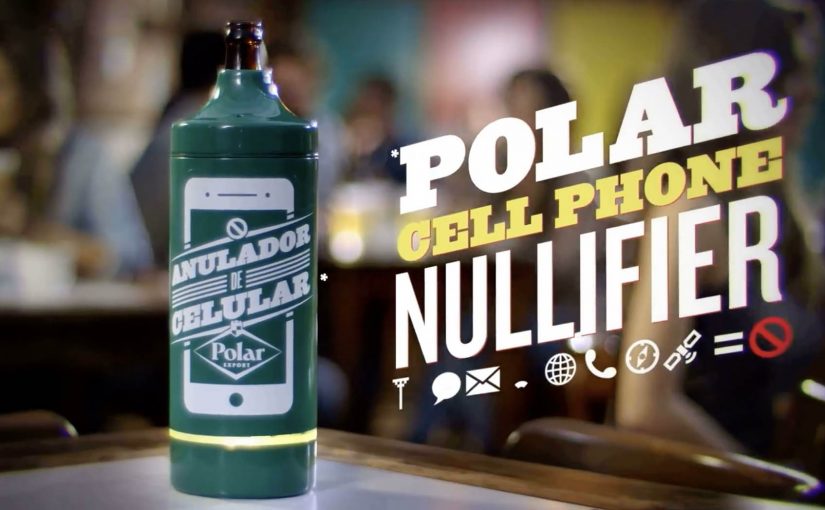
The mechanism is a physical prop with a blunt promise. A special Polar cooler is described as blocking 3G, 4G, Wi Fi, and GSM signals for devices within roughly a five-foot radius. Order Polar. Get served in the cooler. Watch the room look up.

In bar and nightlife settings, the strongest behavior-change ideas work when they attach to an existing ritual and alter it with minimal effort from the audience.

Because the cooler makes the phone temporarily useless at the table, conversation becomes the path of least resistance.

Why it lands, even if people hate it for a minute

This plays with a familiar tension. Everyone complains about “phubbing,” the habit of snubbing people in front of you by focusing on your phone, but nobody wants to be the first person to say “can we put phones away.” The cooler does the awkward social work on behalf of the group.

Extractable takeaway: If a social norm is breaking down, redesign the environment so the better behavior becomes the default. Remove the need for a lecture, and replace it with a small constraint that everyone experiences equally.

The brand benefit is also clean. Polar is not asking for attention. It is buying it back for you, then sitting at the center of the moment it created.

What the stunt is really selling

On the surface it is a gadget. Underneath it is a positioning move. Polar equates itself with real-world connection and the kind of night people say they want, even when their hands keep reaching for the screen.

The real question is whether you can earn attention by subtracting distraction, not by adding more stimulation.

This is a smart positioning move because it delivers the promise through the ritual, not through a slogan.

It is also a reminder that “anti-tech” can be a tech story. The cooler is not anti phone as an identity. It is pro conversation as an outcome.

Steal this for phone-free nights

  • Target the moment, not the attitude. Fix the table behavior, not the entire relationship with smartphones.
  • Use a prop that belongs in the setting. A cooler at a bar feels natural. A lecture does not.
  • Make it equal. The constraint applies to everyone in range, so it feels like a shared game, not a personal attack.
  • Build a story people retell in one sentence. “The beer that makes your phone stop” spreads fast.

A few fast answers before you act

What is Polar’s “Cell Phone Nullifier”?

It is a branded beer cooler concept described as cutting off nearby phone connectivity, so people ordering Polar are nudged into talking to each other instead of scrolling.

Why does blocking the signal work as a behavior-change tactic?

It removes the temptation rather than arguing with it. By changing the environment, it turns “I should put my phone away” into “my phone is not part of the table right now.”

What is the core creative mechanism here?

A familiar bar object is redesigned to enforce a social norm. The product ritual, ordering beer and receiving it in a cooler, becomes the delivery system for the idea.

How can brands adapt this without feeling preachy?

Focus on shared benefits and shared participation. Make the intervention playful and collective, and keep the user action simple and voluntary.

What is the biggest risk if you copy this idea?

If the constraint feels forced or punitive, it becomes the story instead of the conversation it was meant to protect. Keep it lightweight, contextual, and easy to opt into.

Heineken Ignite

Last year I had written about StartCap, the world’s first digitally enabled bottle top. Now, Heineken has created LED based “smart bottles” that put serious tech into drinking beer.

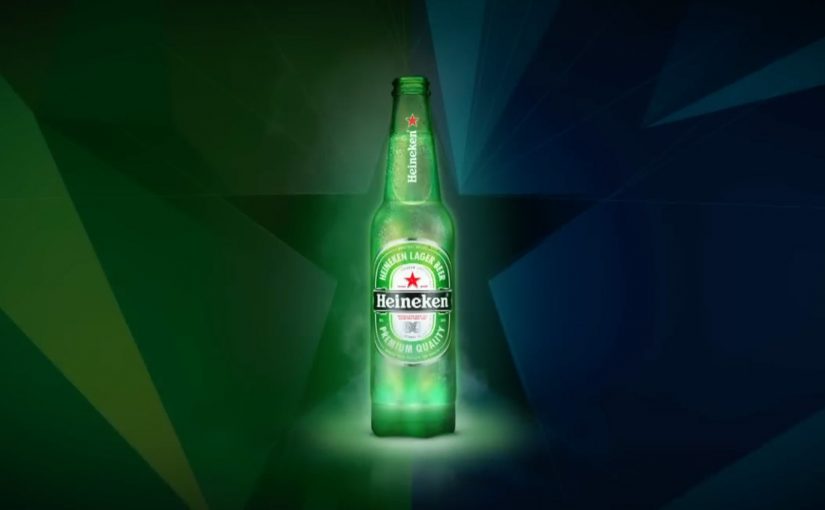
These interactive bottles are designed to react to the gestures that already define a night out. Cheer and clink bottles together and the LEDs flash. Drink and the light pattern speeds up. Put the bottle down and it shifts into an idle “breathing” mode. Here, “breathing” means the LEDs pulse slowly when the bottle is stationary. The concept also includes software control so bottles can synchronize to music cues for a coordinated light show.

Heineken Ignite is a prototype bottle module that combines LEDs, motion sensing, and wireless synchronization so the bottle becomes part of the club experience, not just the drink in your hand.

Why it lands. When the bottle becomes the signal

What separates this from a gimmick is the engineering story. Coverage around the prototype describes an Arduino based circuit board housed in a reusable 3D printed casing that clips onto the bottom of a standard bottle. The electronics include multiple LEDs, a motion sensor to detect cheers and drinking, and wireless connectivity so the “party” effect can spread across a room. Wireless synchronization matters because it scales the effect from one person’s bottle to a room level cue that people can notice together. This is not a gimmick.

Extractable takeaway: If you want a brand experience to spread in a venue, instrument the object people already hold so natural gestures trigger visible, shared feedback.

This is also why the commercial challenge is real. In prototype form, the tech sits in an external module. To reach a mass market use case, the experience needs to be cheaper, smaller, and embedded, not attached. The real question is whether the connected layer can be made cheap and embedded enough that the bottle ships as the interface, not an accessory.

In European nightlife culture, the most effective brand innovation is the kind that turns the product itself into a social signal.

Why it was shown at Milan Design Week

The concept was unveiled during Milan Design Week as part of Heineken’s future of nightlife exploration. That matters because it frames the bottle as design plus experience, not only packaging. It is a statement about how brands might use connected objects to shape atmosphere in shared spaces.

Recognition and why it matters

Heineken later reported that its Ignite bottle earned a Silver Lion at Cannes Lions 2013 for Exhibitions or Live Events, as part of a broader set of design and innovation activations. Awards do not make a product viable, but they do validate that the idea is legible as a new format for brand experience.

Steal the pattern: product-led nightlife cues

  • Use the product as the interface. When the object in hand is the experience, you do not need to fight for attention elsewhere.
  • Design for social gestures. “Cheers” is a better trigger than any forced interaction because people already do it.
  • Make synchronization the payoff. One glowing bottle is a toy. A room that reacts together is a moment.
  • Prototype in public. Early demonstrations can generate press and learning long before the supply chain is ready.

A few fast answers before you act

What is Heineken Ignite?

Heineken Ignite is a prototype “smart bottle” concept that uses LEDs, motion sensing, and wireless synchronization so the bottle lights up in response to cheers, drinking gestures, and music cues in club environments.

How does the prototype work technically?

Reporting describes a clip-on module under the bottle that houses an Arduino based circuit board, LEDs, motion sensing, and wireless connectivity. The module detects motion patterns and can coordinate lighting across multiple bottles.

Why is syncing to music the key feature?

Because it turns individual behavior into shared atmosphere. Synchronization makes the experience visible at a crowd level, which is what creates talkability and makes the brand feel “in the room”.

What is the biggest barrier to commercializing a concept like this?

Miniaturization and cost. A clip-on prototype can prove the idea, but mass market use needs the tech to be smaller, cheaper, and more seamlessly integrated into production packaging.

What is the main marketing lesson here?

If you want to own a nightlife moment, design around existing social rituals. When the trigger is already natural, the experience feels additive instead of forced.