
British Airways: #lookup points to planes

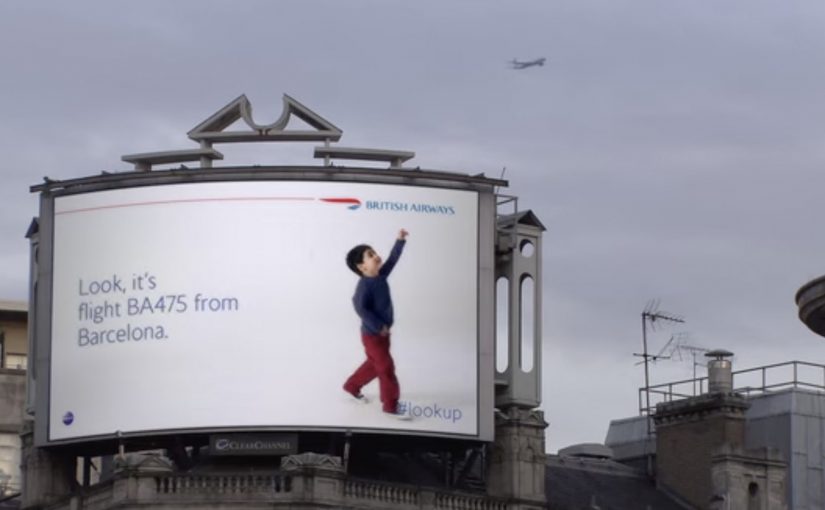
Last month, British Airways set up an interactive digital billboard in London’s Piccadilly Circus. It uses custom-built “surveillance technology” to track British Airways flights passing overhead. Here, that means identifying aircraft and matching them to British Airways flights in real time, not tracking individuals on the street.

On detecting a BA flight, the boy in the ad gets up and points to the plane. An accompanying message displays the flight number and the place it is arriving from.

In high-traffic city centres, digital out-of-home works best when it reacts to the environment rather than shouting at it.

Interactive advertisements are getting more popular with brands. In May, a Spanish organization called ANAR used lenticular printing to show different messages to kids and adults in their campaign for anti-child abuse.

How #lookup works (and what “surveillance” means here)

The magic is simple. The screen stays “normal” until the exact moment a British Airways aircraft is in view. Then the creative switches to a scene that makes you do what the boy does. You look up, spot the plane, and connect the brand to the real object above you.

“Surveillance technology” sounds heavier than what’s happening in practice. In this execution, it is reported as hardware and software used to identify aircraft and match them to British Airways flights in real time. The storytelling trigger is the aircraft, not the crowd.

Definition you can reuse: Context-aware DOOH is outdoor creative that changes based on live signals from the environment (location, time, weather, movement, or public data feeds). It works when the signal is instantly understandable and the change earns attention rather than interrupts it.

In European city-centre media buys, context-aware DOOH is one of the few formats that can earn attention without relying on volume.

Why it lands: a micro-surprise that answers a real question

Most outdoor advertising asks for attention first, and only then offers meaning. #lookup flips that order. It gives you meaning first. A child pointing at something real. Then it rewards your curiosity with an answer you cannot get from a static poster. What flight is that, and where has it come from? Because the trigger is a plane you can actually see, the data reveal feels like an answer to curiosity, not an interruption.

Extractable takeaway: If the environment makes people ask a question, your creative should answer it instantly with one human-readable data point that completes the scene.

The real question is how you turn ambient curiosity into a brand-credit moment people choose to share.

This is the rare “brand moment” where the interface and the emotion line up. A real plane prompts real curiosity. The billboard supplies the missing information. The brand gets credited for the experience.

What British Airways is really buying with this idea

At one level, it’s a smart stunt. At a deeper level, it’s a reframing of air travel. Instead of selling price, routes, or amenities, it sells the feeling of possibility and the breadth of the network.

It also turns a passive medium into an earned-media engine. When a billboard reacts to reality, people record it, talk about it, and share it because it feels like “proof,” not persuasion.

How to borrow the #lookup pattern

  • Pick a signal people already notice. Planes, trains, weather shifts, match scores, queue length, local landmarks. The trigger should be obvious without explanation.
  • Make the reaction immediate and legible. If the audience needs to read a paragraph to understand the mechanic, the moment is lost.
  • Answer a question the environment creates. “Where is that going?” is stronger than “buy now.” Build the creative around curiosity.
  • Use data as a storytelling ingredient, not a dashboard. Flight numbers and origins feel human when they complete the scene, not when they look like telemetry.
  • Keep privacy optics clean. If you must use loaded terms like “surveillance,” clarify what is being detected and what is not.

A few fast answers before you act

What makes the British Airways #lookup billboard “interactive”?

It changes its creative in real time based on a live external trigger. A British Airways aircraft passing overhead. That trigger causes the billboard to play a scene and display flight details tied to the specific plane.

Is this the same as QR codes or touchscreens in outdoor ads?

No. QR codes and touchscreens require deliberate user input. #lookup is environment-triggered interaction. The “input” is a real-world event, not a tap.

Why does real-time data improve out-of-home advertising?

Because it turns a static message into a situated experience. When the content matches what is happening around you right now, attention feels earned and the brand feels more relevant.

What’s the simplest way to replicate this pattern without complex engineering?

Use a clean, reliable signal you can access easily (time of day, weather, local transit status) and design one dramatic creative switch that is instantly visible from a distance.

What’s the biggest risk with “reactive” outdoor ads?

Overcomplication. If the trigger is rare, hard to understand, or the creative change is subtle, the concept will not land. Optimise for clarity and frequency of payoff.

Corona Extra: Luna Corona

Corona Extra and their ad agency Cramer-Krasselt worked with astronomers, planetariums, and universities in the USA to calculate the positioning of the moon, aiming to capture a moment where it would align perfectly with an image of a Corona Extra beer.

The moment was timed so the billboard’s “missing lime” is completed by the moon’s crescent alignment on the nights of June 14 and 15.

When the sky completes the creative

The mechanism is engineered perspective plus a fixed window in time. The billboard artwork is designed so that from a specific viewing position, the crescent moon appears exactly where a lime wedge would normally sit on a Corona bottle. The media placement then turns into a scheduled viewing, because the “full ad” only exists when the moon cooperates.

In out-of-home advertising, aligning a message with a real-world phenomenon can turn a static placement into a time-limited event people actively seek out.

Why it lands

This works because it makes a familiar brand ritual feel discovered rather than advertised. The payoff is not a new claim. It is a real-world moment that feels improbably perfect, which gives people a reason to stop, watch, and tell someone else where and when it happened. The real question is how far a brand can make the physical world do the storytelling for it. The stronger move here is using the moon to deliver the brand cue instead of adding more message.

Extractable takeaway: If you can make the environment complete your creative, you turn passive exposure into participation. That participation becomes the distribution.

What to steal from Luna Corona

  • Design for one unmistakable illusion: one clean visual trick beats multiple clever details.
  • Use time as a feature: a narrow viewing window creates urgency without discounts or gimmicks.
  • Make the “rule” explainable: people should be able to describe it in one sentence.
  • Choose a ritual people already associate with you: the lime wedge is an instantly legible brand cue.
  • Capture proof: the video is not decoration. It is how the idea travels beyond the street corner.

A few fast answers before you act

What is “Luna Corona”?

It is an out-of-home idea where a Corona billboard is positioned and designed so the crescent moon visually becomes the lime wedge on the bottle during a specific time window.

Why involve astronomers and universities?

Because the illusion depends on precise timing and angle. You need accurate lunar position predictions to know when the crescent will “land” in the right spot from the viewer’s perspective.

Is this interactive?

Not in the device sense. The interaction is physical. People move into position, wait for the right moment, and witness the alignment as it happens.

What makes it more than a clever billboard?

The scarcity. It only “works” at certain times, so it behaves like an event, not just media inventory.

What’s the biggest risk with ideas like this?

Fragility. If weather, timing, sightlines, or location details are off, the reveal fails. The planning and production tolerance must be treated like a live event.

Cornetto: Love Plane

A couple tweets a love message with a hashtag, and a few minutes later it appears on a banner flying over the beach. Cornetto’s Love Plane turns summer flirting into public media, with the sky as the timeline.

A Twitter feed you can read in the air

Summer is the season of crazy, unexplainable romances. Cornetto launches the Love Plane in Spain and attaches a Twitter-based banner feed to it.

The mechanism: hashtag in, banner out

People who want to declare their love both online and in the sky tweet using the hashtag #cornettoskytweet. The most popular tweets are then painted on the banner and flown over the beach. To keep things moving, the banner creative is changed every 15 minutes.

In European FMCG summer activations, a simple real-time mechanic can turn social posting into a shared public moment that people notice even if they are not online.

Why this lands

This works because it upgrades a small, personal gesture into something you cannot ignore. A tweet becomes physical, scarce, and time-bound, which raises the perceived stakes and makes participation feel like a mini event rather than just another post.

Extractable takeaway: If you want social participation at scale, convert digital inputs into a visible, time-boxed output in the real world, so the reward is public and immediate, not buried in a feed.

What Cornetto is really doing

Cornetto is smart to make participation public instead of leaving the interaction inside Twitter. The brand is borrowing the emotional energy of summer romance and using it to create a repeatable content loop. By a repeatable content loop, this means each new tweet can create another visible banner moment and another round of attention.

The real question is how a brand turns disposable social chatter into a public moment people want to trigger and watch.

People supply messages. The campaign outputs spectacle. Onlookers become an audience. Participants become distributors.

What summer activation teams should steal

  • Make the reward unmistakably public. Participation feels bigger when others can witness it.
  • Use a simple popularity rule. “Most popular tweets win” is easy to understand and easy to compete in.
  • Keep the cadence fast. Refreshing every 15 minutes creates urgency and repeat attention.
  • Match channel to emotion. Romance works when the output feels bold, not subtle.

A few fast answers before you act

What is the Cornetto Love Plane?

It is a plane flying over beaches with a banner that displays selected tweets, turning social posts into a public sky message.

How do people participate?

They tweet a message using the hashtag #cornettoskytweet. The most popular tweets are selected to appear on the banner.

Why change the banner every 15 minutes?

Frequent updates create urgency and make the activation feel live, which encourages repeated participation and attention.

What does this communicate about the brand?

That Cornetto “owns” summer romance moments, and that the brand can turn small gestures into shared experiences.

What is the main operational risk with this idea?

Moderation and logistics. You need tight filtering for messages, plus reliable production timing so the “real-time” promise holds.