KLM’s Bonding Buffet

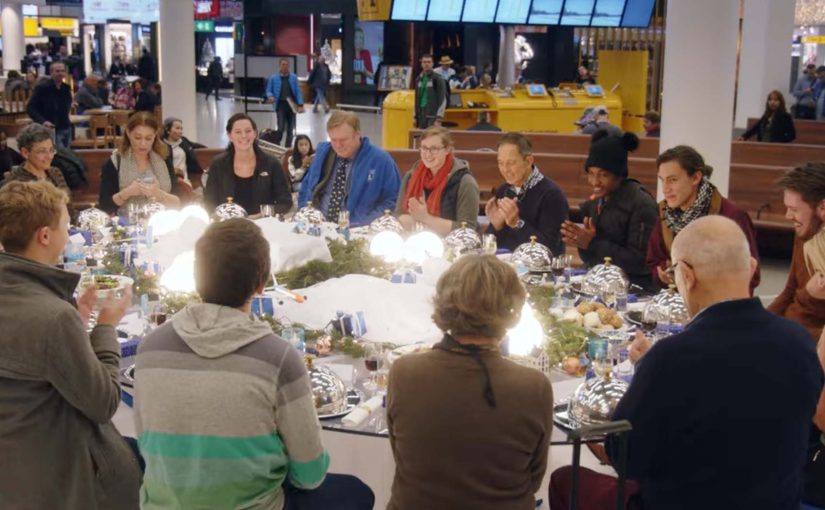
Airports can be lonely places, but Christmas is all about being together. So KLM sets up the Bonding Buffet at Amsterdam Airport Schiphol. A table with a full Christmas dinner sits 4.5 metres above the ground, clearly out of reach. The only way to bring it down is to cooperate.

The mechanic is beautifully simple. Travelers sit on the stools around the table. Each occupied seat lowers the table a little. When every seat is taken, the table is fully lowered and dinner can start.

As a result, people from over 20 different countries bond with each other, and the table injects some much-needed Christmas spirit into a busy airport.

Why this activation works so well

KLM does not “tell” people to connect. It forces a shared outcome that can only be achieved together. The campaign turns a common airport truth. Waiting alone. Into a social moment with a clear reward.

There are three tight design choices that make it land:

  • A visible constraint. The meal is there, but unreachable.
  • A cooperative mechanic. Everyone has a role. One seat at a time.
  • A shared payoff. The dinner only happens when the group commits.

The brand story is embedded in the experience

This is brand storytelling through behavior, not messaging. KLM positions itself as the airline that understands what travel feels like. Disconnected. Transitional. Sometimes lonely. Then it engineers a moment that flips the emotional state from isolation to togetherness.

The experience is also culturally portable. You do not need language to understand it. Sit down. Help lower the table. Eat together.

What to steal from this if you build live experiences

The transferable lesson is not “build a giant table.” The lesson is how to design bonding:

  • Make the goal obvious.
  • Make the mechanic collaborative, not competitive.
  • Make the payoff immediate and human.
  • Make it impossible to complete alone.

When those conditions are true, the social outcome becomes the content.


A few fast answers before you act

Q: What is KLM’s Bonding Buffet?
A Christmas activation at an airport where a dinner table starts 4.5 metres high and only lowers when travelers sit together on all seats.

Q: How does the table come down?
Each person who sits on a stool lowers it a bit. When every seat is taken, the table fully lowers and dinner begins.

Q: Where does it take place?
At Amsterdam Airport Schiphol.

Q: What is the human outcome KLM is designing for?
Strangers bonding. Turning lonely transfer time into a shared Christmas moment.

Q: Why is this a strong brand move?
Because KLM expresses its brand through an engineered experience that changes traveler behavior, not through slogans.

IKEA Manland

Last month IKEA in Sydney, Australia ran a four-day trial of Manland. They created a dedicated area in the store which men with short retail attention spans could use to escape the pains of weekend shopping at IKEA. In simple words, it was day-care for husbands and boyfriends who wanted to take a break from the shopping.

The store offered free hot dogs, Xbox consoles, pinball machines and nonstop sports action on TV. IKEA even handed out buzzers so women would get reminded to come back and pick up their men after a short session.

Turning “waiting time” into a branded service

Manland works because it is not pretending men suddenly love shopping. It acknowledges the reality. Some people will be there for the relationship, not the retail. So IKEA reframes the pain point as a service, the same way Småland turns “kids are restless” into a solved problem.

The mechanism is deliberately low-effort. You do not need an app, a QR code, or an explanation. You just drop in, decompress, and rejoin the trip with less friction and fewer arguments.

In big-box retail, weekend shopping is often a couple activity, and boredom is a conversion killer for the accompanying partner.

Why this becomes press, not just a gimmick

It is instantly legible. A “day-care for men” is a headline. The imagery does the distribution work. Consoles, sports, hot dogs, and a buzzer are all recognisable symbols, so the concept travels across cultures even if you have never been to an IKEA.

It is also slightly provocative, which helps. People argue about whether it is funny, patronising, or brilliant. That debate is oxygen for earned media.

The business intent: protect dwell time and reduce walk-outs

The practical goal is simple. Keep groups in-store longer, reduce the urge for someone to storm out, and make the trip feel easier, especially on peak weekend traffic. The PR upside is a bonus. But the operational benefit is the real value.

What to steal for your next in-store activation

  • Solve a real friction. If it does not remove pain, it will not spread.
  • Make the rules obvious. The best retail ideas need zero onboarding.
  • Build a “photo truth”. If the experience photographs well, it earns its own distribution.
  • Use time limits to keep it fair. A short session keeps it accessible and stops it becoming a hangout that blocks capacity.

A few fast answers before you act

What was IKEA Manland?

Manland was a short trial inside an IKEA store in Sydney. It offered a staffed, game-and-sports lounge where men could take a break while their partners shopped.

Why did the buzzer matter?

The buzzer turned “come back later” into a simple timing system. It made pickup predictable and helped manage capacity without complicated queueing.

Is this primarily an ad idea or an operations idea?

Both. It is an operations idea that creates PR. The experience removes friction inside the store, then the simplicity of the concept turns it into a shareable story.

What makes this kind of activation risky?

Stereotypes. If the tone feels insulting or dated, the press flips from amused to critical. The safest version is to frame it as optional decompression, not a judgment.

What should you measure if you do something similar?

Dwell time, drop-off rates, and satisfaction in exit feedback. For comms, track earned pickup and social sharing, but only after the in-store metrics look healthy.

Kit Kat: Jesus Loves Kit Kat

When a bite turns into a “sighting”

Every so often the internet latches onto a “miracle” story. This one starts with a simple, everyday moment. Someone takes a bite of a Kit Kat, and suddenly the bite pattern is framed as a face. Cue the inevitable question. Is it real, or is it just our brains doing what they always do with patterns?

Either way, the punchline lands immediately because the brand line is already waiting for it. Jesus loves Kit Kat. Have a break. Have a Kit Kat.

The stunt behind the headline

The mechanism is a simple one. Take a familiar cultural pattern. The “miraculous sighting” story. Then attach it to an everyday object and let curiosity do the distribution work.

In European FMCG marketing, low-budget PR seeding can outperform paid media when the story is easy to retell and the brand cue is unmistakable.

In this case, the campaign is described as being kick-started by sending a tip to major Dutch news sites about a “Jesus face” discovered in a bitten Kit Kat, complete with “proof” photos. Once the story lands, the audience spreads it for free, partly to react, partly to mock, and partly to forward the joke.

Why it lands: the audience writes the punchline

It works because the viewer instantly knows what to do with it. “Is it real” is the hook. “Obviously not” is the release. Then the slogan becomes the comment section fuel, because “Have a break” and “Give me a break” are ready-made responses that keep repeating the brand.

What the brand is really buying

This is not persuasion. It is memory and talk value. The goal is to force a moment of attention in a low-involvement category, then lock the attention to a slogan people already know well enough to quote without effort.

What to steal if you want earned reach without begging for it

  • Use a story shape people already recognise. Familiar formats travel faster than “new idea” explanations.
  • Make the brand cue inseparable from the joke. If the gag works without the product, you are funding entertainment, not brand recall.
  • Design for repeatable phrasing. The best hooks come with a built-in line people will type in their own words.
  • Know the risk. Hoax-style PR can backfire if your category depends on trust, seriousness, or institutional credibility.

A few fast answers before you act

What is happening in “Jesus Loves Kit Kat”?

A playful “sighting” style story frames a bitten Kit Kat as if it reveals a face, and the curiosity and debate around it drives sharing.

What is the core mechanism?

PR seeding plus a familiar meme-like story format. People click to judge it, then share to react, mock, or pass along the joke.

Why does this kind of story travel fast?

Because it is easy to retell and invites opinion. The audience becomes the distributor by arguing about whether it is “real”.

What is the brand risk to watch?

Hoax-style hooks can backfire in categories where trust and seriousness matter. The technique needs category-fit and tone discipline.

What is the most transferable takeaway?

If you use a cultural format people already recognise, make sure the brand cue is inseparable from the punchline, otherwise the joke outlives the brand.