
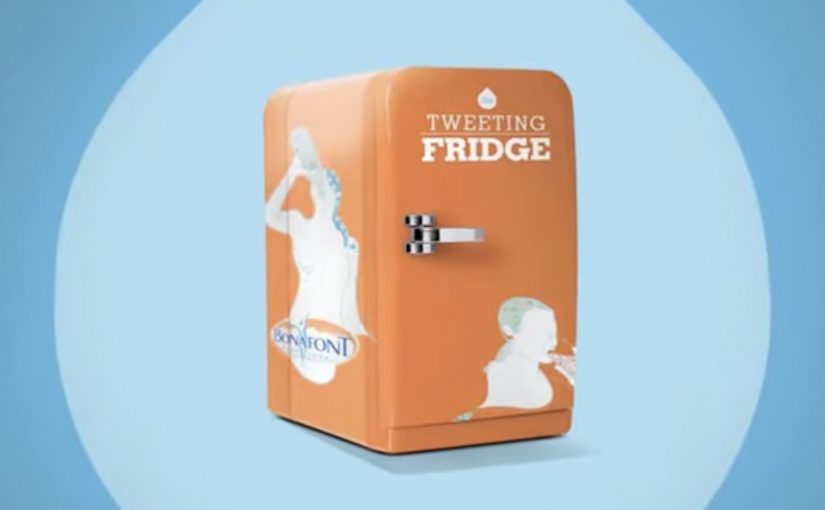
Bonafont: The Tweeting Fridge

The campaign starts with a simple gift. Bonafont sent a mini fridge stocked with 2 liters of bottled water to an influential Twitter personality in Brazil.

The twist was inside the door. The fridge was wired so every time it was opened, a tweet was automatically posted on the celebrity’s account, signaling to thousands of followers that they were drinking water. With a library of pre-written messages, the feed stayed fresh while the behavior stayed consistent.

In other words, hydration became a public ritual, and the act of opening the fridge became the publishing trigger, meaning the moment that automatically creates the post.

The most effective reminders are the ones that piggyback on social proof from people an audience already pays attention to.

A social reminder disguised as a connected object

The mechanism is straightforward. A door-open event triggers a social post. The creative leap is turning a private habit into a visible cue, so the audience gets a repeated prompt without ever being directly targeted by an ad. It is an Internet-of-things demo used as a behavioral nudge.

In global consumer health and FMCG marketing, habit cues scale best when they ride on routines people already perform and signals people already notice.

Why it lands

People rarely fail to drink water because they disagree with the idea. They fail because they forget, especially during work hours. This execution attacks the memory problem, not the belief problem. It also makes the reminder feel lighter. You are not being lectured by a brand. You are seeing someone you follow take a sip.

Extractable takeaway: When the behavior you want is repetitive and easy to forget, attach the reminder to a reliable physical trigger and let social proof do the distribution, so the message spreads as a habit signal, not a campaign slogan.

The real question is whether your reminder can show up as a lightweight cue at the moment of action, rather than as persuasion delivered in advance.

This is a pattern worth copying when “forgetting” is the main barrier and the trigger can be made automatic.

Stealable moves for your next behavior-change activation

  • Choose a trigger that is automatic. Door opens, post happens. No extra step means no drop-off.
  • Borrow credibility from the right messenger. The influencer is not decoration. They are the proof carrier.
  • Keep content variation ready. Repetition builds habit, but repetition with identical copy feels spammy.
  • Make the action visible, not the persuasion. Showing the behavior is often more powerful than explaining it.
  • Scale through a simple rotation model. Passing the object to new personalities keeps attention without redesigning the system.

A few fast answers before you act

What is “The Tweeting Fridge” in one sentence?

A connected mini fridge that automatically tweets when the door is opened, using social proof to remind followers to drink water.

Why is the fridge better than a normal “drink water” campaign?

Because the reminder is tied to a real-world trigger and delivered through a trusted voice, so it feels like a habit cue rather than an ad.

What problem does it solve for the brand?

It increases consumption by turning “forgetting” into “remembering,” using repeated prompts that keep the brand present at the moment of use.

What is the biggest risk if a brand copies this idea?

Over-automation. If the posting feels spammy or deceptive, audiences can turn against the brand and the influencer at the same time.

How do you keep an automated post from feeling spammy?

Use a small rotation of natural messages and avoid excessive frequency, so the automation reads like a habit signal instead of a bot loop.
Germanwings: Planemob at 30,000 Feet

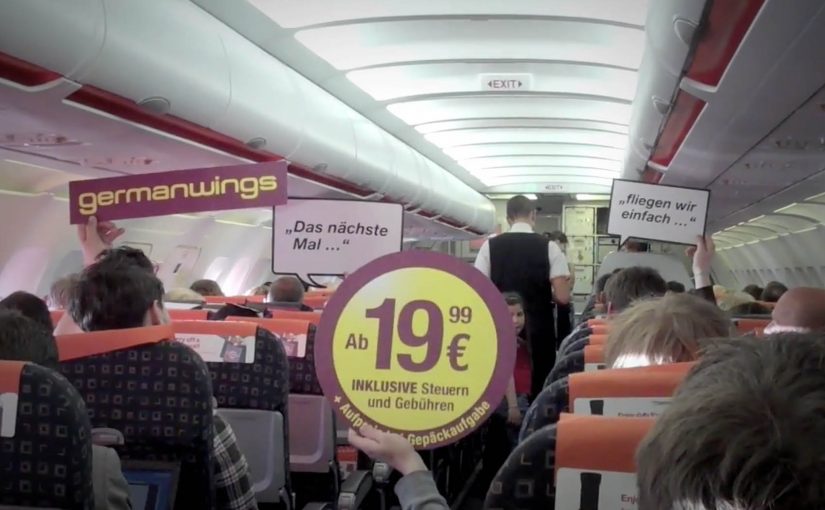
Five creatives board a competitor’s flight with nothing but cardboard signs, a camera, and a plan. At cruising altitude, they run a “planemob” in the aisle. In practice, that means a flashmob-style brand stunt staged on a plane and filmed to travel later as content. The cabin becomes the set, and the passengers become the audience.

A brand comparison staged where the problem happens

The idea is credited to Lukas Lindemann Rosinski in Hamburg. The stunt is described as taking place on a rival low-cost carrier flight, and it uses the rival’s own boarding and seating dynamics as the backdrop for the message.

The execution is deliberately low-tech. A small group reveals a sequence of placards that make a simple point about “quality” versus the small annoyances of no-frills flying, especially the chaos that comes with free seating when groups try to sit together.

The mechanic: hijack the moment, not the media

This is guerrilla advertising in the literal sense. Instead of buying more airtime, the campaign borrows a moment that already has full attention: passengers strapped in, phones out, and nothing else to do.

That works because the stunt captures attention at the exact moment the irritation is most legible, so the comparison feels less like copy and more like proof.

Filming the stunt is not an afterthought. It is the distribution strategy. The onboard moment creates the story, and the video carries it to everyone who was not on the plane.

In European low-cost aviation, brand promises live or die on small frictions that frequent flyers feel immediately.

Why it lands: it turns irritation into proof

Most airline positioning stays abstract because the product is hard to “show” in a single line. Planemob goes the other way. It demonstrates the promise by contrasting it against a situation passengers recognize without explanation. This is smart brand theatre because the proof arrives inside the passenger experience instead of sitting above it as a slogan.

Extractable takeaway: If your differentiator is a reduction of friction, stage the proof inside the friction. Do it in a setting where the audience is already feeling the problem, and keep the message simple enough to travel as a clip.

The business intent: earned attention that outlives the flight

The immediate audience is small. The real audience is everyone who sees the video afterwards. That’s the trade. A short, high-constraint performance buys a longer, shareable narrative, and it tends to get discussed precisely because it happens “in real life” rather than inside a media slot.

The real question is whether a tiny live audience can trigger a much larger story once the moment is filmed and shared.

Award listings also suggest the work gained industry recognition, including a Spotlight Festival Gold in web & mobile categories for “Planemob”.

What to steal for your next guerrilla moment

  • Exploit a captive moment ethically: pick a context where attention is naturally high and interruption is minimal.
  • Use props that read instantly: big typography, one point per beat, no cleverness that needs a caption.
  • Build the distribution into the idea: if it does not work as a video, it does not scale.
  • Anchor the claim in a felt pain point: “quality” lands when it maps to a concrete irritation people already know.
  • Keep the crew small: constraints make it believable, and believability is the fuel for sharing.

A few fast answers before you act

What is a “planemob”?

A planemob is a flashmob-style stunt staged on an aircraft, designed to create an attention-grabbing in-flight moment that can be filmed and shared as a campaign video.

Why does this count as guerrilla marketing?

Because it uses a real-world environment and a minimal set of materials to generate earned attention, rather than relying primarily on paid media placements.

What is the core persuasive trick in this execution?

It connects the brand claim to a situation passengers have experienced. The message feels like evidence because it is delivered inside a recognizable pain point.

What should you watch out for if you copy this approach?

Operational risk and brand risk. You need a concept that is safe, respectful to bystanders, and strong enough to survive without heavy explanation. If it needs a long caption, it will not travel.

How do you measure success for this kind of stunt?

Video reach and completion rates are the baseline. More meaningful signals include press pickup, share-to-view ratio, branded search lift, and whether the stunt strengthens a specific product attribute in brand tracking.

Kit Kat: Jesus Loves Kit Kat

When a bite turns into a “sighting”

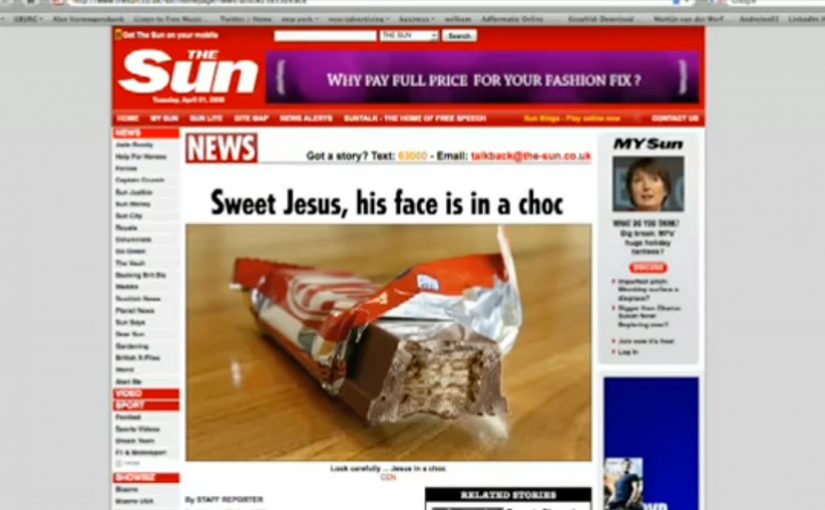
Every so often the internet latches onto a “miracle” story. This one starts with a simple, everyday moment. Someone takes a bite of a Kit Kat, and suddenly the bite pattern is framed as a face. Cue the inevitable question. Is it real, or is it just our brains doing what they always do with patterns?

Either way, the punchline lands immediately because the brand line is already waiting for it. Jesus loves Kit Kat. Have a break. Have a Kit Kat.

The stunt behind the headline

The mechanism is a simple one. Take a familiar cultural pattern. The “miraculous sighting” story. Then attach it to an everyday object and let curiosity do the distribution work.

In European FMCG marketing, low-budget PR seeding, meaning you plant the story with a few publishers to trigger pickup, can outperform paid media when the story is easy to retell and the brand cue, the unmistakable product signal inside the joke, is inescapable.

In this case, the campaign is described as being kick-started by sending a tip to major Dutch news sites about a “Jesus face” discovered in a bitten Kit Kat, complete with “proof” photos. Once the story lands, the audience spreads it for free, partly to react, partly to mock, and partly to forward the joke. That works because the audience is invited to judge the “realness” and repeat the brand line while they do it.

Why it lands: the audience writes the punchline

It works because the viewer instantly knows what to do with it. “Is it real” is the hook. “Obviously not” is the release. Then the slogan becomes the comment section fuel, because “Have a break” and “Give me a break” are ready-made responses that keep repeating the brand.

Extractable takeaway: If you use a familiar “sighting” format, design the sharing loop so people repeat the brand line as they debate whether it is “real”.

What the brand is really buying

The real question is whether the stunt forces a repeatable brand line, not whether anyone believes the “sighting”.

This is not persuasion. It is memory and talk value, meaning the worth of being talked about. The goal is to force a moment of attention in a low-involvement category, then lock the attention to a slogan people already know well enough to quote without effort.

Steal the “sighting” shape for earned reach

  • Use a story shape people already recognise. Familiar formats travel faster than “new idea” explanations.
  • Make the brand cue inseparable from the joke. If the gag works without the product, you are funding entertainment, not brand recall.
  • Design for repeatable phrasing. The best hooks come with a built-in line people will type in their own words.
  • Know the risk. Hoax-style PR, where you let people briefly wonder if it is real, can backfire if your category depends on trust, seriousness, or institutional credibility.

A few fast answers before you act

What is happening in “Jesus Loves Kit Kat”?

A playful “sighting” style story frames a bitten Kit Kat as if it reveals a face, and the curiosity and debate around it drives sharing.

What is the core mechanism?

PR seeding plus a familiar meme-like story format. People click to judge it, then share to react, mock, or pass along the joke.

Why does this kind of story travel fast?

Because it is easy to retell and invites opinion. The audience becomes the distributor by arguing about whether it is “real”.

What is the brand risk to watch?

Hoax-style hooks can backfire in categories where trust and seriousness matter. The technique needs category-fit and tone discipline.

What is the most transferable takeaway?

If you use a cultural format people already recognise, make sure the brand cue is inseparable from the punchline, otherwise the joke outlives the brand.