
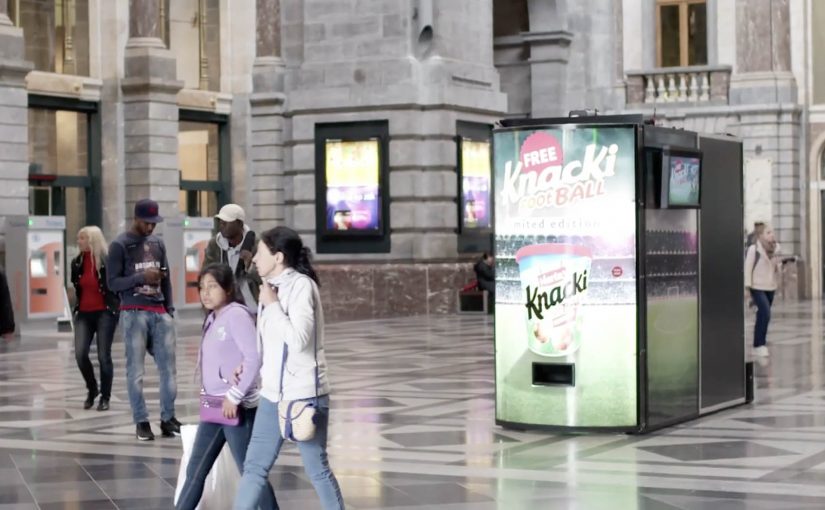
Herta Knacki FootBall: The Football Machine

Herta, described as a Nestlé brand in Belgium, launched Knacki FootBall. Small meatballs designed to look like footballs. Instead of relying on standard sampling, the brand and BBDO Brussels turned a train-station moment into a game people could not ignore.

At Antwerp Central Station, a vending machine offered the product for free. Then came the twist. Press the button and the machine opened into a miniature football pitch, with Belgian football legend Leo Van Der Elst waiting inside. To walk away with the snack, you had to score.

In high-traffic commuter environments, the best sampling ideas turn “free” into a short challenge with a story-worthy payoff.

Free is easy. Earning it is memorable.

The mechanic is deliberately unfair in the right way. People approach expecting a quick handout. The reveal forces a choice. Walk away, or step in and play. That decision point creates tension, and tension creates attention.

Standalone takeaway: Sampling gets retold when it includes a moment of risk or effort. The product becomes a trophy, not a giveaway.

A vending machine that behaves like a stadium

The physical design does most of the communication. The moment the door opens, everyone nearby understands what is happening. It becomes a spectator event, which is crucial in a station setting where most people do not want to stop unless something is already happening.

Why the celebrity opponent matters

Leo Van Der Elst is not a generic “host.” He is the difficulty setting. His presence turns the activation into a genuine duel, and that makes the outcome feel earned whether you win or lose. It also gives the content a built-in headline when the story travels online.

What the brand is really reinforcing

Knacki FootBall is a novelty product, so the job is not deep education. It is instant association. Football. Fun. A quick bite. The machine makes those associations physical, then anchors them to a specific place and moment people remember.

What to steal from The Football Machine

  • Build a single, obvious action. Press the button. The rest happens to you.
  • Make the reveal legible from 10 meters away. If bystanders cannot decode it fast, you lose the crowd effect.
  • Turn sampling into a challenge. Effort increases perceived value and shareability.
  • Use a real “difficulty signal.” A credible opponent or constraint makes the game feel legitimate.
  • Design the exit. Winning should end with a clear reward and a clean photo moment.

A few fast answers before you act

What is Herta Knacki FootBall “The Football Machine”?

It is a vending machine activation where commuters expecting a free sample discover a miniature football pitch inside, and must score a goal to win Knacki FootBall.

Where did the activation run?

It is described as being installed at Antwerp Central Station in Belgium.

Why use a vending machine for a food launch?

Because it creates a familiar expectation. Then you can subvert it. That contrast generates surprise, crowd attention, and strong word of mouth while still delivering the product sample.

What makes this work in a train station specifically?

Stations are full of people who are time-poor. A reveal that is instantly understandable, plus a short game loop, can stop people without requiring explanation.

What is the biggest operational risk with this kind of live activation?

Throughput and safety. If the game takes too long, queues become friction. If the experience feels unsafe or embarrassing, people avoid participation and the crowd effect collapses.
Heineken Departure Roulette

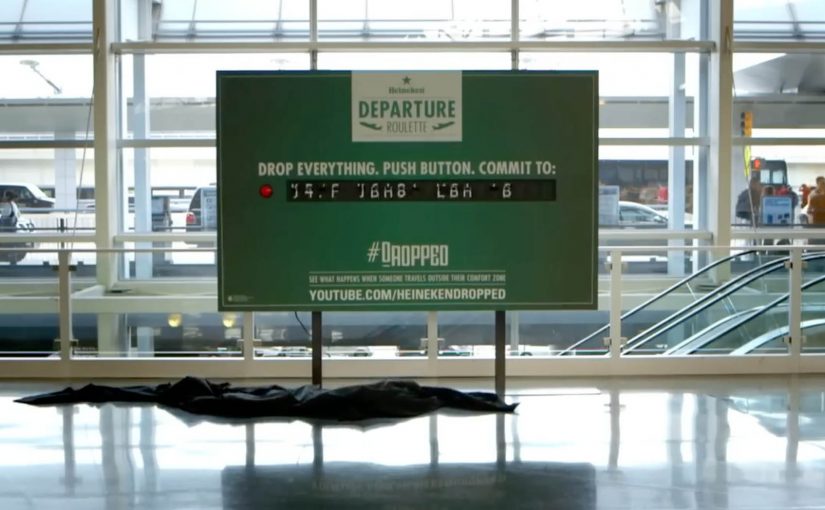
Board at JFK Terminal 8. A single red button. A real decision. To embody Heineken’s adventurous spirit, Wieden + Kennedy in New York sets up a Departure Roulette board at JFK’s Terminal 8 and dares travelers to play. If they press the button, they drop their existing plans and go somewhere totally new and exotic.

The commitment is real. The travelers who take the dare receive $2,000 to cover expenses and get booked into a hotel for two nights at the new destination. This is the recently released video of how it unfolds at JFK.

The stunt links to a broader idea. The game draws inspiration from Dropped, a Heineken campaign launched from W+K Amsterdam in which four men get sent to remote destinations, and the adventure of getting back gets filmed.

Why this stunt works

It makes spontaneity measurable

Most people can say they are spontaneous. Departure Roulette forces a binary choice in public. Press or walk away. The brand promise becomes an observable action.

It raises stakes without needing complex rules

The mechanic is simple. The tension is high. You do not need a long explanation to understand what is at risk: your plan.

It turns a brand value into a story people retell

The red button is a prop with meaning. It compresses the entire narrative into one symbol that is easy to remember, share, and debate.

How to apply the pattern

  1. Create one unmistakable action. A single step that proves intent, not interest.
  2. Make the trade-off clear. People must know exactly what they give up and what they gain.
  3. Design for the decision moment. The most valuable content is the second before and after commitment.
  4. Operationalize the reward. If logistics fail, the story turns from daring to disappointing.

What to measure beyond views

  • Participation rate. How many approached travelers agree to play.
  • Completion rate. How many press the button after hearing the rules.
  • Story lift. How often people retell the mechanic correctly.
  • Brand linkage. Whether the audience connects the act to “adventurous spirit,” not just “free trip.”

A few fast answers before you act

What is Departure Roulette?

A physical airport activation where travelers can press a red button and immediately swap their planned trip for a surprise destination.

What is the core mechanic?

One irreversible choice that turns a brand value into an action people can witness.

What makes it repeatable for other brands?

The format is not travel. It is a high-stakes choice with a simple trigger, a clear trade-off, and a real reward.

What is the biggest failure mode?

When the commitment is not credible, or the operations cannot deliver the promise.

Mikado Resistance Test

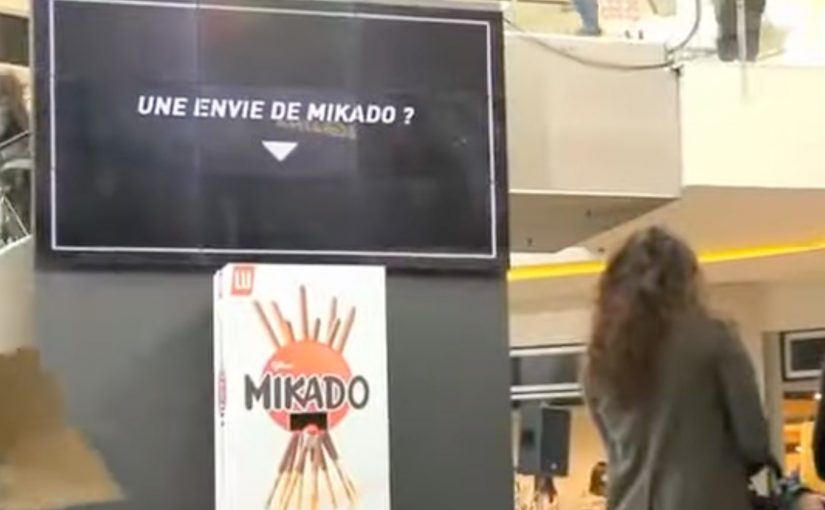
You are doing your shopping in a mall, and you spot a giant Mikado dispenser. Above it, a message scrolls: “Une envie de Mikado ? Vous ne devriez pas…”. A free box is right there. The temptation is immediate. People hesitate for half a second, then they reach for it anyway.

The moment the “victim” takes the Mikado, reality shifts. In a beat, they “fall” into an absurd, high-stakes scene. A nightmare wedding. A robbery. A knife-throwing scenario. Six variations. Each one staged to make a single point feel physical: Mikado is hard to resist, even when you are warned not to.

The idea in one line

Turn “irresistible” from a claim into a public dilemma. Then prove it by watching people choose temptation in front of everyone.

What Buzzman builds for Mikado

This is a deliberately simple setup with a brutal logic loop:

Step 1. Offer the product for free, but add a warning

The dispenser invites you, then immediately tells you not to do it. That contradiction creates tension and curiosity in the exact moment of decision.

Step 2. Make the consequence entertaining, not moralizing

When the actor takes the box, they “drop” into a surreal scenario. The audience in the mall watches the fall. Then they watch the scene unfold. The humor is the proof mechanic.

Step 3. Extend it into a digital series with repeat value

The campaign runs as a set of videos with multiple protagonists and outcomes. The variety matters because it turns one stunt into a format.

Step 4. Make the viewer complicit

At the end of the video experience, you can choose who becomes the next “victim.” That interactive twist is not a gimmick. It reinforces the theme: you are part of the temptation chain.

Why it works

It turns a brand truth into a behavioral test

The campaign does not explain why Mikado is irresistible. It sets up a moment where resisting is the story.

The warning is the creative fuel

“You shouldn’t” is what makes people want to do it. The copy creates the tension. The action resolves it.

The audience reaction is the distribution engine

People do not only watch the “victim.” They watch the crowd. The social proof is built into the scene itself.

The deeper point

If you want a product attribute to stick, stop describing it. Build a situation where people demonstrate it for you. Especially when the attribute is emotional (irresistible, addictive, impossible to ignore), the most persuasive proof is behavior under temptation.


A few fast answers before you act

What is the core mechanic?

A public dispenser offers free Mikado while warning you not to take it. When someone does, the stunt flips into a staged “consequence” scenario that proves irresistibility.

Why multiple scenarios?

Because a single stunt becomes a repeatable content format. Six outcomes keep it watchable and shareable.

What is the role of interactivity?

Viewers can choose the next “victim” at the end of the video experience, extending participation beyond the mall moment.

What is the transferable pattern?

Design a public “temptation test” where the desired product truth is demonstrated through behavior, not explained through messaging.

What is the biggest risk?

If the consequence feels mean-spirited or unsafe, the tension flips from funny to uncomfortable. The stunt has to stay playful.