To launch their new game Madden NFL 15, EA Sports wanted to connect with young, football-obsessed fans and grow its association with the real world NFL. Since the average football fan was watching the game with their smartphone in hand, EA teamed up with Google to allow sport fans to provoke rivals from the comfort of their own sofa and bring trash talk into the 21st century.
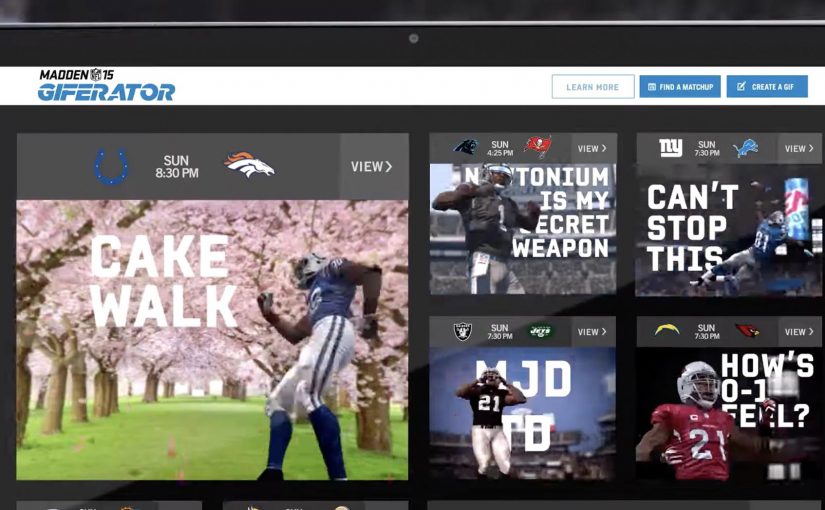
Using pioneering technology, live NFL data was fused with Madden 15 game footage to generate GIF highlights for every single game. All of this was delivered via real-time ads across sports websites and apps. As a result there was an ever growing collection of GIFs that football fans could simply take, edit and share to shove in the face of their rivals.
How the GIFERATOR works
The mechanic is a real-time trigger loop. As live NFL moments happen, a data signal maps those moments to a library of Madden NFL 15 visuals, headlines, and team-specific ingredients. The system then assembles a ready-to-share GIF that matches what fans are watching, right when the emotion spike is highest.
In sports marketing, second-screen behavior turns live moments into shareable social currency.
Why it lands
The creative idea is not “GIFs”. It is timing plus relevance. Because the asset shows up while the emotion spike is still live, it feels native to the fan conversation instead of delayed brand content. When fans are already checking stats, group chats, and social feeds mid-game, you meet them where their thumbs already are. The format just happens to be the internet’s fastest unit of trash talk.
Extractable takeaway: If you can translate a live moment into a personalized, ready-to-share asset within the same minute, you convert attention into participation, and participation into distribution.
Where the real value sits
The real question is how to make a boxed game feel as live, social, and rivalry-ready as the sport it simulates.
This is also a credibility move. By fusing live NFL action with Madden footage, the game positions itself as culturally current, not just a boxed product. It borrows the emotional heat of real games and channels it into the Madden universe, play after play.
What second-screen marketers should steal
- Build a trigger map: define which live signals create which assets, and keep the mapping simple enough to scale all season.
- Design for viewer control: let people tweak copy or choose variants, so the output feels like “mine”, not “an ad”.
- Win the second screen: deliver creative where fans already browse during live events, not only on your owned channels.
- Make rivalry the editor: structure content around opponents, not around generic brand lines, so sharing feels inevitable.
- Ship a content engine, not a one-off: the compounding library is the advantage, because it stays fresh week after week.
A few fast answers before you act
What is the Madden GIFERATOR?
It is a real-time GIF creation system that generates Madden NFL 15-themed GIFs that match what is happening in live NFL games, designed for instant sharing and trash talk.
Why does “real-time” matter here?
Because it catches fans during peak emotion. The closer the asset appears to the live moment, the more it feels like part of the conversation instead of an interruption.
What is the core pattern to reuse?
Use live signals to automatically assemble relevant, lightweight assets, then distribute them on the channels people naturally use while watching.
Is this mainly a social campaign or an ad campaign?
Both. The distribution is described as real-time advertising across sports sites and apps, while the product experience is built for fans to edit and share the output socially.
What is the biggest execution risk?
Relevance drift. If the mapping from live moments to generated assets feels off, or if the output arrives too late, it stops feeling “in the game” and becomes just another banner.