
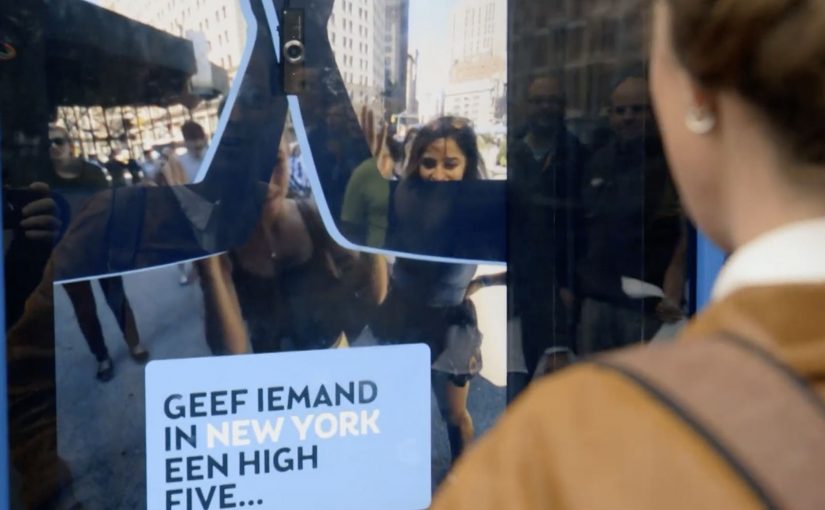
KLM: Live High Five

On 28 August, KLM connects hundreds of people in Amsterdam and New York via a live interactive video display, letting strangers on the streets of two cities come face to face.

It echoes the kind of “city to city” street connection seen before, such as the French railway (SNCF) linking Lyon and Brussels.

How the high five contest works

The twist is competitive: the connected pairs are asked to high five each other through the screens. For every successfully timed high five, participants win two tickets to New York or Amsterdam.

In global travel marketing, adding a clear participatory mechanic, meaning a simple action anyone can attempt without instruction, turns a “nice moment” into a repeatable behavior people recruit others into.

Why a high five is the right interaction

A high five is universally understood and visually obvious at distance. It is also time-bound, which creates tension. People lean in. They coordinate. They try again. That retry loop, the quick cycle of attempt, miss, adjust, and try again, is where energy builds and the crowd becomes part of the content.

Extractable takeaway: Pick an interaction that is instantly readable to bystanders, time-bound, and designed to invite visible retries. That is how the crowd becomes the amplification.

What KLM is really buying here

This is a route brand idea, meaning a story that makes a specific connection between two places feel tangible, disguised as play: KLM makes the transatlantic connection feel immediate, human, and winnable. The real question is whether your activation makes distance feel collapsible in under five seconds. This is the right kind of public interactivity when your promise is connection between places. The prize is valuable, but the real asset is the public proof that the brand can engineer connection between two cities in a way passers-by can instantly grasp.

Patterns to borrow for your own city-scale activation

  • Use one gesture everyone knows. The simpler the action, the more strangers will attempt it without instruction.
  • Add a timing challenge. Time-based coordination creates drama and repeat tries.
  • Make the reward match the story. Here, tickets reinforce the “two cities” premise.
  • Design for crowds. The best interactions are legible to bystanders, not just participants.

A few fast answers before you act

What is KLM Live High Five in one line?

A live video street installation connecting Amsterdam and New York where timed high fives between cities unlock travel tickets.

What is the key mechanism?

Two public screens link strangers in real time, then convert the connection into a simple, repeatable contest action.

Why does the high five mechanic work so well?

It is universal, physical, and instantly readable. The timing requirement creates suspense and encourages repeated attempts.

What is the biggest execution risk?

If timing feedback feels laggy or unclear, people stop retrying. The interaction needs instant, visible confirmation so the crowd stays invested.

What is the transferable lesson?

If your idea is “connection”, make people physically coordinate across distance and reward the moment with a prize that matches the narrative.
Thomas Cook: Surprise Wedding on a Plane

The secret to epic video marketing is to start with the smile of your audience, and then work back from there. In this stunt, Thomas Cook Travel Belgium does exactly that.

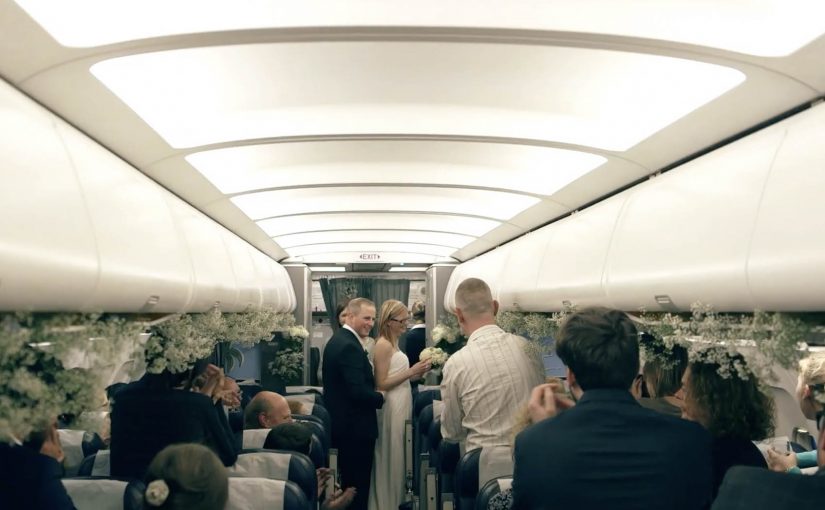
Thomas Cook asked fans on Facebook: if given the chance, would you marry your love on a plane. From the replies, one lucky fan was chosen and a surprise wedding was planned at cruising altitude, described as around 35,000 feet. The stunt was described as being funded by Thomas Cook, with the airline and family helping make it all come together. Here is the six-and-a-half minute video of how it unfolded.

How the story is engineered

The mechanism is a social prompt, meaning a simple public invitation for people to opt into the story, turned into a real-world payoff. A simple question creates a pool of willing participants. Selection creates stakes. Then a tightly planned surprise turns an ordinary flight into a once-in-a-lifetime moment. The camera simply follows the reveal, because the reveal is the content.

In travel marketing, surprise-led experiences that turn customers into protagonists can convert brand awareness into emotional preference.

The real question is how a simple social interaction becomes a moment people want to retell. This is smart brand storytelling because the experience is the ad, not a wrapper around it.

Why it lands

This works because it gives people a clean emotional arc in one sitting. A romantic setup. A public reveal. Genuine reactions. Then a resolution that feels earned because the participant initiated the story by saying “yes” in the first place.

Extractable takeaway: When you start with a simple audience prompt and pay it off with a real experience, you do not just “tell” a brand story. You manufacture a memory that participants and viewers will retell accurately.

What travel brands can borrow

  • Start with a low-friction question: make it easy for people to opt into the story with a simple response.
  • Design a single, clear payoff: one big moment beats five smaller surprises.
  • Let real reactions do the work: authenticity is the differentiator, not production polish.
  • Build in collaborators early: crew, family, and logistics must be part of the plan, not a last-minute add-on.
  • Keep the edit tight: preserve the emotional arc so the viewer gets the full journey without filler.

A few fast answers before you act

What is #FlightYes14?

It is Thomas Cook Belgium’s campaign framing for a surprise wedding staged on a flight, built from a fan prompt and captured as a shareable video story.

Why does a wedding work as travel marketing?

Because travel brands sell anticipation, emotion, and “big life moments”. A wedding is a concentrated version of that promise, and it creates instant viewer empathy.

What is the core mechanism behind the stunt?

A social prompt creates participation, a selection creates stakes, and a real-world surprise creates the payoff. The filming turns the payoff into distribution.

What makes this feel authentic rather than like an ad?

The participant’s reaction and the presence of real constraints. A plane is a real environment with real logistics, which makes the moment feel less like a set.

What is the main risk with this format?

Logistics and consent. If the surprise feels intrusive, staged, or poorly coordinated, the tone flips quickly. The planning has to protect the participant’s comfort and safety.

Heineken Departure Roulette En Route

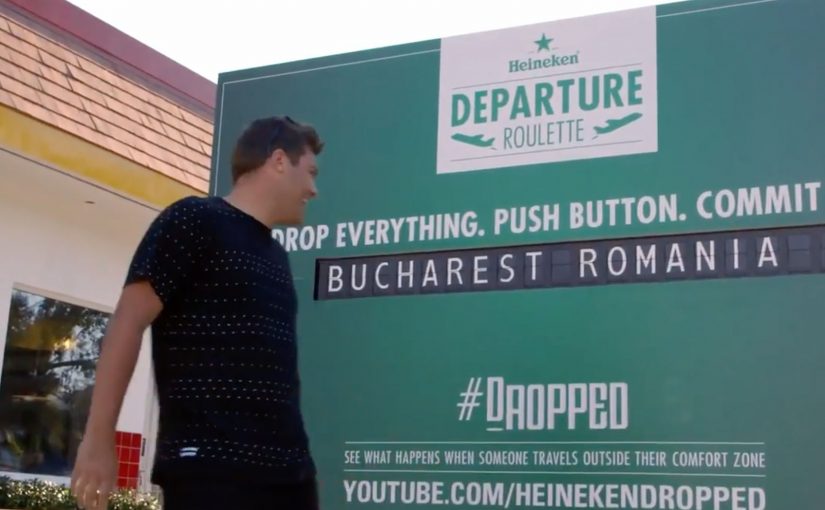
Heineken spots the tweets. Then they make them real. People watch the original Departure Roulette stunt and post the inevitable line on Twitter: “I’d press the button.” Heineken takes that public intent seriously. They track down a few of the people who tweet about wanting to play. Then they offer them the chance to play Departure Roulette on the spot. Real time, real commitment, no rehearsal.

If you want the backstory first, the original Departure Roulette activation sets the frame: a physical roulette board at JFK Terminal 8. One red button. Press it and you accept a new destination immediately. Read about the original here.

What “En Route” gets right: it turns social intent into action

The smartest part of this follow-up is not the surprise. It is the mechanism. Heineken treats social conversation as a live signal of willingness, not just commentary. Here, “social intent” means an explicit public statement like “I’d press the button,” not passive engagement. By acting on that signal fast enough to feel connected, the brand turns curiosity into a credible story of commitment.

Extractable takeaway: When people declare intent in public, treat it as an opt-in trigger. Respond fast with a real commitment moment, and make the decision itself the content.

The real question is whether you can turn “I’d do that” intent into a real commitment fast enough to feel causal, while keeping consent and safety airtight.

If you cannot deliver the commitment reliably in real time, you should not run this pattern.

It rewards declared intent in public

A tweet is a lightweight commitment. Heineken upgrades it into a real decision. The gap between “I would” and “I did” becomes the content.

It closes the loop from earned media to owned experience

The original stunt earns attention. The follow-up re-enters the stream where that attention lives. Social becomes a trigger for a real-world activation, not just a distribution channel.

It stays consistent with the campaign’s core promise

Departure Roulette is about spontaneity and courage. The follow-up keeps the same proposition, just delivered to a different moment and audience.

In global consumer brands running real-time social and experience programs, the advantage comes from turning explicit public intent into a safe, opt-in moment of commitment.

What to measure beyond views

  • Intent volume. How many people explicitly say they would do it.
  • Conversion rate. Percentage of selected participants who actually commit when approached.
  • Time-to-response. How quickly you move from trigger to activation.
  • Amplification quality. Replies and quote-posts that debate “would you do it,” not just “nice video.”
  • Brand linkage. Whether the audience repeats the core idea (spontaneity, adventure), not just the prank.

Risks and guardrails that matter

  • Consent and privacy. Do not approach people in a way that feels extractive. Keep it clearly opt-in.
  • Safety and duty of care. High-stakes travel stunts need hard boundaries, support, and contingencies.
  • Credibility. The offer must be unquestionably real, or the story collapses into suspicion.
  • Operational readiness. The logistics are the product. If ops fail, the story turns.

How to reuse this pattern without copying the stunt

  1. Define the “press the button” moment. Pick one unmistakable action that proves intent.
  2. Listen for explicit triggers, not vague sentiment. Look for “I would,” “I want,” or “If you did this I’d…” rather than likes alone.
  3. Respond fast enough that it feels connected. If the follow-up arrives too late, it reads like a promotion, not a story.
  4. Make the commitment real, but safe. Build constraints on timing, eligibility, logistics, and consent.
  5. Capture the decision, not just the reward. The moment of choice is the asset. The prize is the justification.

A few fast answers before you act

What is Departure Roulette En Route in one line?

It is a social-powered follow-up where Heineken turns “I’d press the button” tweets into a real-world chance to do exactly that.

Why does it spread?

Because it stages a high-stakes, relatable decision in public: keep your plan, or choose the unknown.

What is the reusable strategy?

Treat public intent as a trigger for action. Then deliver a real experience that proves the brand promise.

What is the minimum viable version for a brand without travel budgets?

Reward declared intent with an immediate upgrade: surprise access, exclusive drop, instant appointment, or fast-track service.

Where does this go wrong fastest?

When it feels like surveillance, or when the logistics do not deliver on the promise.