
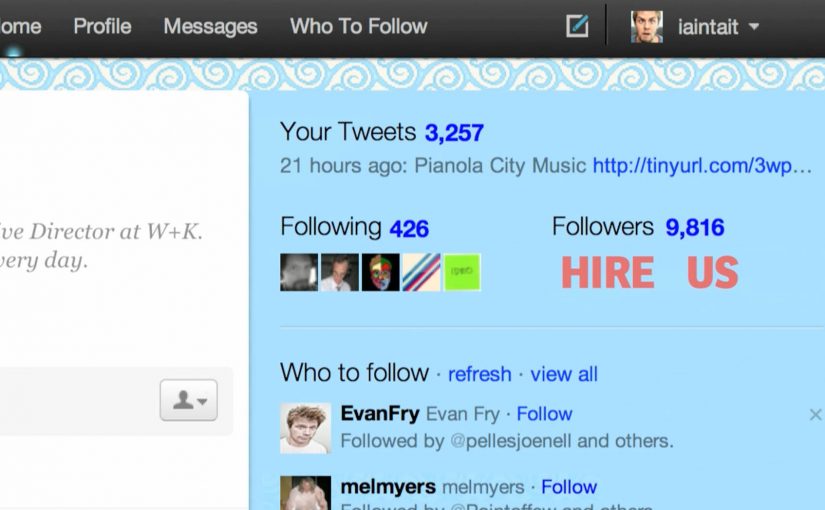
Hire Us: Twitter Follow Stunt Lands a Job

Dutch creative team Bas van de Poel and Daan van Dam set up five separate Twitter accounts and started following various Dutch Creative Directors on Twitter. Their message was simple: HIRE US.

Even though the idea is very similar to the Jeep Twitter Puzzle campaign, the execution is different and innovative. It gets them noticed and finally a job with Boondoggle in Amsterdam.

Why five accounts is the point, not the gimmick

The mechanism is engineered repetition. By “engineered repetition,” I mean deliberately creating multiple small signals that form an obvious pattern in the target’s notifications. One account can be ignored. Five accounts create a pattern. When multiple new followers arrive with the same blunt message, it triggers curiosity and a small sense of social pressure. Someone is doing something intentional, and it is hard not to look.

It is also highly targeted. They do not broadcast “hire us” into the void. They place it directly in the attention stream of the people who can change their outcome.

In creative hiring markets, attention is scarce, so using a platform’s native behaviours to deliver an instantly legible message is often the fastest way to get noticed.

Why it lands: interruption plus clarity

This works because it is instantly legible. No clever puzzle to decode. No long portfolio pitch. The call to action is the entire creative idea. That clarity is what makes it feel confident. And because it happens inside Twitter’s native behaviours, following, notifications, profile clicks, it does not require extra friction. The recipient can react in seconds.

Extractable takeaway: When you need attention from specific decision-makers, create a small pattern using the platform’s native behaviours that communicates the ask in one glance and makes the next step easy.

The intent: turn hiring into a creative brief

The business intent is obvious. Get hired. But the deeper intent is to reframe the hiring process. Instead of asking for a meeting, they create a live demonstration of how they think. Targeted, lightweight, and culturally fluent in the medium.

The real question is how you create an impossible-to-ignore signal for the right people without turning the medium into spam.

Done with tight targeting and restraint, this approach is a legitimate creative proof point. Done broadly or repeatedly, it backfires as noise.

Borrow this for your own career marketing

  • Be specific about who you want. Target decision-makers, not “everyone”.
  • Design an interruption that fits the platform. Use native behaviours, not extra hoops.
  • Make the message instantly legible. One idea. One line. No explanation required.
  • Turn the ask into proof. Show your creativity in the method, not in a PDF pitch.
  • Keep it respectful and reversible. Clever is good. Spammy is not.

A few fast answers before you act

What did Bas van de Poel and Daan van Dam actually do?

They created five Twitter accounts and followed Dutch Creative Directors with a single message: “HIRE US”.

Why did using multiple accounts matter?

It created a noticeable pattern and a stronger interruption than a single follow, prompting curiosity and profile clicks.

How is this different from the Jeep Twitter Puzzle?

It is similar in spirit, but the execution is simpler and more direct. A single clear call to action rather than a puzzle mechanic.

What made it effective as self-promotion?

High targeting, low friction, and a message that communicates confidence in one second.

What is the main takeaway for personal branding?

If you want attention from decision-makers, design a small, platform-native experience that demonstrates how you think and makes the next step easy.
Turkcell: #Turkcelltweet Live Unboxing

Turkcell was launching new smartphones bundled with mobile internet and wanted to build awareness among heavy internet users. So Turkcell’s agency, Rabarba from Istanbul, created a live Twitter competition designed to pull exactly those people in.

A Twitter game that literally unwraps the prize

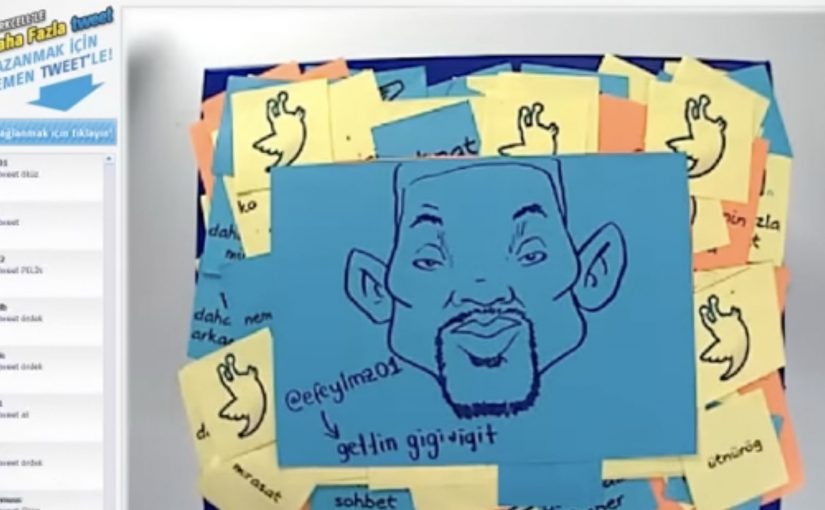
The smartphone was packed in gift boxes and covered with Post-it notes. Players had to tweet what was written on the Post-its to “unwrap” the boxes, using the hashtag #Turkcelltweet. Along the way, contestants joined quick games that won them free minutes and mobile data. The final challenge was to get a celebrity to retweet the message, which won the successful Twitter user a smartphone.

In mobile-first consumer markets, live social mechanics can turn a product launch into a participatory event that spreads through existing networks.

Why it lands

This works because it converts passive watching into a simple, fast action. Read. Tweet. Progress. It also creates a public scoreboard effect. Everyone can see the stream, feel the speed pressure, and understand why a specific player is moving closer to the prize.

Extractable takeaway: When you need attention from people who tune out advertising, design a live loop where participation creates visible progress and the reward feels plausibly “earned” in public. By “live loop” I mean a repeatable action-reward cycle that updates in real time.

What the brand is really buying

The real question is whether you are buying a one-off spike or a repeatable participation habit you can trigger again.

On the surface, it is a giveaway. Underneath, it is audience training. The campaign teaches people to watch Turkcell’s channel closely, to act quickly, and to associate the bundle with active internet culture rather than with standard telecom promotion.

If you cannot guarantee fair rules and real-time moderation, do not run a live social competition like this.

Steal this live unboxing loop

  • Build a single clear verb. “Tweet this to unwrap” is easier than any multi-step entry mechanic.
  • Make progress visible. The crowd should be able to understand what is happening in seconds.
  • Use micro-rewards. Minutes and data keep non-winners engaged, not just the front-runner.
  • Reserve one high-status finish. A celebrity retweet creates a final boss moment that feels bigger than “random draw”.
  • Design for throughput. Live contests die if the pace slows or the rules feel inconsistent.

A few fast answers before you act

What is #Turkcelltweet in one sentence?

It is a live Twitter competition where people tweet Post-it clues to unwrap a boxed smartphone, win small rewards on the way, and compete for a phone as the final prize.

Why does “unwrapping in public” work as a mechanic?

Because it creates visible progress that spectators can follow, and it turns every participant action into content the network can see.

What role do the small prizes play?

They keep the wider crowd engaged. Even if you do not win the phone, you can still gain minutes or data and feel the game is worth playing.

What is the biggest risk with live social competitions?

Fairness and reliability. If timing, moderation, or rule enforcement looks inconsistent, sentiment can flip fast.

What should you measure beyond hashtag volume?

Unique participants, repeat participation, completion rates across stages, sentiment, and whether the campaign lifts bundle consideration and store inquiries in the launch window.

Fey & Co: Lullaland

Around the world, people say good night on Twitter, often with #goodnight. Jung von Matt/Elbe collected those tweets for mattress manufacturer Fey & Co and turned them into a daily, shareable sleep ritual.

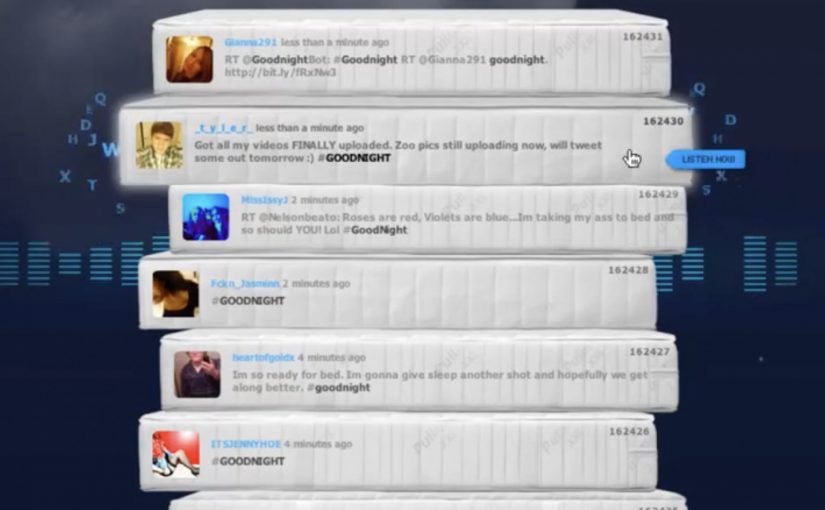
Every good night tweet automatically became part of the campaign. With a simple retweet, users were invited to www.lullaland.net, where short tweets were converted into melodic “lullatweets” for the world. Fey & Co positioned itself as an ambassador for good sleep inside the bedtime behavior of a digital generation.

How Lullaland turns tweets into lullabies

The mechanic is a tight translation loop. Capture tweets containing the hashtag. Convert the letters into tones to generate a simple melody. Store and present the results as a browsable collection, so each new tweet becomes both content and invitation. That works because the system turns an existing bedtime signal into branded content without adding effort.

In consumer categories built on comfort and routine, attaching the brand to an existing nightly habit is a durable way to earn repetition without forcing a new behavior.

Why it lands

It respects the moment. “Good night” is already intimate and low-energy, so the idea stays lightweight and fits the mood. The conversion from text to sound also makes participation feel magical without requiring people to do anything beyond what they already do, tweet.

Extractable takeaway: When you want to own an emotional territory, do not only advertise the feeling. Embed the brand into a recurring micro-ritual, then turn real audience behavior into the content that keeps the ritual alive.

What the brand is really buying

This is not a mattress demo. It is salience at the exact time the category is most relevant, right before sleep. Each contribution expands the library, each retweet can recruit new contributors, and the campaign accrues credibility because it is built from real messages rather than brand copy.

The real question is how a sleep brand earns a place in the bedtime habit before the purchase decision is even active.

What to steal from Lullaland

  • Use an existing verb. Build on a habit people already perform daily, then add one small layer of transformation.
  • Translate data into emotion. Turning text into music creates feeling fast, even when the input is mundane.
  • Make participation automatic. Lower friction by letting normal behavior qualify as entry.
  • Create a browsable archive. A growing collection gives the idea longevity beyond a launch spike.

A few fast answers before you act

What is Lullaland in one sentence?

A campaign that collects #goodnight tweets and converts them into short lullaby-like melodies, linking Fey & Co to a nightly digital ritual.

Why does converting tweets into music matter?

It turns a familiar social action into an emotional artifact, which makes the participation feel more meaningful than a normal hashtag post.

What makes this effective for a mattress brand?

It shows up at bedtime, uses real “good night” behavior, and reinforces sleep as a cultural moment rather than a product feature list.

What is the main risk with ritual-based campaigns?

If the experience is slow, confusing, or repetitive, people do it once and stop. The conversion has to feel instant, and the output has to feel varied enough to revisit.

What should brands copy from this idea?

Start with a recurring user behavior, add one simple transformation that creates emotion, and make the output easy to browse or share so the system keeps renewing itself.