
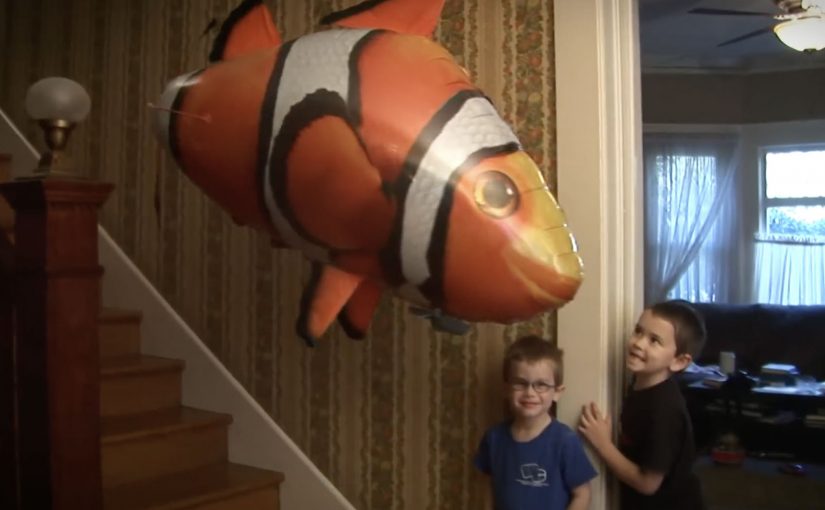
Air Swimmers: Flying Shark and Clownfish

Have you ever seen a fish that can swim in the air with smooth, life-like motion. Air Swimmers is a US-based company that developed these remote controlled, helium-filled flying fish.

They are designed for indoor fun even in small rooms. Air Swimmers describes them as running on four AAA batteries, one in the body and three in the controller, with up, down and 360 degree turning control.

How it works

The mechanism is lighter-than-air buoyancy plus simple steering controls. The helium does the lifting. The controller provides direction and small adjustments that make the movement read as “swimming” rather than “flying”. The technology fades into the background, and the illusion becomes the product.

In consumer retail for playful tech products, the fastest path from curiosity to purchase is a demo that looks impossible at first glance, but becomes obvious after ten seconds of watching it move.

The real question is how quickly your demo turns “that can’t be real” into “I want to try that”.

Lead with the impossible-looking motion first, and let the explanation come second.

Why it lands

It delivers a clean emotional sequence. Surprise first. Then control. The viewer sees it drift like a creature, then realises someone is steering it with precision. Because buoyancy handles the lift, small steering inputs read as effortless, which makes the motion feel alive and shareable. That makes it instantly shareable because the value is visible without narration or specs.

Extractable takeaway: If your product’s value is delight, design a demo that creates a visible illusion, then reveal just enough control to make people want to try it themselves.

Guerrilla activation lessons from Air Swimmers

  • Make the demo the message. If the value is visual, build your marketing around one clip that proves the experience in seconds.
  • Use “living motion” as the hook. Here, “living motion” means movement that reads like a creature rather than a machine, so people treat it as a moment worth filming.
  • Turn everyday space into a stage. Air Swimmers were also used as a guerrilla execution for SEA LIFE Speyer in Germany. Reported coverage describes Leo Burnett Frankfurt sending “flying sharks” through Frankfurt, including public locations and public transport, to turn the city into a temporary “aquarium” and build awareness for the aquarium in the Rhein-Main region.
  • Design for spectators, not only users. The best stunts create a second audience. Passers-by who do not control the object still get the full story.

A few fast answers before you act

What is an Air Swimmer?

A helium-filled balloon “fish” you steer indoors with a handheld controller, designed to move with a swimming-like motion through the air.

Why does it feel more impressive than other RC toys?

Because buoyancy handles the “floating,” so the control inputs translate into smooth, creature-like movement rather than noisy, mechanical flight.

What makes a product like this easy to market?

The demo is the message. One short clip communicates the full value without specs, because the motion is the proof.

Why was this a good fit for a SEA LIFE guerrilla execution?

Because it is thematically aligned with marine life, instantly attention-grabbing in public spaces, and it creates a moving spectacle people want to film and talk about.

What should the first ten seconds of the demo show?

Start with the “impossible” floating motion, then reveal the steering control quickly, so people understand it is real and want to try it.
Newcastle Brown Ale: Shadow Art Billboard

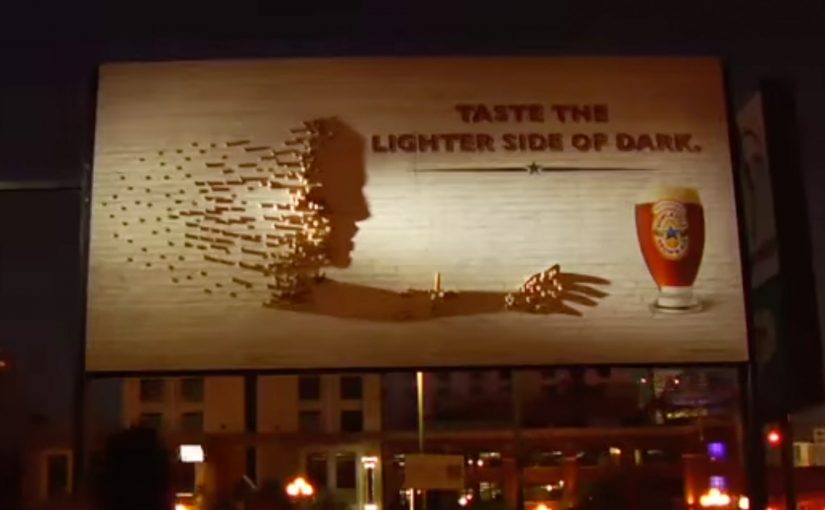
Newcastle Brown Ale’s Shadow Art has debuted in San Diego’s nightlife hub, the Gaslamp district, now through the end of September. Using only a single light source and thousands of Newcastle Brown Ale bottle caps, two New York shadow artists partnered with Newcastle to bring to life a shadow sculpture spanning 128 square feet. Shadow art is an installation that reads abstract until a specific light angle casts a deliberate image.

How it works when the sun goes down

By day it reads like an abstract field of caps. By night, the light angle does the magic. The caps become a pixel grid, and the shadow resolves into a clear image that connects directly to the brand world and the “Lighter Side of Dark” idea. Because the image only resolves under the right light angle, it invites a second look and conversation in a noisy street.

In dense entertainment districts where outdoor media competes with movement, neon, and noise, physical interactivity that rewards a second look beats anything that needs time to decode.

The real question is whether your outdoor idea earns a second look without asking for extra attention.

Why it lands

It makes the reveal the reward. The billboard does not shout at you. It waits until the conditions are right, then surprises you with an image that feels like you discovered it.

Extractable takeaway: Out-of-home becomes memorable when the medium changes state based on real-world conditions like light and viewpoint. If the message only appears when the environment cooperates, the audience feels like they unlocked it.

It uses the product as raw material. Bottle caps are not a metaphor. They are literally the building blocks, which makes the craftsmanship feel inseparable from the brand.

It turns a static surface into a time-based experience. You do not just “see an ad”. You experience a transformation. That shift is what creates talk value in public spaces. Talk value here means it gives people a simple reason to bring it up to others in the moment.

Borrow from Shadow Art billboards

  • Design for a two-stage read. First glance should intrigue. Second glance should reward with clarity.
  • Make the material part of the story. When the build uses brand-native ingredients, the proof feels baked in.
  • Choose locations where “stop and stare” is natural. Nightlife zones work because people are already scanning, wandering, and socializing.
  • Anchor the payoff to one simple brand line. The reveal should resolve into a message people can retell in a sentence.

A few fast answers before you act

What is “shadow art” in an advertising context?

An installation that looks abstract from one angle or in one lighting condition, but becomes a clear image when a specific light source and viewpoint create the intended shadow.

Why use bottle caps instead of printed graphics?

Caps add texture, depth, and authenticity. They also turn the build into a craft story that people talk about, photograph, and share.

What makes this work in a place like the Gaslamp district?

Because it competes with nightlife the right way. It creates a moment people can discover and show to friends, rather than trying to out-shout the environment.

What is the business intent behind an installation like this?

To generate earned attention and brand distinctiveness by creating a public experience that feels “worth a look”, then “worth a share”.

What is the most transferable lesson?

Build a reveal that is conditional on the real world. Light, angle, and time can do the targeting for you without any data.

Coca-Cola: Rush Hour Cinema

Bogotá gridlock, turned into a cinema you are already sitting in

On an average, commuters in Bogota spend daily 4 hours stuck in traffic. The infernal rush hour traffic jams are the result of unfinished constructions on main avenues, as well as on the rapid transit system, TransMilenio, which has seen work on its expansion come to a halt, due to irregularities in the handling of funds, and corrupt contractors.

So Coca-Cola with ad agency Ogilvy Colombia turned these traffic jams into a drive in cinema. The soda-pop giant launched this ingenious initiative on the eve of their 125th anniversary.

The mechanism: a drive-in cinema without the driving

The idea is as direct as it gets. If people are trapped in cars for hours, give them something worth watching, right there on the route they cannot escape.

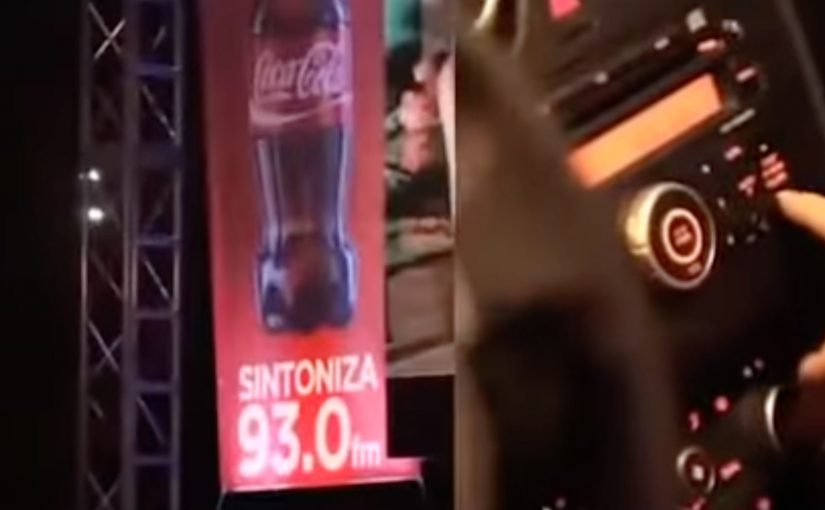
A drive-in cinema activation is a public screening designed for people inside vehicles, typically using a large screen for the picture and a radio frequency so the car stereo carries the audio.

In big-city commuting cultures, attention is already captive.

The smartest brand experiences do not try to fight the context. They use it.

The real question is whether you can turn inevitable waiting into a shared moment people remember, without adding friction.

Why it works: it flips frustration into a shared moment

Traffic jams create the same emotional pattern every day. boredom, irritation, and the feeling that time is being stolen. Rush Hour Cinema interrupts that loop with something communal. Drivers are not just waiting. They are watching the same thing together. Because the screen and radio audio synchronize everyone into the same story, the jam feels less like wasted time and more like an event. The experience also changes what people do with their phones. Instead of complaining or doom-scrolling, they have a simple story to capture and retell.

Extractable takeaway: When you synchronize strangers into the same moment, you convert “stuck” into “shared”, which boosts recall and retell.

The business intent behind the “nice surprise”

This is not a product pitch. It is brand behavior on display. Coca-Cola shows up as the brand that makes an unavoidable moment feel lighter, and it does it at scale, in the exact place where annoyance peaks. This is a strong play when the pain point is predictable and unavoidable, because you can upgrade the moment instead of interrupting it.

It is also efficient media. The audience is guaranteed. The dwell time is long. And the memory is anchored to a very specific location and feeling, which makes recall easier later.

Rush Hour Cinema is an ambient Coca-Cola activation in Bogotá that uses rush hour gridlock as the venue, transforming waiting time into a public drive-in style screening. Here, “ambient” means the experience lives in the environment people are already in, rather than pulling them into a separate channel.

Steal this pattern for pain-point media

  • Pick a context where time is already lost. Commuting, queues, delays, waiting rooms. People will thank you for filling it.
  • Make participation effortless. No app. No sign-up. Just look up and tune in.
  • Design for group reality. People experience it side-by-side, so the moment becomes social proof.
  • Keep the message implicit. When the gesture is the point, the brand earns goodwill without talking.

A few fast answers before you act

What is Coca-Cola’s Rush Hour Cinema?

It is an ambient activation in Bogotá that turns rush hour traffic into a drive-in style cinema. Drivers watch a large roadside screen while the audio plays through their car radios.

Why does a traffic jam make sense as a media channel?

Because attention and dwell time are already there. People cannot leave, and they are actively looking for relief from boredom and frustration.

What is the key design principle behind this idea?

Do not fight the context. Upgrade it. When you improve an unavoidable moment, the brand gets disproportionate gratitude and retell value.

How does the audio work in a drive-in setup?

The video runs on a big screen, and the audio is broadcast on a radio frequency so drivers can tune in using their car stereo.

What makes this feel like a shared experience, not just content?

Everyone watches the same thing at the same time, side-by-side. That turns private frustration into a communal moment, which increases memorability.

What is Coca-Cola trying to achieve with this execution?

It is not a product pitch. It is brand behavior on display. Coca-Cola shows up as the brand that makes an unavoidable moment feel lighter, right where annoyance peaks. If you copy this pattern, measure recall and sentiment in the moment, plus organic capture and retell.