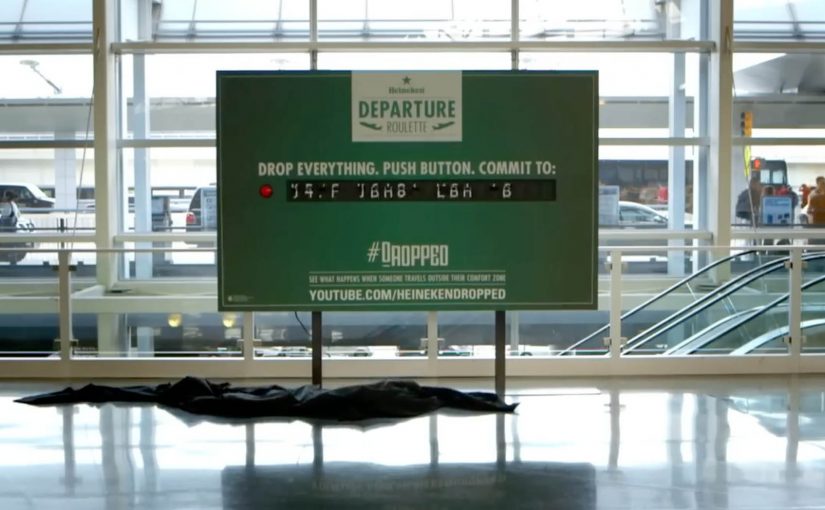
Board at JFK Terminal 8. A single red button. A real decision. To embody Heineken’s adventurous spirit, Wieden + Kennedy in New York sets up a Departure Roulette board at JFK’s Terminal 8 and dares travelers to play. If they press the button, they drop their existing plans and go somewhere totally new and exotic.
The commitment is real. The travelers who take the dare receive $2,000 to cover expenses and get booked into a hotel for two nights at the new destination. This is the recently released video of how it unfolds at JFK.
The stunt links to a broader idea. The game draws inspiration from Dropped, a Heineken campaign launched from W+K Amsterdam in which four men get sent to remote destinations, and the adventure of getting back gets filmed.
In global FMCG brand marketing, high-traffic moments like airports make public, irreversible choices unusually effective at turning a value into proof.
Why this stunt works
The power is not the prize. It is the forced, public decision moment that turns “adventurous” from a claim into an observable act.
Extractable takeaway: If your brand stands for a value, design one visible, irreversible choice that makes people either live it or walk away.
It makes spontaneity measurable
Most people can say they are spontaneous. Departure Roulette forces a binary choice in public. Press or walk away. The brand promise becomes an observable action. Because the choice is binary and public, it creates proof people can retell without needing extra context.
It raises stakes without needing complex rules
The mechanic is simple. Here, the mechanic is the single red-button press that swaps your itinerary on the spot. The tension is high. You do not need a long explanation to understand what is at risk: your plan.
It turns a brand value into a story people retell
The red button is a prop with meaning. It compresses the entire narrative into one symbol that is easy to remember, share, and debate.
The real question is whether your brand promise can survive a real, irreversible choice in front of people.
This pattern is worth copying only when the commitment and the logistics are truly real in the moment.
What to measure beyond views
- Participation rate. How many approached travelers agree to play.
- Completion rate. How many press the button after hearing the rules.
- Story lift. How often people retell the mechanic correctly.
- Brand linkage. Whether the audience connects the act to “adventurous spirit,” not just “free trip.”
Steal the red-button blueprint
- One irreversible trigger: Reduce the experience to a single action that cannot be half-done.
- Visible trade-off: Make what they give up as clear as what they gain.
- Decision-first filming: Capture the seconds before and after commitment, not just the outcome.
- Operations as creative: Treat booking, payout, and handoff as part of the story, because failure kills believability.
A few fast answers before you act
What is Departure Roulette?
A physical airport activation where travelers can press a red button and immediately swap their planned trip for a surprise destination.
Where did the activation take place?
At JFK Airport, Terminal 8, where the Departure Roulette board invited travelers to press the red button and swap trips.
What is the core mechanic?
One irreversible choice that turns a brand value into an action people can witness.
How does it connect to Heineken’s Dropped campaign?
It borrows the premise from Dropped, where participants are sent to remote destinations and the journey back becomes the story that gets filmed.
What makes it repeatable for other brands?
The format is not travel. It is a high-stakes choice with a simple trigger, a clear trade-off, and a real reward.
What is the biggest failure mode?
When the commitment is not credible, or the operations cannot deliver the promise.