
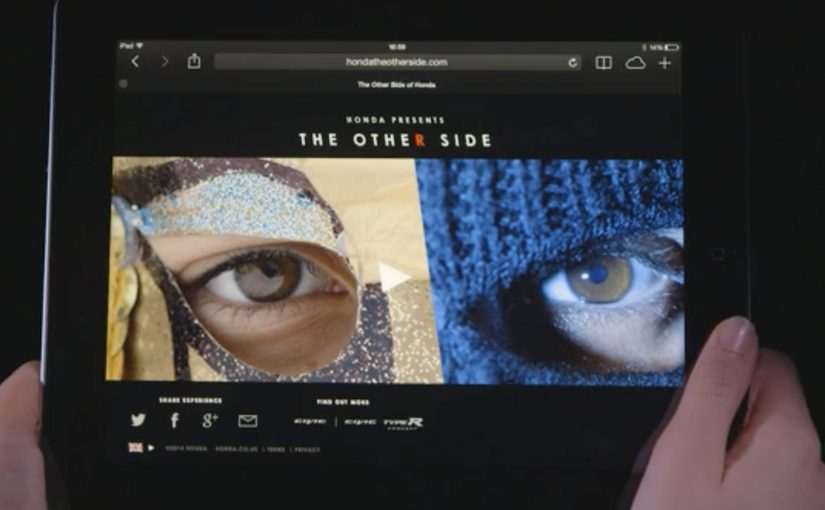
Honda – The Other Side

Car brands are always trying to show that their cars have different sides to their personalities, sporty vs reliable, safe vs cool, etc. What makes Honda’s latest effort unique is its YouTube video. By simply holding down the “R” key on the keyboard, the viewer can instantly switch between two different videos.

To execute this innovation, Wieden & Kennedy London had to create two storylines, one of an easygoing Dad doing the school run and the second as an undercover cop posing as a getaway driver. Both of which were then expertly mirrored with contrasting style and tone. The interactive experience was then put together by Stinkdigital at Honda’s YouTube Channel.

Why the mechanic matters more than the novelty

The “hold R to switch” idea is a simple interaction mechanic, meaning the viewer action changes how the story is revealed, but it changes how you watch. You are not just viewing a story. You are actively comparing two versions of the same moment, in real time.

Extractable takeaway: When a brand claim depends on contrast, the strongest format is often one that lets the audience trigger the comparison for themselves.

The real question is whether the interaction makes the brand point clearer, not whether the tech looks clever.

  • One scene, two meanings. The mirrored structure makes contrast instantly legible.
  • Viewer control. You control the cut, which increases attention and repeat viewing.
  • Storytelling as product proof. Different “sides” of a car become a narrative device, not a claim.

Execution discipline: mirrored scenes, opposite tone

This only worked because the two storylines were designed to align. Timing, framing, and beats had to match so the switch felt seamless, not like two unrelated edits.

The payoff is that contrast becomes the hero. Calm family routine vs high-pressure escape. The same underlying vehicle context. Two different emotional reads.

In digital brand storytelling, interactive mechanics only earn their place when they make the positioning easier to grasp, not harder.

The business intent is clear: turn Honda’s “different sides” message into a felt comparison, so the format demonstrates the proposition instead of leaving copy to explain it.

What to take from this if you build interactive brand content

  1. Make the interaction explain itself. If the mechanic needs instructions, you lose momentum.
  2. Design for replay. The best interactive films reward going back and re-watching with intent.
  3. Let structure carry the message. When the format proves the point, you do not need heavy-handed copy.
  4. Keep the tech invisible. Viewers remember the feeling of control and contrast, not the implementation details.

A few fast answers before you act

What is Honda “The Other Side”?

It is an interactive film experience where viewers can switch between two parallel storylines by holding down the “R” key.

What are the two storylines?

One follows an easygoing Dad doing the school run. The other follows an undercover cop posing as a getaway driver, with both narratives mirrored scene-by-scene.

Why is the “hold R to switch” mechanic effective?

It gives the viewer control and makes the contrast immediate. That active comparison increases attention, engagement, and replays.

Who created the work?

Wieden & Kennedy London created the two mirrored storylines, and Stinkdigital put the interactive experience together on Honda’s YouTube Channel.

What is the transferable lesson for digital teams?

If you can express your message through an interaction that is instantly understandable, the format itself becomes the persuasion.
Your Music School: Voice-Navigated Website

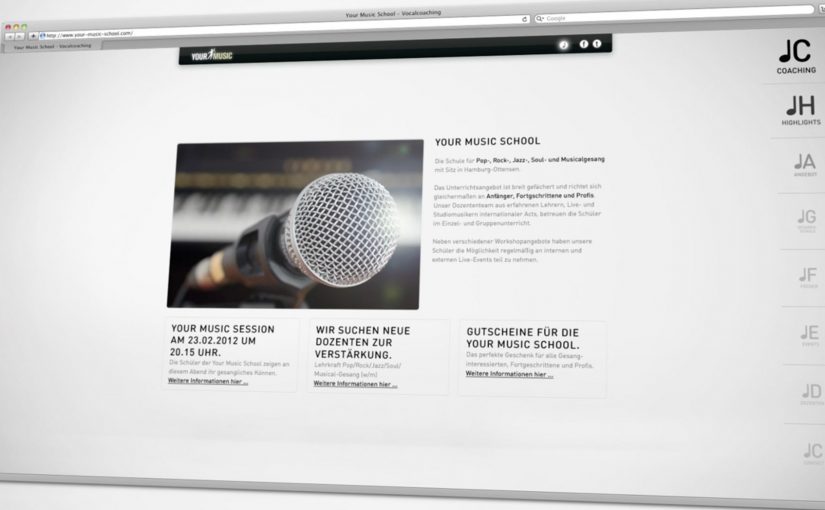
Your Music School is a school for vocal education in Hamburg. To generate more applicants for the school’s vocal coaching courses, ad agency Red Rabbit Hamburg developed a website that can be navigated by using one’s own voice.

The eight menu items on the navigation are arranged on a scale. By singing the appropriate notes, you can directly hit the desired menu item. As a result, the website increased applications to the vocal coaching courses by almost 30%.

When the interface previews the course

This is recruitment as product demonstration. Before you read about vocal coaching, you are already doing a micro-version of it. You listen, you match pitch, you get feedback, and the site responds.

The mechanic: navigation as a singing exercise

The interaction design is a single clear rule. Map menu choices to notes on a scale, then let the user’s voice act as the pointer. It removes the mouse, reduces explanation, and makes the site’s subject matter unavoidable in the best way.

In European education marketing, interactive admissions touchpoints work best when the first interaction proves the promise, and makes the applicant feel capable within seconds.

Why this lands

It turns curiosity into participation. People arrive expecting a standard brochure site, and instead get a playful challenge that feels aligned with the goal of singing better. That alignment makes the brand feel confident, and it lowers the psychological barrier to applying because the visitor has already taken a first “lesson” without committing.

Extractable takeaway: If you sell skill-building, make the first click a tiny skill moment. Let the interface demonstrate the value before the copy explains it.

What it is really optimizing for

The real question is whether the interface proves course fit before the application form appears.

The point is not novelty. The point is qualified intent. Qualified intent means interest from people already comfortable with the core behavior the course demands.

Anyone willing to test their voice to navigate is self-selecting into the right audience, which makes the application uplift more believable than a pure traffic spike.

What to steal from voice-led admissions

  • Turn a site feature into a proof of value. Navigation becomes the product, not a wrapper around it.
  • Use one rule and make it learnable fast. One mapping. Immediate feedback. No instructions-heavy onboarding.
  • Design for confidence. Small early successes are what convert interest into action.
  • Let the interaction pre-qualify. People who enjoy the mechanic are more likely to enjoy the offering.

A few fast answers before you act

What is special about the Your Music School website?

It can be navigated by voice. The main menu sits on a musical scale, and users select items by singing the corresponding notes.

Why does voice navigation make sense for a vocal coaching school?

Because the interface demonstrates the subject immediately. It converts the first visit into a small singing task, which aligns the experience with the promise of the course.

What outcome did the site drive?

The site increased applications to the vocal coaching courses by almost 30%.

Why is this more than a gimmick?

Because the interaction previews the course itself. Visitors are not just exploring the site. They are rehearsing the core behavior the school teaches, which helps qualify interest and reduce hesitation.

When should you use this pattern?

When your product is skill-based and you can translate the skill into a simple, low-friction interaction that builds confidence and qualifies interest.

Corning: A Day Made of Glass 2

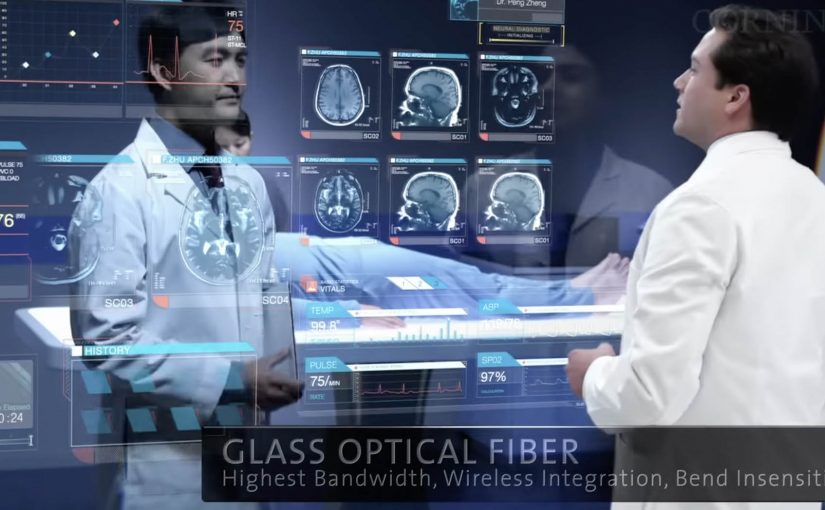
Corning is best known as a high-tech glass manufacturer. Their Gorilla Glass is used across a huge number of smartphones. In March last year they released “A day made of glass”. A futuristic look at glass technology.

Now they are back with an expanded vision for the future of glass technologies. This video continues the story of how highly engineered glass, with companion technologies, will help shape our world.

What’s new in the expanded vision

The core mechanic stays the same. Glass is no longer a cover. It becomes the interface. The expansion is about reach and density. More environments. More surfaces. More moments where information appears “in place” and responds directly to touch.

In consumer electronics, automotive interiors, and collaborative workplaces, the real shift is treating surfaces as shared touch-first interfaces rather than single-purpose screens.

The interaction pattern underneath the glass

Strip away the material science and you can see a product blueprint. Persistent identity across contexts. Content that follows the user. Direct manipulation as the default. And big surfaces that invite more than one person to participate at the same time.

In global enterprise and consumer-tech product teams, smart-surface visions only pay off when the interaction rules stay coherent across devices and contexts.

Why this vision sticks

It sells immediacy. You touch the thing you mean. You get feedback where your eyes already are. There is less “device ceremony”, meaning fewer unlocks, app switches, and mode changes, and more task flow. Because the interaction is direct and feedback stays in place, the experience feels faster and more trustworthy, which is why these concept films can persuade even before the enabling tech is fully mainstream. These concept films are worth using, but only if you translate them into interaction rules you can actually prototype. The real question is whether you can keep those rules coherent across surfaces once the demo glow fades.

Extractable takeaway: When you are designing a future-facing experience, define the interaction grammar first, meaning the repeatable set of gestures, feedback cues, and handoffs that make the experience feel consistent. If the same gestures, feedback, and handoffs work across two form factors, your concept has legs. If they don’t, the material is just a costume.

Steals from the smart-surface UX model

  • Prototype the handoffs early. Moving from phone to wall to table is where visions usually collapse. Test that seam before you polish anything else.
  • Design for two people, not one. Large surfaces create collaboration by default. Add rules for turn-taking, ownership, and conflict resolution.
  • Keep data anchored to the decision. The strongest moments are when information shows up exactly where action happens, not in a separate dashboard.
  • Make “glanceable” a first-class mode. If the surface is always there, the experience must work in 2-second looks, not only long sessions.

A few fast answers before you act

What is “A Day Made of Glass 2” actually demonstrating?

It demonstrates an interface direction. Glass surfaces behave like interactive displays, so information can appear in place and be manipulated directly by touch.

Is the value here the glass technology or the UX model?

The transferable value is the UX model. Direct manipulation, seamless handoffs, and multi-user surfaces. The materials enable it, but the interaction design makes it believable.

What is the biggest risk in “smart surfaces everywhere” thinking?

Interface overload. If every surface can talk, the environment becomes noisy. The discipline is deciding when to stay quiet and when to surface the one next action.

How do you scope a first prototype so it stays realistic?

Pick one job-to-be-done, two surfaces, and a single handoff. Then enforce a small set of interaction rules so you can observe friction before you add polish.

What is one practical next step after watching the video?

Write down the 6 to 10 interaction rules you believe the film is using. Then build a rough prototype that applies those rules in two contexts, such as phone plus kiosk, or tablet plus meeting room display.