Hyundai Elantra: Driveway Decision Maker

When choice made the Elantra harder to buy

In North American automotive marketing in 2012, the hardest moments are often the ones created by success: when a winner expands and the buyer suddenly has more to compare.

The Hyundai Elantra was named 2012 North America Car of the Year. Momentum was strong.

Then Hyundai introduced two additional variants. The Elantra Coupe and the Elantra GT. Suddenly, a clear win turned into a harder purchase decision.

More choice created more hesitation. Hyundai needed to simplify the decision again, without reducing the range.

Turning your driveway into the showroom

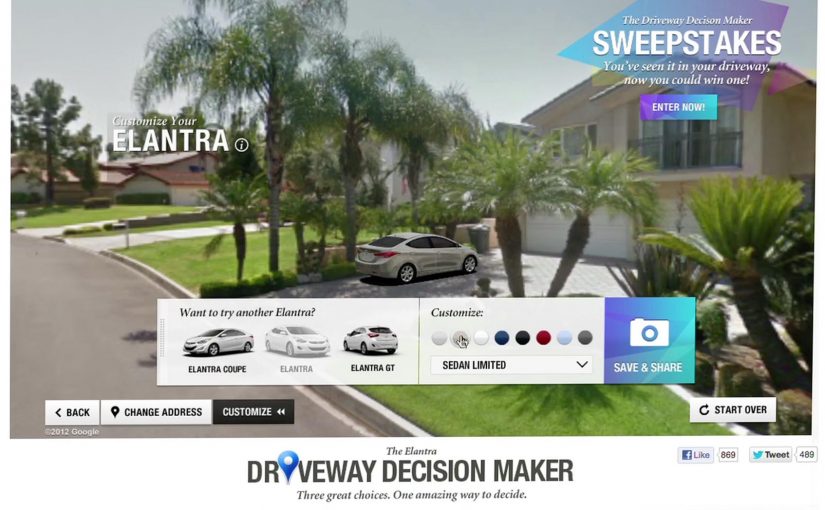
Instead of pushing another brochure or comparison chart, Hyundai built the Driveway Decision Maker, a tool that let prospective buyers preview what an Elantra would look like parked outside their own home.

By combining Google Street View, projection mapping, and real-time 3D animation, prospective buyers could see exactly what an Elantra would look like parked in their own driveway.

The experience replaced imagination with visualization. No guessing scale. No abstract renders. Just your house, your street, and the car.

In high-consideration categories where products physically live at home, a realistic preview in the buyer’s own environment reduces comparison fatigue.

Why seeing it at home removed friction

Car buying is emotional, but doubt creeps in when people cannot picture ownership.

Extractable takeaway: If your buyer must imagine ownership to decide, put a realistic preview into their own environment so the choice feels concrete.

The Driveway Decision Maker collapsed distance between consideration and ownership. By anchoring the car to a familiar, personal environment, Hyundai removed uncertainty about fit, size, and presence.

The experience also shifted control to the viewer. Instead of being told what to like, buyers explored the car in their own context.

The business goal behind the experience

The intent was not novelty. The real question is how you help someone choose when a clear winner becomes a lineup.

Hyundai wanted to reduce decision paralysis created by a broader lineup and move people confidently from interest to purchase. By helping buyers visualize the outcome, the brand shortened the path to commitment.

This was about restoring clarity, not adding noise. Interactivity is only worth it when it makes a decision easier.

What brands can steal from Driveway Decision Maker

  • Bring the product into the customer’s world. Context beats abstraction.
  • Replace imagination with visualization. Show the outcome, not the promise.
  • Use technology to remove doubt. Innovation works best when it answers a real buying question.
  • Support choice instead of limiting it. Help people decide rather than forcing simplification.

Hyundai invited consumers to try the experience themselves on the PickMyElantra site.


A few fast answers before you act

What problem was Hyundai solving?

Too much choice created hesitation. Buyers struggled to decide between Elantra variants.

How did the Driveway Decision Maker work?

It combined Google Street View, projection mapping, and real-time 3D animation to place the car into a buyer’s actual driveway.

Why was this more effective than a configurator?

Because it grounded the decision in a personal, familiar environment instead of abstract specifications.

What business outcome did Hyundai target?

Reducing purchase friction and restoring confidence across an expanded model lineup.

What is the transferable lesson?

If your product requires imagination to buy, use technology to make the outcome visible.

Volkswagen Amarok Live Test Drive

October seems to be a month of innovative test drive campaigns. In this campaign, ad agency AlmapBBDO Brazil has created a neat interactive meets experiential campaign.

The idea was to create a virtual test drive for Volkswagen’s new Amarok that people could experience live from their home or office. Here, “virtual test drive” does not mean a screen-only simulation. It means remote input controlling a real vehicle on a real outdoor track. So a huge outdoor test track was setup, along with an automated car that takes your virtual test drive directions over the phone while you watch it live on your computer.

The campaign had 327 live test drives, 500,000+ unique site visitors and generated 7,392 online purchase intentions during the campaign period.

Why this “virtual test drive” feels real

The smart move is that the interaction is not simulated on a screen. The driving happens in the real world, on a physical track, with a real vehicle. Your input is remote, but the outcome is tangible and visible live. That makes the experience feel more like participation than advertising because your input creates an immediate, visible consequence in the real world.

Extractable takeaway: When remote input produces a live, physical outcome, the experience feels credible because people are judging a real product response, not a simulated promise.

In automotive marketing, the hard part is making remote interest feel credible enough to trigger real purchase consideration.

What makes it a strong test drive pattern

This is a stronger test-drive idea than most digital demos because it turns product proof into a live behavior, not a rendered claim. The real question is whether a remote experience can create enough confidence to move someone from curiosity to purchase intent. The business value is that the same interaction generates attention, product understanding, and a measurable hand-raise in one flow.

  • Real-time control. Phone directions turn passive viewing into active steering.
  • Live proof. Watching the vehicle respond on a real track builds trust fast.
  • Measurable intent. “Online purchase intentions” connects the spectacle to business outcomes.

What to steal for remote test drive campaigns

  1. Make the proof physical, not simulated. A real car on a real track instantly raises trust versus a screen-only demo.
  2. Design one clear control loop. Simple input (phone directions) and immediate live response keeps the experience intuitive.
  3. Turn “watching” into “doing”. Viewer control is the difference between a stunt film and a product experience.
  4. Capture intent at the peak moment. If the experience feels like a true test, the follow-up CTA can be direct without feeling salesy.

A few fast answers before you act

What is the Volkswagen Amarok Live Test Drive?

A virtual test drive experience where people remotely guided an automated Amarok on a real outdoor track via phone instructions while watching live online.

Who created the campaign?

AlmapBBDO Brazil.

What made it different from a normal online test drive?

Instead of a digital simulation, a real vehicle drove a real track live, responding to the user’s directions.

What results were reported?

327 live test drives, 500,000+ unique site visitors, and 7,392 online purchase intentions during the campaign period.

What’s the transferable lesson?

If you can combine remote control with live, physical proof, you can turn “watching” into “doing” and generate measurable intent.

Skoda Fabia RS: Augmented Reality Test Drive

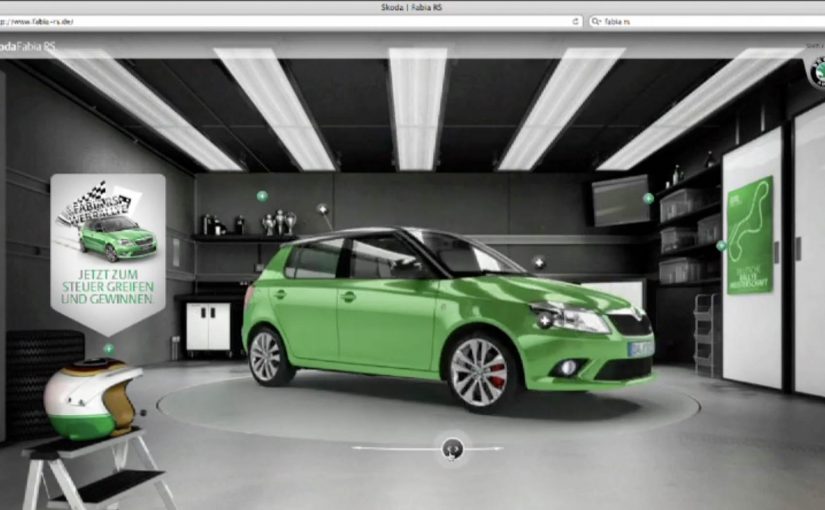
Skoda has just released a rally-based, augmented reality test drive for the Fabia RS. Here, “augmented reality test drive” means an AR overlay combined with a live webcam feed so you appear inside the cockpit view. The hook is simple and instantly personal: you become the driver, right down to a helmet view that pulls your face in via the webcam.

A rally fantasy built on a very real webcam

The execution borrows the language of motorsport. Helmet cam framing, tight cockpit perspective, and the feeling that you are inside the run rather than watching an ad.

Mechanically, the idea is an AR layer plus a live camera feed. The interface does not just show the car. It places you into the experience so the “test drive” feels like a game you are starring in.

In European automotive launch teams, webcam-first interactivity can differentiate faster than another spec-led asset.

In automotive launches where feature parity is high, interactive test drives create faster differentiation than another spec sheet or beauty film.

Why the helmet view is the smartest detail

Most virtual test drives keep the viewer outside the car. This one pulls the viewer into the cockpit, which changes the emotional contract. You are no longer evaluating. You are participating.

Extractable takeaway: Move the viewer from evaluator to participant, and the demo becomes something they remember and share without being asked.

That participation is what makes the concept naturally shareable, even without shouting for shares. People want to show the version where their own face is in the helmet view, because it is proof they “did the thing.”

What the brand is really reinforcing

The real question is whether the experience makes performance identity feel personal, not just visible.

On the surface, it is a playful rally twist. Underneath, it signals performance identity. The Fabia RS is framed as a car with motorsport DNA, not just a faster trim level.

The AR wrapper also makes an implicit promise: this is a modern car for people who like modern interfaces. The experience becomes a proxy for the product personality.

How to borrow the webcam POV trick

  • Make the viewer the protagonist, not just the audience. Webcam and POV tricks do more than cinematic polish.
  • Choose one unmistakable motif that communicates the category story fast, here it is rally and helmet cam.
  • Turn “try” into “play” so the time spent feels like entertainment, not evaluation.
  • Design a single talkable detail people can retell in one sentence, for example “it pulls your face into the helmet view.”

A few fast answers before you act

Is this more ad or more game?

It sits in the middle. The structure behaves like a lightweight game, while every element points back to a single product identity, rally performance.

What is the core mechanism that makes it work?

Personalization through webcam plus a strong point-of-view frame. The experience feels like it is happening to you, not in front of you.

Why does AR help here, instead of just a normal virtual drive?

AR adds “presence.” It creates the feeling of being inside the moment, which is harder to achieve with a standard video or configurator flow.

What is the biggest execution risk with webcam-based experiences?

Friction and permission. If setup is clunky or people feel uncertain about using the camera, completion drops fast. The first 10 seconds must feel safe and effortless.

What is the transferable lesson for other categories?

Put a real person into the proof. When the viewer’s face, voice, or choices become part of the demo, the demo becomes content people want to share.