
Renault Clio: A Test Drive Takes a Sexy Turn

Renault Clio: A Test Drive Takes a Sexy Turn

TNT’s “A dramatic surprise on an ice-cold day” meets Pepsi MAX’s “Jeff Gordon test drive prank” in this latest test drive video for the all new Renault Clio.

In the video a couple of guys are seen taking the Renault Clio for a spin. After a regular beginning, the salesman shows off the “va va voom” button, a prank trigger that flips the drive into a choreographed romantic scene.

This is a staged test-drive prank, not a feature demonstration. The “va va voom” button is the trigger that flips an everyday drive into a choreographed French fantasy.

And here is a version for the ladies.

The button as a narrative trigger

The mechanism is a single, irresistible cue. A salesman introduces a mysterious button. The driver presses it. The world outside the windows transforms into a set-piece built from instantly recognizable signals, so the passenger can “feel” the promise without a single spec sheet.

In automotive marketing, test drive formats often double as shareable entertainment that reaches far beyond the dealership.

The real question is whether the launch gives people a story worth retelling once the drive is over.

Why it lands

This works because it turns a low-drama ritual into an event with a clear before-and-after. The joke is simple enough to follow in seconds, and the escalation is visual enough to hold attention without context. Most importantly, it makes the test drive itself the content, not the car brochure. The stronger creative move is the trigger-led transformation, not the flirtation itself.

Extractable takeaway: If you can attach a single, obvious trigger to a dramatic “world change”, you turn a routine product interaction into a personal story. Personal stories are easier to retell, and harder to forget, than feature lists.

What to borrow without copying the exact gag

  • One trigger, one transformation: keep the entry point unmistakable and the payoff immediate.
  • Design for first-time viewers: someone should understand the premise even if they start watching mid-scene.
  • Let the participant stay authentic: the strongest moments are the unscripted reactions, not the actors.
  • Use stereotypes carefully: shorthand can make an idea legible fast, but it can also age poorly if the tone tips.
  • Make the edit do the persuasion: pace and escalation matter more than how many “surprises” you add.

A few fast answers before you act

What is the Renault Clio “va va voom” test drive video?

It is a staged test-drive prank where pressing a “va va voom” button triggers a choreographed romantic, Paris-themed scene around the car.

Why does this format work for car launches?

Because it makes the test drive itself feel like an event. That creates watchable reactions and gives people a reason to share the experience, not just talk about the vehicle.

What’s the key mechanic to reuse?

A single, easy-to-understand trigger that causes an immediate, visible change in the environment. The trigger creates curiosity. The transformation creates the story.

Is the “va va voom” button a real product feature?

No. In this context it functions as a storytelling device that kicks off the prank and reframes the test drive as a fantasy sequence.

What’s the main risk with this style of stunt?

Tone control. If the surprise feels awkward, intrusive, or relies on stereotypes in a way that offends, the conversation can flip from “fun” to “cringe” fast.
Hyundai i30: Light Drive Test Drive Game

Hyundai i30: Light Drive Test Drive Game

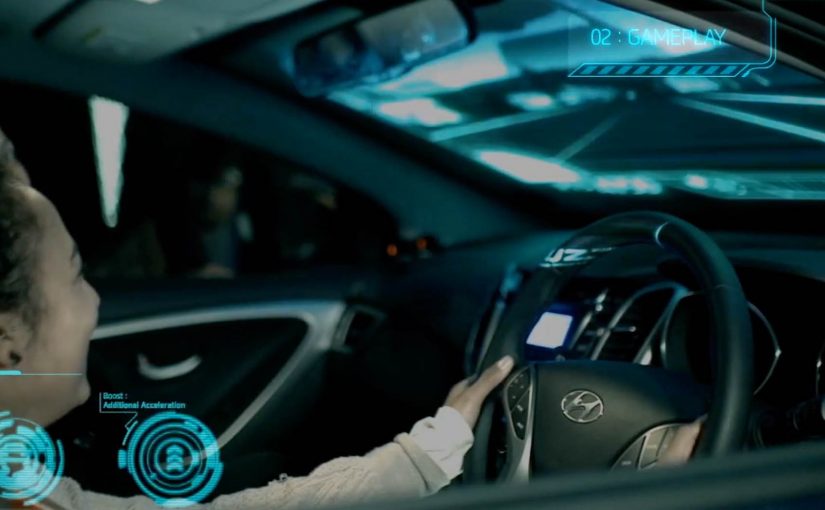
To launch the new generation i30 in South Africa, Hyundai reinvented the test drive with the Hyundai i30 Light Drive. It is a virtual racing game projected onto the i30’s front windscreen, played from inside the car.

Instead of waiting for people to visit a dealership, Hyundai took the experience to South Africa’s hottest nightspots in Johannesburg, Durban and Cape Town. Anyone, at any time, could step in, experience the car’s slick dynamic features, and compete for the top spot on the leader board.

A test drive that behaves like entertainment

The mechanism is smart because the “drive” is no longer a polite sales ritual. It is a game with stakes, progress, and a score. Two-man teams work together on the track to collect icons. Each icon represents an i30 specification, and collecting them powers up the car and boosts the team’s score.

That turns feature education into gameplay. Specs are not listed. They are earned. The i30’s story is embedded in the rules of the experience.

In experiential automotive launches, product education lands best when features are translated into gameplay mechanics that people can learn by doing.

The real question is whether your product education can be designed as a loop people want to repeat in public.

Why it lands in a nightlife setting

Nightspots are where people are already in a social, competitive mood. A leader board gives instant status. A queue becomes part of the atmosphere rather than a frustration, because everyone can watch and anticipate their turn. Hyundai amplified that social energy with HD cameras streaming the live test drive to a large screen outside the car. The crowd can watch the teams compete in real time, which makes the experience feel bigger than the physical footprint of the vehicle.

Extractable takeaway: In social environments, make learning visible. Use a score people can chase and a spectator view people can watch, so the product story spreads while the line forms.

Facebook Connect turns players into publishers

Hyundai linked the i30 Light Drive to Facebook Connect, turning participation into a shareable identity moment. Photos of the teams are posted instantly onto their timelines, extending the experience beyond the venue and turning “I played” into “I was seen playing”.

Even the waiting time is engineered. People queuing to play are educated and entertained with a touch screen brochure on the i30’s rear windscreen. It is product information, but delivered in an interactive format that matches the energy of the activation.

The intent: make the i30 feel modern before anyone compares price

The business intent is clear. Hyundai wants the i30 to feel like the next generation. Not just in features, but in attitude. By turning a test drive into an interactive spectacle, the brand signals innovation, tech confidence, and social relevance. The car becomes an event.

Moves to borrow from Hyundai i30 Light Drive

  • Move the experience to the audience. Take the product out of the showroom and into high-traffic social contexts.
  • Teach through interaction. Turn product features into game mechanics so learning is part of play.
  • Design for spectators. Live screens and streaming make the activation bigger than the footprint.
  • Make sharing native. Identity-based posting works best when it is built into the flow, not bolted on later.
  • Use the queue. If people are waiting, give them interactive content that reinforces the product story.

A few fast answers before you act

What is Hyundai i30 Light Drive?

It is an in-car virtual racing game projected onto the i30’s windscreen, designed to turn a test drive into an interactive competition.

How does it communicate the i30’s features?

Teams collect icons on the track that represent i30 specifications. Those icons act as power-ups, so the specs become part of the game’s reward loop.

Why target nightspots instead of dealerships?

Nightlife venues provide a ready-made social crowd. Competition and spectacle fit the context, and the experience spreads through observation and sharing.

What role does live streaming play in the activation?

HD cameras stream the gameplay to a large screen outside, turning players into performers and the crowd into an audience, which increases participation and energy.

What is the key takeaway for experiential launches?

Design an experience that people want to play and watch. When product education is embedded inside a compelling interaction loop, attention follows naturally.

The Nissan Virtual Showroom

The Nissan Virtual Showroom

There was a time when people would go to the dealership to research cars. But now most research (70%) is done online, with 50% of buyers stating that online information was the most influential part of their research.

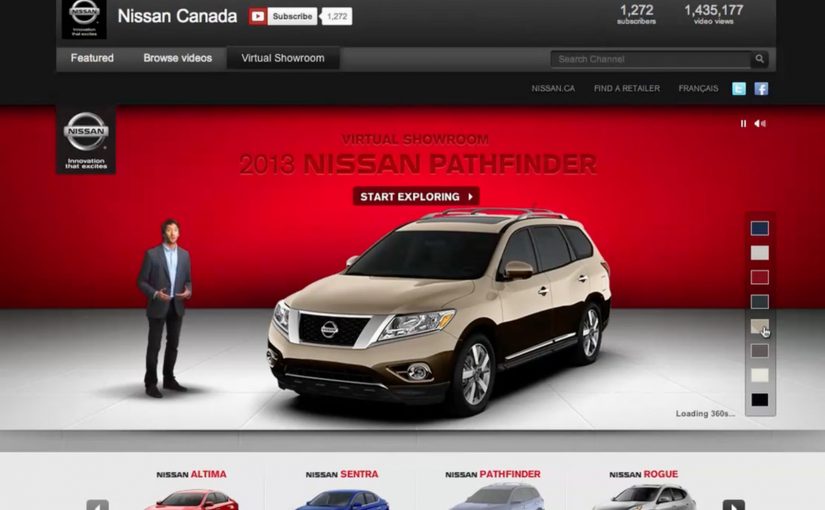
So Nissan decided to bring their dealership to the online audience through a custom YouTube Channel experience.

And for people on the go using smartphones for research, they also created a first of its kind custom mobile YouTube Channel, where they replicated the desktop experience for smaller screens.

As a result Nissan is said to have received an extremely positive response, along with a significant increase in people looking for their dealership after researching.

When a channel becomes product UI

What makes this interesting is not that Nissan published more videos. It is that the channel itself is treated like product UI. Here, “product UI” means the navigation and information scent that helps shoppers self-direct to the next best video step. Instead of forcing viewers to hunt through a generic grid, the experience is designed to guide shopper intent from model discovery to feature deep-dives, then onward to the next step in the buying journey.

A “virtual showroom” in this sense is a structured video experience that lets a buyer explore models, features, and trims in a self-directed way, without sales pressure, and without leaving the environment where they are already doing research.

In automotive marketing, the research screen becomes the showroom. So the channel needs to behave like a product experience, not a playlist.

In platform-led categories, the “research screen becomes the showroom” dynamic shows up anywhere buyers start their learning inside someone else’s interface.

The real question is whether you are designing the research journey, or just uploading assets into a grid.

Why it lands with real car-shopping behavior

The psychology is simple. When someone is researching a car, they want control. They want to compare, replay, and go deep only on the features they care about. A channel-built showroom supports that viewer control, and it keeps momentum high because the buyer never has to “leave to learn” and then try to find their way back.

Extractable takeaway: If your customer’s moment of curiosity happens on mobile, mirror the same structured pathways on the small screen so intent is not lost to a new search.

Business intent: turn video curiosity into dealer intent

Nissan is said to have received an extremely positive response, along with a significant increase in people looking for their dealership after researching. Brands should treat high-intent platform surfaces like product UI when the buyer journey starts there. The strategic bet is clear. If you can keep the research experience coherent and confidence-building, you increase the odds that the next action is dealership search, a test drive, or a shortlist decision, rather than another brand’s video.

Stealable patterns for your next “research-first” launch

  • Design the navigation, not just the content. The way viewers move matters as much as the videos themselves.
  • Map content to buyer questions. Make it easy to jump from overview to the exact feature proof someone is hunting for.
  • Keep parity across devices. If your audience researches on mobile, do not treat mobile as a scaled-down afterthought.
  • Build a clean handoff to the next step. The experience should naturally lead into dealer discovery, test drive intent, or model comparison.

A few fast answers before you act

What is a “virtual showroom” on a brand channel?

A virtual showroom is a structured video experience that helps shoppers explore products like they would in-store, with clear pathways from model overview to feature details, without relying on a salesperson or a separate site.

Why build the showroom inside a video platform experience?

Because that is where research attention already lives. Keeping the experience native reduces friction, preserves intent, and lets buyers move from curiosity to confidence without context-switching.

What makes a mobile virtual showroom different from “mobile video”?

It is not just playback on a phone. It is an interface designed for mobile decision-making, where browsing, comparing, and drilling into details still feels coherent on a smaller screen.

How does this drive dealership outcomes without being pushy?

By making the buyer feel informed and in control. When research is easy and confidence increases, dealer search and test drive intent tend to follow naturally as the next step.

What content do you need for this to work?

You need a library that covers the full set of buyer questions. Walk-throughs, feature explainers, comparisons, and proof points that can be consumed in any order depending on what the shopper cares about.

How do you measure whether it worked?

Track signals that reflect progression in the funnel, such as deeper feature engagement, repeat visits, branded search lift, and increases in dealer-locator usage or dealership queries following content exposure.