
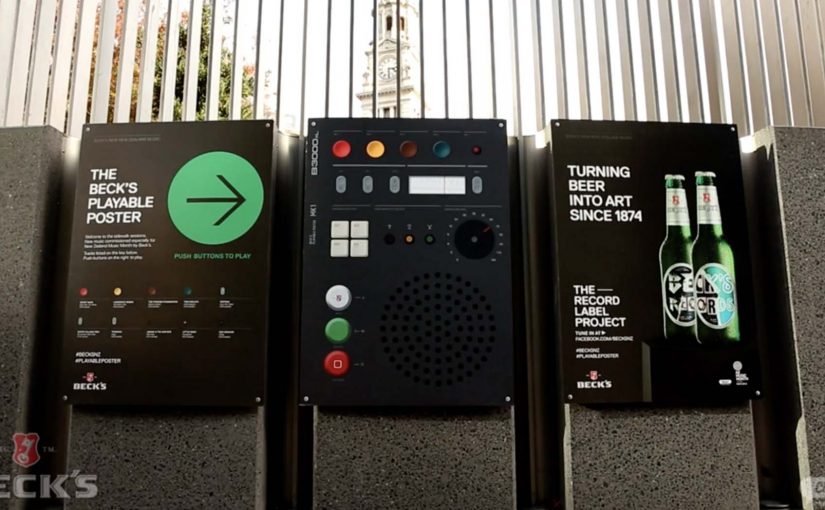
Playable Music Posters: Tap to Hear

Playable Music Posters: Tap to Hear

Borders between media are blurring. Books are being swiped, magazines digitally scrolled and even in print one can today occasionally navigate. So it is no surprise when regular paper posters come to life on being combined with bluetooth, conductive ink, sensors and speakers.

Paper as an interface, not a surface

The mechanism is straightforward. Conductive ink turns parts of a poster into touch-sensitive zones. Sensors detect taps, knocks, or touch patterns. Bluetooth and small speakers, or a paired phone, provide the audio output. The poster stops being an image and starts behaving like a controller.

In public retail and event environments, touch-based posters only work when people feel safe and permitted to interact.

In consumer marketing and live environments, interactive print means print that senses touch and triggers a digital response. It is a way to turn passive out-of-home into a touchpoint that behaves like a device.

Beck’s Playable Poster

Looking for an innovative way to mark New Zealand’s Music Month, Beck’s partnered with Shine to design a playable poster. Using conductive ink and speakers the posters were made playable with a simple tap of the finger.

The Sound of Taste

Herb and spice brand Schwartz is all about flavour. So to dramatise flavour which was invisible and silent, they got print tech collective Novalia and ad agency Grey London to collaborate on an interactive poster. The poster used conductive ink to turn the surface area of the paper into an interactive interface that also connected to the viewers smartphone to deliver a richer experience.

Change the tune

Agency Republic from UK created a poster with an embedded sensor which when knocked changed the song being played on the agencies shared sound system.

Why these work: the demo happens in your hands

Each example keeps the interaction legible. Tap to trigger sound. Touch to explore flavour as audio. Knock to skip a track. The poster does not ask people to learn a new behavior. It hijacks an existing one, touching a surface, and rewards it instantly.

Extractable takeaway: When you want print to feel alive, make one obvious gesture trigger one immediate reward, and let the brand message ride on that moment of viewer control.

The real question is whether the interaction earns enough memorability to justify the added production. If the payoff is not instant and on-message, do not build it. Because the audience causes the outcome with a simple touch, the message sticks.

Practical patterns for interactive print

  • One interaction, one reward. Do not overload the surface with too many modes.
  • Make the “how” obvious. A tap zone, a knock cue, a simple instruction. Then deliver instantly.
  • Use phones as infrastructure. If pairing adds depth, let the phone do what paper cannot, audio, saving, sharing.
  • Design for public confidence. People will only touch a poster if it feels safe, clean, and socially acceptable.

A few fast answers before you act

What is “conductive ink” doing in these posters?

It creates touch-sensitive paths on paper, so taps or touches can be detected and mapped to actions like playing audio.

Do these posters need special printing like QR codes?

They still require specialist production, but the interaction can be integrated invisibly into the design. The poster itself becomes the control surface rather than carrying visible codes.

Why add Bluetooth to print?

Bluetooth allows paper to trigger sound through a phone or external speaker, which is essential when the content is audio or when you want richer layers than print can carry.

What makes an interactive poster feel “worth it” to a passer-by?

Immediate payoff and low friction. If the result is instant and satisfying, people will try it. If setup or pairing is slow, they walk past.

Where does this format fit best?

In environments where people have dwell time and curiosity, festivals, transit hubs, retail windows, office interiors, and brand experiences where interaction is socially normal.
Jung von Matt/Alster: The Trojan Font

Jung von Matt/Alster: The Trojan Font

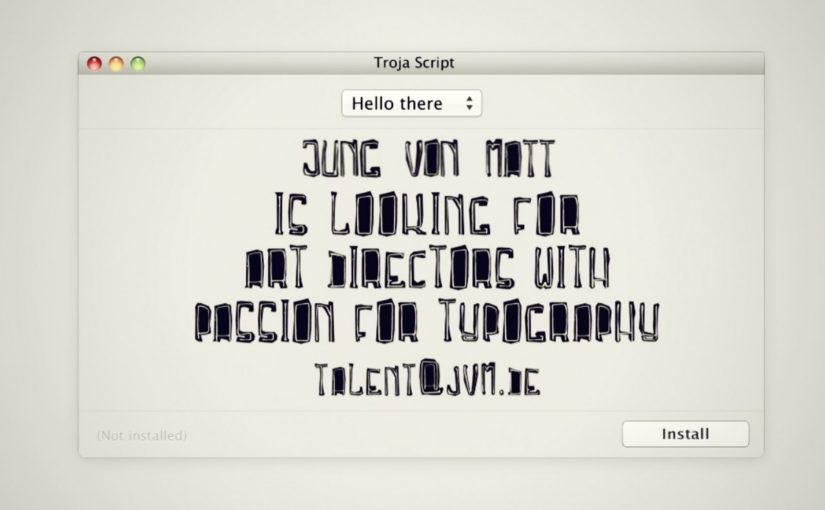
To reach designers with a passion for typography, Jung von Matt/Alster created a font of their own. Dubbed “Troja Script,” the typeface hides a recruitment ad where you’d normally expect the standard font preview.

Uploaded to free font websites, the font turned the download flow into a hiring funnel. Instead of “Aa Bb Cc,” the preview text itself carried the job pitch, so the first interaction with the product was the message.

Why the font format is the perfect carrier

Fonts are one of the few “free resources” designers actively seek out and evaluate with intent. That evaluation moment is intimate. You’re zooming in, testing, imagining usage. Replacing the preview with a recruitment message means the ad arrives when attention is already high and the audience is self-selected.

In creative industry hiring, embedding the application hook directly into a designer’s natural workflow can outperform broad employer-brand messaging.

Why this lands

This works because the medium is the filter. If you’re downloading free fonts, you’re likely the exact kind of person the agency wants to talk to. The message also feels earned rather than intrusive, because it appears inside a utility the user chose to access.

Extractable takeaway: If you’re recruiting for a specialist craft, place the pitch inside a tool or asset that specialists already pull into their process, so the channel itself does the targeting.

The business intent underneath

The stronger move is not to promote the vacancy more loudly, but to place it inside a behaviour that already signals fit.

The real question is how to turn a specialist asset into a self-qualifying hiring channel.

The campaign turns three steps into one. Discovery, qualification, and application. The reported outcome is a high ratio of signal to noise, because downloads come from the right community, and applications come from people who actually noticed and understood the move.

What this teaches about workflow-native recruiting

  • Make the artefact do the targeting. Put your message inside something only the right audience will seek out.
  • Embed the pitch in the default interaction. Use the “preview” moment, not an extra landing page.
  • Keep the twist legible. If the audience needs explanation, the hack loses momentum.
  • Measure the whole funnel. Track not just reach, but qualified actions (downloads) and outcomes (applications).

A few fast answers before you act

What is the “Trojan Font” idea?

It’s a font distributed through free font sites where the preview text is replaced with a recruitment message, turning a download into a hiring touchpoint.

Why target designers through free font websites?

Because that’s where typography-minded designers actively browse and evaluate resources, so attention and relevance are naturally high.

What makes this more effective than a normal job ad?

The audience is self-selected, and the message arrives inside a workflow moment, so it feels like discovery rather than interruption.

What result did the campaign report?

It was reported to generate around 14,000 downloads and 23 job applications for the open role.

How can other companies adapt the pattern?

Create a useful specialist asset, distribute it where specialists already look, and embed the hiring hook in the default usage or evaluation step.

O2: Be More Dog

O2: Be More Dog

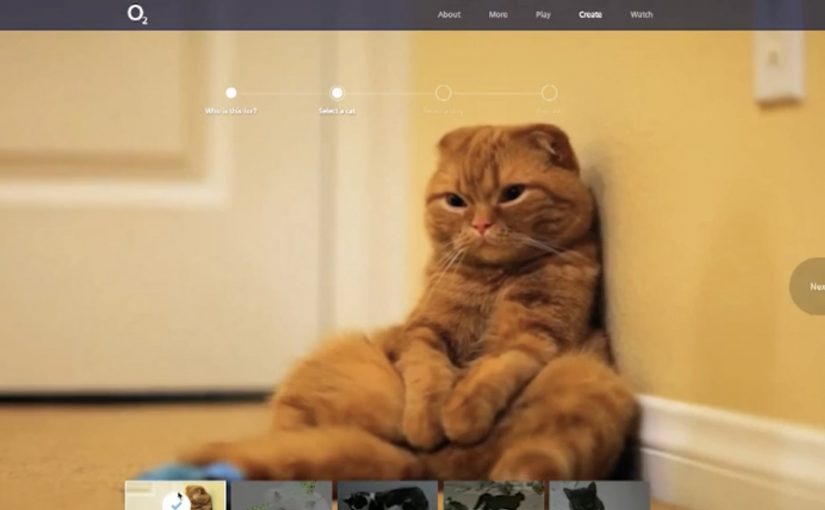
A cat decides it has had enough of being indifferent. It chases, leaps, splashes, and generally behaves like a dog. O2 UK uses that simple flip to ask people to do the same with technology. Less “meh”. More curious.

With VCCP and the Moving Picture Company, the campaign extends beyond the TV spot into a participation layer. That participation layer means the idea does not stop at the film but gives people something to do and share. On visiting www.bemoredog.com, people are greeted by a cat that acts more like a dog, then pulled into interactive play through a dual-screen HTML5 Frisbee game and a set of customisable cat videos designed for sharing.

How the integration is designed

The mechanism is a clean handoff. TV creates the character and the phrase. Mobile turns into the controller for a dual-screen game. Social carries the customisable video layer so people can pull friends into the same joke and the same attitude shift.

In UK consumer telecoms, where functional claims blur quickly, a memorable behavioural metaphor can do more positioning work than another round of feature talk.

Why it lands

It works because it uses a familiar truth. The cat-to-dog flip works because it turns an abstract behaviour change into a visual joke people understand in seconds. Cats look cool and detached. Dogs look curious and all-in. That contrast is instantly readable, and it translates directly into what O2 wants from people. Try the new thing. Explore. Stop acting like technology is background noise.

Extractable takeaway: If you want people to reframe a category, give them a single, sticky metaphor and one simple interaction that lets them experience the new attitude, not just hear about it.

What O2 is really trying to shift

This is brand positioning dressed as entertainment. The real question is how to make curiosity about new technology feel socially easy and emotionally attractive, not technically demanding. O2 is steering perception toward optimism and exploration, and using connected play to make “embracing the new” feel easy, not technical. In context, the timing also supports a broader push into newer network experiences, including 4G-era behaviour change.

What brand teams can steal from Be More Dog

  • Use one character as the bridge. The cat carries TV, site, game and shareables without needing extra explanation.
  • Make mobile do a job. Second-screen control is more convincing than a generic “download our app” prompt.
  • Build sharing into the format. Customisable videos give people a reason to tag or send, not just watch.
  • Keep the interaction lightweight. Quick play beats complicated onboarding when the goal is broad participation.

A few fast answers before you act

What is “Be More Dog”?

It is an O2 UK brand campaign that uses a cat acting like a dog as a metaphor for being more curious and enthusiastic about new technology, supported by second-screen and shareable digital experiences.

What is the core digital mechanic?

A dual-screen HTML5 Frisbee game that uses a phone as the controller, plus customisable cat videos designed for social sharing.

Why does the cat versus dog metaphor work so well?

It compresses a complex ask into a simple behavioural contrast people instantly understand, then turns that contrast into a repeatable line and a repeatable action.

What makes this an integrated campaign rather than “TV plus a website”?

The channels do different jobs that depend on each other. TV creates meaning. Mobile enables interaction. Social distributes personalised variants that pull others back into the idea.

What is the biggest way this pattern fails?

If the digital layer feels bolted on. The interaction has to express the same promise as the film, otherwise it becomes a novelty that does not move perception.