
Burger King: The Whopper Lust Challenge

Burger King: The Whopper Lust Challenge

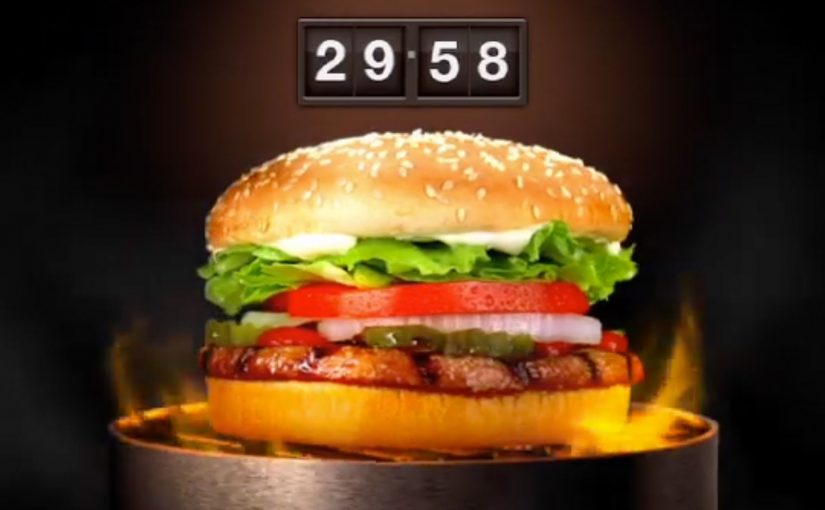
Stare at a picture of a Whopper long enough and you win one. That’s the premise of an interactive TV campaign from Burger King. What looks like a never-ending ad is actually a dedicated TV channel on DirecTV channel 111, built around a spinning flame-grilled burger and a timer.

To win, you tune in and activate the Whopper Lust challenge. A five-minute countdown starts, and you have to keep watching the rotating Whopper for the full duration. Make it to five minutes and you earn one free burger. Keep going for another ten and you earn two. Keep going and the rewards scale. The longer you last, the more you unlock.

The catch is that the channel occasionally prompts you to hit buttons on your remote. Miss one and the clock resets, so you lose the reward you were building toward. Complete the challenge and you can claim the free burger directly on the TV.

How the mechanic turns attention into currency

This is “watch time” treated like a loyalty program. Here, “watch time” means the viewer’s sustained, verified attention, not just a channel left on in the background. The spinning Whopper is deliberately hypnotic, the timer makes the commitment explicit, and the remote prompts prevent passive cheating. It is simple, but it forces real engagement rather than background viewing.

That works because the timer defines the commitment, the remote prompts verify attention, and the visible progress makes the reward feel earned rather than handed out.

In US quick-service marketing, converting a passive channel into a participation loop can buy disproportionate attention without buying proportional media.

Why this lands

It works because it is a dare, not a discount. The reward feels earned, and the friction is oddly satisfying because it creates tension. Will you slip and reset. The interaction also turns a solitary act. Watching TV. Into a game you can talk about immediately.

Extractable takeaway: If you want people to stay with a message, make the “cost” a clear, timed commitment and add periodic interaction checks, so attention becomes an active choice rather than a passive exposure.

What Burger King is really optimizing

This is not just a giveaway. It is a retention play. The real question is how to turn passive media time into a branded challenge people willingly stay with. The channel trains repeat viewing, creates a habit loop, and attaches the brand to a measurable “I lasted” story. Reported campaign figures describe large volumes of burgers given away and large volumes of watch minutes generated over the week.

What to steal from attention-for-reward mechanics

  • Make the rule instantly legible. “Watch X minutes. Win Y.” is frictionless to understand.
  • Prevent passive participation. Add simple interaction prompts to keep it honest.
  • Let rewards compound. Escalation keeps people in the loop longer than a single prize.
  • Turn viewing into a game. A timer and resets create stakes without complex tech.

A few fast answers before you act

What is the Whopper Lust Challenge?

It’s an interactive TV activation where viewers watch a dedicated Burger King channel and earn free Whoppers based on how long they stay engaged.

How do you win a free Whopper?

You activate the challenge, watch the spinning Whopper for five minutes, and respond correctly to occasional remote-control prompts so the timer does not reset.

Why add remote button prompts?

To ensure people are actually watching and interacting, not leaving the channel on in the background.

What makes this different from a normal TV ad?

The ad is the channel, and the viewer is part of the mechanic. Time and interaction directly determine the reward.

What’s the main risk with this format?

If the interaction prompts feel unfair, too frequent, or glitchy, frustration overwhelms the fun and people drop out.
Peugeot 408: Print ad with a real airbag

Peugeot 408: Print ad with a real airbag

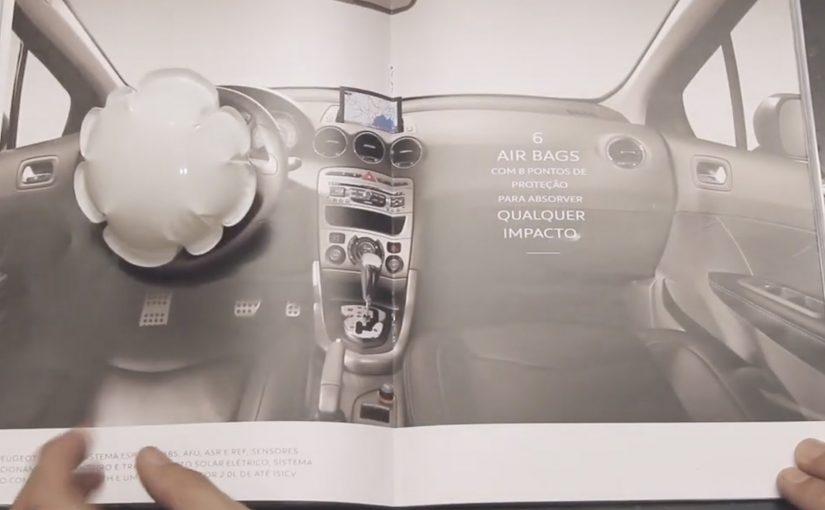
To advertise the safety benefits of the Peugeot 408, Brazilian agency Loducca put a mini airbag inside a print ad. Readers were invited to hit a marked spot on the page and see what happened. On impact, the tiny bag inflated, demonstrating in miniature what an airbag would do.

The ad appeared in Brazil’s business magazine Exame and was reportedly distributed with protective packaging so the airbag would not trigger by accident.

A magazine page you have to hit

The mechanism is brilliantly blunt. You do not watch a crash test. You perform a micro impact, a small, deliberate tap that simulates impact, with your hand, and the medium responds. That action turns a passive read into an experience, and it makes the “airbag” benefit impossible to ignore. Brands should treat safety claims as proof problems and design demonstrations the viewer can personally trigger.

In automotive safety marketing, the highest-performing proof is the kind you can physically trigger yourself.

The real question is whether your proof of safety can be triggered by the audience, not merely asserted by the brand.

Why print becomes more credible when it behaves like a product

Print normally communicates through trust in words and images. This ad adds a different kind of credibility, mechanical proof. Because it inflates on cue, the viewer’s brain files the message as something closer to engineering than persuasion. That matters because “safety” is a hard attribute to sell with rhetoric alone. People want reassurance, not adjectives.

Extractable takeaway: When a product claim is about protection, the strongest creative move is to make the audience feel a cause-and-effect demonstration, not just read about it.

The packaging is part of the idea

The special packaging is not just logistics. It signals intent. This is a controlled, designed interaction. It is also a reminder that experiential print has operational realities. Here, “experiential print” means print that behaves like a product interaction, with a designed trigger and response. If you build an ad that can go off in someone’s bag, you must engineer the distribution like you would engineer a product.

How to design triggerable safety proof

  • Make the claim triggerable. If the benefit is physical, design a physical proof moment.
  • Keep the interaction single-step. One obvious action, one immediate response, no instructions needed.
  • Let the medium do the explaining. The inflation is the headline. Copy becomes supporting detail.
  • Design the supply chain, not just the concept. Packaging, safety, and consistency are part of creative effectiveness.
  • Use spectacle sparingly. The wow moment is strongest when it directly maps to the product truth.

A few fast answers before you act

What is the Peugeot 408 “airbag in a print ad” idea?

A magazine ad with a real mini airbag insert that inflates when the reader hits a marked spot, mimicking an airbag deploying during impact.

Why does this work better than a normal safety print ad?

Because it converts a claim into a physical demonstration. The reader triggers the proof, which feels more credible than copy alone.

What makes interactive print feel premium instead of gimmicky?

When the interaction is directly tied to the product benefit and works reliably. The mechanism should be the message, not a disconnected trick.

What’s the biggest risk with mechanical inserts in magazines?

Execution risk. Misfires, non-fires, and distribution issues can overwhelm the idea. The production and packaging have to be engineered as carefully as the concept.

How can a brand replicate this approach on a smaller budget?

Design a tactile proof moment using simple materials and one clear action. The key is immediate cause-and-effect that maps cleanly to the claim.

Norte: The Best Excuse Ever

Norte: The Best Excuse Ever

A night out with the boys usually needs an excuse, at least as the joke goes. Norte, a beer brand associated with northern Argentina, decides to turn that familiar line into a socially useful premise.

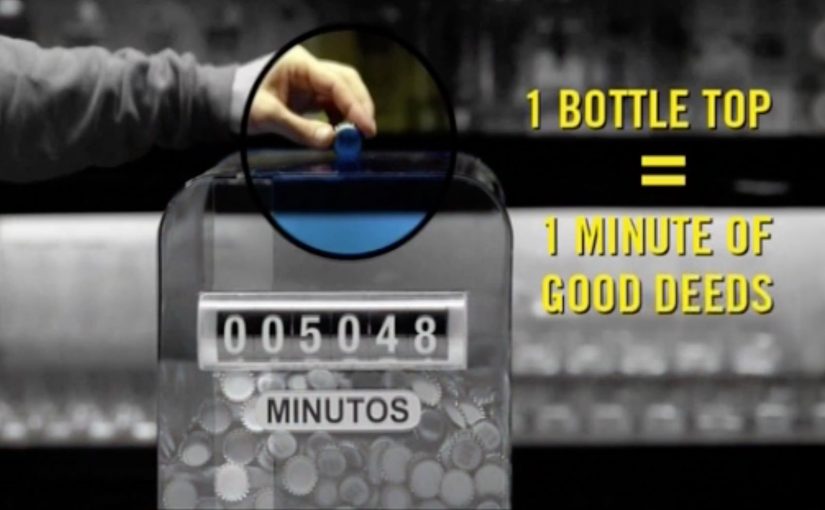
The idea is deliberately simple. For every Norte beer consumed at a bar, the brand donates one minute of time to practical community work, including fixing houses, maintaining parks, and repairing schools. Followers can monitor the donated minutes and the progress made through a dedicated website, which turns “we went for a beer” into a measurable counter of good deeds.

How the “minutes” mechanic works

The mechanic converts consumption into a visible unit of contribution. One beer equals one minute, then the brand performs the work and publishes progress so the audience can see the tally move. The counter is the proof, and the proof is the story people repeat.

In FMCG marketing, especially in categories tied to social rituals, converting a purchase into a transparent, trackable unit of public benefit can reframe indulgence as participation.

Why it lands

It removes the defensiveness from the behavior by giving it a credible upside. The campaign is not asking people to stop going out. It is redirecting the narrative from “pointless drinking” to “we contributed minutes.” The tracking layer matters because it reduces cynicism, since the audience can follow a concrete output rather than a vague promise.

Extractable takeaway: If your category has a guilt narrative, turn the core behavior into a quantifiable unit of visible impact, then publish progress often enough that people can use it as social proof.

What the brand is really trying to win

This is reputation as much as reach. Norte is positioning itself as the beer you can choose without needing to defend the choice later. The community work is the legitimacy, and the “best excuse” line is the social wrapper that helps the story travel.

The real question is whether a beer brand can turn a familiar excuse into a credible, repeatable proof of usefulness.

What to borrow from Norte’s minute logic

  • Make the unit understandable. A minute is easier to grasp than a donation percentage.
  • Design the proof before the film. A public counter and visible work outputs keep the idea credible.
  • Let the audience retell it in one sentence. “Every beer adds a minute” is built for word-of-mouth.
  • Guard the integrity. Transparency and follow-through matter more here than polish.

A few fast answers before you act

What is “The Best Excuse Ever” in one line?

A beer campaign where each Norte beer consumed converts into one minute of real community work, tracked publicly so people can see progress.

Why does the minute-based unit help?

It is concrete and easy to visualize. It also makes progress feel additive, so participation scales naturally with social occasions.

What makes this more credible than typical cause marketing?

The proof mechanism. A visible counter plus documented work outputs reduces the “donation fog” that often makes audiences skeptical.

What is the biggest risk with this approach?

If the brand cannot consistently deliver the promised work, the counter becomes a liability and the campaign reads as opportunism.

When does this model work best?

When consumption is already social and habitual, and the brand can operationally execute real-world outputs at the pace the campaign generates demand.