The Schweppes Facebook Profile App

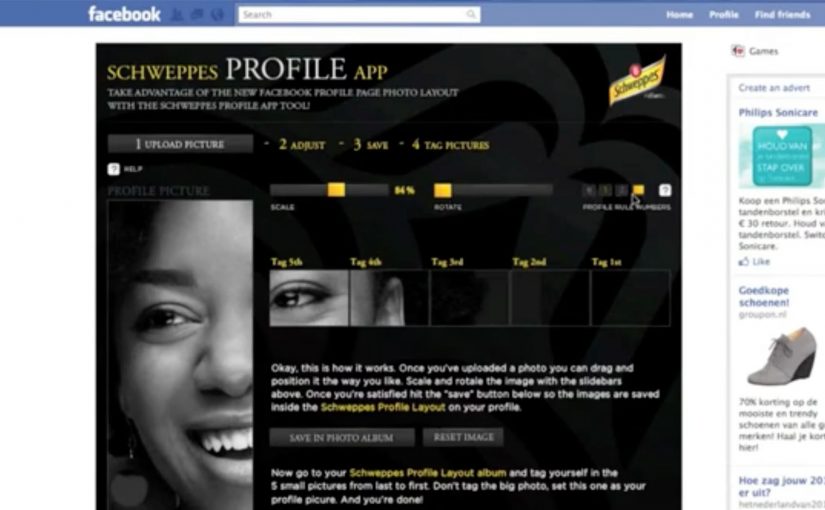
You want a standout Facebook profile, but you do not have Photoshop skills. Schweppes solves it with a Profile App that helps you build a polished new profile design in minutes, using simple templates instead of design tools.

What changed on Facebook that triggered this

Facebook rolled out improvements to the profile experience that made it easier to tell your story and learn about your friends. Creative people quickly started experimenting with the new profile design, turning profiles into personal canvases.

What did Schweppes build

That wave inspired Schweppes to develop the Schweppes Profile App on Facebook. It gave anyone who did not have Photoshop skills, and does not have much time, a way to create a great new profile.

On social platforms where the profile itself is part of how people present themselves publicly, the strongest brand utility is the one that makes visible self-expression easier.

The real question is whether the brand can make a rising social behaviour easier to join without making the experience feel like advertising.

Why this is a smart brand move

This is a smart brand move because it provides a service that becomes increasingly popular as the trend catches on. Templates matter here because they turn a design behaviour into something ordinary users can complete quickly, which is why Schweppes gets used inside the trend instead of interrupting it from the outside.

Extractable takeaway: When a platform change creates a new expression trend, the most effective branded response is often a simple utility that removes skill and time barriers so more people can participate.

What Schweppes is really buying

The business intent is not just profile creations. It is to link Schweppes to an emerging Facebook behaviour at the moment people are actively shaping how they appear to others, which gives the brand relevance through participation rather than message repetition.

What to steal if you build branded social tools

  • Ship a tool that helps people express themselves. Identity improvements get repeated use because the user cares about the output.
  • Ride an emerging behaviour with utility, not messaging. When a platform change sparks a trend, a simple enabler scales faster than a campaign claim.
  • Make quality accessible for non-experts. Templates turn “I need skills” into “I can do this in minutes”.
  • Measure what stays live, not just what gets tried. Adoption is about how many people keep the output active and visible to others over time.

A few fast answers before you act

What is the Schweppes Facebook Profile App?

It is a branded Facebook app that helps people create a customised profile look without needing Photoshop or design skills.

Why does this work as content people actually use?

Because the output is identity-based. People are motivated to improve how they present themselves, so a tool that makes it easy gets adoption.

What is the core pattern to copy?

Spot an emerging behaviour, then ship a simple tool that helps people do it better. The brand earns attention by enabling, not interrupting.

Why does accessibility matter more than creative polish here?

Because the idea scales only if ordinary people can complete it quickly. Templates beat complexity when the goal is broad participation, not elite design output.

What should you measure if you run something similar?

Creations completed, share and usage rate, how many people keep it live, referral loops from friends viewing profiles, and repeat usage over time.

WWF: The .wwf Unprintable PDF Format

German ad agency Jung von Matt is back with another stellar idea. A new green file format called .WWF.

The WWF format is a PDF-like document that is designed not to print. The point is simple: avoid unnecessary printing by making the “do I really need paper for this?” decision explicit at the moment you save or share a file.

How the .wwf idea works

At the center is a small tool that lets you “save as WWF”. The resulting file behaves like a regular PDF for reading and sharing, but the print option is blocked by design. In other words, it is a familiar format with one permission deliberately switched off.

WWF frames this as a practical nudge within its broader “think before you print” message. It is not trying to shame printing. It is trying to stop the default reflex of printing what never needed to exist on paper in the first place.

In document-heavy organizations, small defaults like a print-disabled file option reduce waste because they change the decision moment without changing the workflow.

Why this lands beyond the gimmick

It turns a values statement into a product behavior. Plenty of sustainability campaigns ask people to care. This one asks people to choose differently in a place they already spend time: saving, sharing, and circulating documents.

Extractable takeaway: When you want less waste, change the default at the moment of action, and keep an intentional override for the few cases that truly need it.

The real question is whether you can make “think before you print” feel like a normal workflow choice, not a policy fight.

It preserves user choice. The format does not decide what “should” be printed. It pushes the decision back to the sender, who knows the context. That framing matters, because it avoids the “policy tool” vibe and keeps it as a lightweight, voluntary habit.

It spreads by forwarding. A file format is distribution. When people send documents around, the format travels with the content and keeps reintroducing the idea in a natural, non-media-buy way.

Steal this pattern for document workflows

  • Change the default, not the lecture. If you want different behavior, move the intervention into the everyday step where the behavior happens.
  • Make the “good choice” feel like a normal choice. Keep the action one click away and compatible with existing habits.
  • Design for shareability. Tools and formats can be media when they travel inside the work people already exchange.
  • Define the mechanism in one sentence. “A .wwf file is essentially a PDF with printing permissions locked, saved under a different extension to force a conscious print decision.”

A few fast answers before you act

What is a .wwf file, in plain terms?

A .wwf file is a PDF-style document saved with a different extension and configured so that printing is blocked by default.

Is it truly impossible to print a .wwf document?

The intent is to block the normal print command, not to claim physical impossibility in every edge case. The point is to remove the easy, mindless print path.

How is this different from just using a “do not print” note?

A note is social friction. A format change is functional friction. The latter works even when people ignore instructions.

Where does this work best?

In teams that pass around drafts, read-only decks, internal updates, agendas, and reference documents. Anywhere printing is mostly habit, not requirement.

What is the real behavior change goal?

To make printing a deliberate act again. The win is fewer automatic prints, not zero printing.

Yellow Pages: Location Based Banner

Here is the next generation of interactive web banners. Tel Aviv agency Shalmor Avnon Amichay/Y&R promoted the Yellow Pages augmented reality location-based app by creating a banner that does the same thing. Here “location-based” means it surfaces nearby businesses based on where you are.

The banner opens your webcam and lets you see the businesses around you. Wave your hand to switch between businesses. Click a business to jump straight to its Yellow Pages listing.

A banner that behaves like the product

The clever part is that this is not “interactive” for decoration. It is a working demo of the core value proposition. If the app helps you find what is near you, the banner proves that promise immediately, inside the placement, without asking you to imagine anything. Utility products should be advertised by demonstrating usefulness, not by describing features.

The mechanic: webcam as context, hand wave as UI

The flow is intentionally simple. Turn on the camera. Overlay nearby business options. Use a wave to move through results. Use a click to convert curiosity into action via the listing page.

In local discovery experiences, the strongest persuasion is a live, context-matched preview of usefulness rather than a feature claim.

Why it lands: it removes the “so what” gap

Most directory and local-search advertising dies in the space between promise and proof. The real question is whether your ad can turn a promise into proof without leaving the page. This banner collapses that gap, because it starts with your own context, then shows results, then lets you act. The interaction is the explanation.

Extractable takeaway: The fastest way to make a utility app feel essential is to let people experience the “aha” moment before they ever leave the page they are on.

What Yellow Pages is really trying to achieve

The business intent is to reposition Yellow Pages as modern, digital, and situationally useful, not just a legacy directory brand. The banner also creates a clear performance path. Engagement inside the unit, then click-out to a listing that can drive calls, visits, or follow-on app consideration.

Steal the demo-first local discovery pattern

  • Mirror the product in the ad. If the product is a tool, make the ad behave like the tool.
  • Use one gesture people understand. A wave as “next” is instantly legible. No tutorial needed.
  • Keep the ladder of commitment short. Preview. Browse. Click through. No extra steps.
  • Make the experience readable for bystanders. Obvious motion plus clear on-screen change sells the mechanic in shared environments.
  • Watch privacy optics. If you turn on a camera, be explicit that it is for interaction and context, not identification.

A few fast answers before you act

What is a “location based banner”?

It is a banner ad that adapts its content to the user’s situation, typically location or environment cues, so the ad can show relevant nearby options instead of generic messaging.

How does this Yellow Pages banner work?

It opens a webcam view, overlays nearby business options, lets you wave to cycle through businesses, and lets you click a result to open the corresponding Yellow Pages listing.

Why use a webcam at all?

Because it makes the experience feel immediate and personal. The ad becomes a live “finder” interface rather than a static claim about finding things.

What makes gesture-controlled banners risky?

Friction and variability. If the gesture detection fails or is unclear, users assume the ad is broken. The interaction must be forgiving and the feedback must be instant.

What is the safest way to replicate the idea today?

Keep the mechanic to one simple input, provide clear on-screen feedback, and ensure the user can still get value even if they do not enable the camera.