
SAS: Up for Grabs on Facebook

SAS: Up for Grabs on Facebook

To promote a million-seat fare sale, Scandinavian Airlines (SAS) and Crispin Porter + Bogusky Stockholm ran a Facebook competition where fans could “grab” a free trip. The ask was visual and dead simple, and it turned participation into the media.

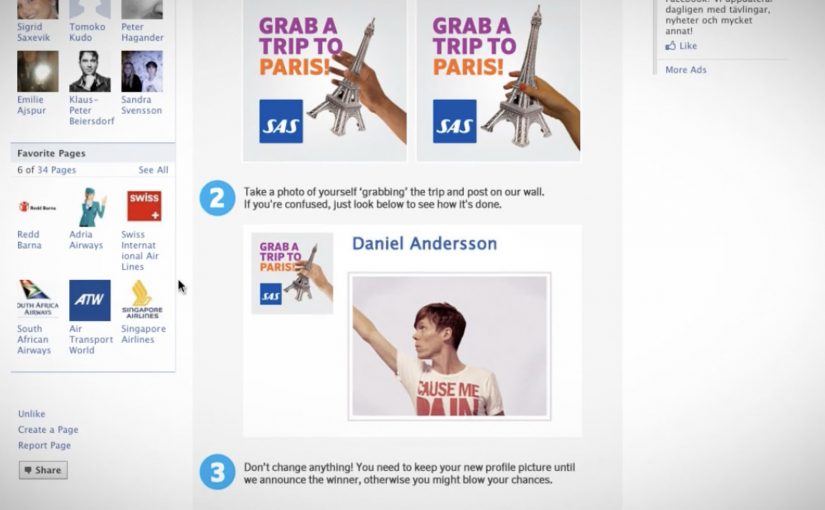
Fans changed their profile picture into a custom “Up For Grabs” image, then posted a matching photo on the SAS Facebook wall where they physically “grabbed” the trip. Every entry looked like an ad, and every ad looked like a friend.

The mechanic that turns fans into distribution

The campaign’s mechanism was a two-step loop. First, replace your profile image with a branded frame that signals you are “in”. Second, publish a playful photo on the brand wall that demonstrates the concept, grabbing the prize. That wall then becomes a live gallery of social proof, with each new post re-selling the fare sale in a more human way than a banner ever could.

In airline marketing, promotions that convert participation into shareable images can outperform price-only fare announcements.

Why it lands

It turns an abstract offer into a physical gesture. “Grab a trip” becomes something you can perform, photograph, and show. The profile-picture switch is a light commitment that broadcasts intent, and the wall post is a public performance that invites imitation. The momentum comes from visibility, because the more entries you see, the more “normal” it feels to join.

Extractable takeaway: When you need scale fast, design one participation artifact that doubles as an ad unit, and make the action easy enough that people will copy it without instructions.

What the shutdown reveals about the strategy

The campaign was reportedly against Facebook promotion terms, and it was shut down. That ending is part of the story, because it highlights the tightrope of social-first promotions. The creative is built on a behavior Facebook historically restricts for contest entry, asking people to publish specific content as a condition of participation, even if the idea is clever and the buzz is real.

The real question is whether the participation mechanic can spread the offer without depending on a platform behavior that can be switched off overnight.

The stronger strategic read is that the creative idea is right, but the distribution mechanic is too dependent on borrowed platform rules.

What to steal for your own launch

  • Make the entry format the message. If the entry itself demonstrates the offer, you get free repetition of the proposition.
  • Use a low-friction first step. Profile-picture frames and templates work because they are fast and socially legible.
  • Design a single visual trope. “Grabbing” is a trope anyone can reproduce, and that consistency creates a recognizable feed.
  • Build compliance in from day one. If the mechanic depends on prohibited platform behaviors, plan a compliant alternative before launch.

A few fast answers before you act

What is the core idea of Up for Grabs?

A Facebook contest where fans change their profile picture to a branded frame and post a “grabbing the trip” photo on the SAS wall to compete for a free flight.

Why does the profile-picture step matter?

It turns participation into persistent visibility. The frame signals “I am in”, and it spreads through everyday browsing without requiring an additional media buy.

What made the campaign travel beyond the SAS page?

Each entry was both participation and promotion. When fans changed their profile picture and posted a matching photo, the fare sale moved into personal networks instead of staying inside brand media.

Why was it shut down?

It was reportedly closed for violating Facebook promotion rules by conditioning entry on specific platform actions, such as posting photos on the wall.

How do you keep the upside without the platform risk?

Keep the visual template and the “grab” trope, but move the submission mechanic to a compliant entry flow, then allow optional sharing that is not required to participate.
100 000 Books: Books-Fresheners

100 000 Books: Books-Fresheners

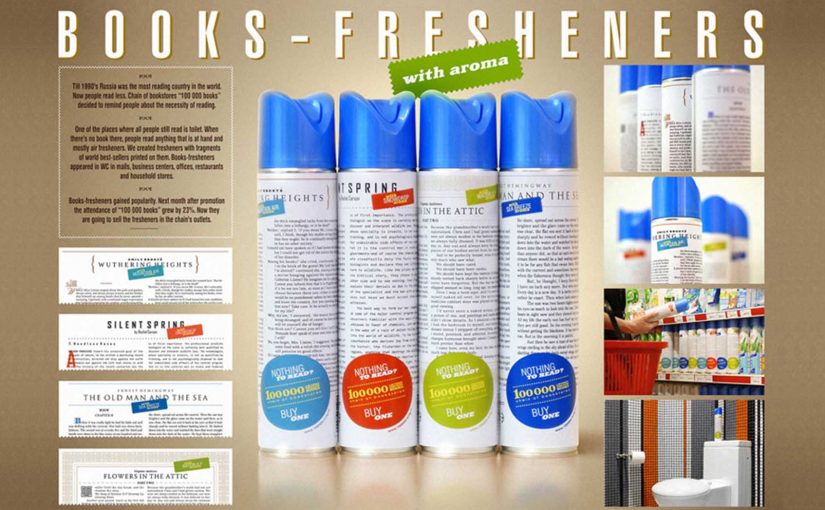
A chain of bookstores called “100 000 books” wanted to remind people to read more. The idea they shipped is blunt and situational. Put fragments of world best-sellers on the one “reading material” people often reach for in a toilet. Air fresheners.

These Books-Fresheners appeared in toilets across malls, business centers, offices, restaurants, and household stores. The campaign narrative says they gained popularity quickly, and the brand later chose to sell them in-store as well.

How Books-Fresheners turns a dead moment into reading

The mechanism is a point-of-need intervention. By that, the campaign places the reading trigger exactly where boredom already exists. Identify a context where people are bored and will read anything available. Replace the default object with something that carries real text, in a format that is impossible to ignore because it is already in your hand. That works because it removes the need to persuade people to start reading from scratch and attaches the prompt to a behavior that is already happening.

In mass retail environments, behavior-change prompts work best when they are embedded in an existing habit, not when they ask people to form a new one.

Why it lands

It is funny, but it is also practical. It acknowledges how people behave when they have a few idle minutes and nothing else to do. The creative choice, printing literature on a disposable object, creates contrast that makes the message stick, and it directs attention back to books without preaching.

Extractable takeaway: If you want to revive a declining habit, do not only market the habit. Place a small, high-quality sample inside a moment where the audience is already receptive, and let the sample create the itch for more.

What the bookstore is really buying

This is an offline distribution hack for a reading brand. The campaign story also reports a measurable store attendance lift after a month of placements.

The real question is whether a bookstore can turn an idle, forgettable minute into a prompt that restarts the act of reading.

The freshener format spreads through everyday locations, generates talk value, and creates a physical reminder that books exist.

What to borrow from Books-Fresheners

  • Start from a real micro-behavior. “People read whatever is nearby” is a better foundation than “people should read more”.
  • Use a familiar object as media. The medium already has permission in the environment, so the message gets read.
  • Sample the product, not the slogan. A book excerpt is a product sample, not a claim.
  • Design for portability. If people can take it, show it, or talk about it, it becomes distribution.

A few fast answers before you act

What are Books-Fresheners?

Air fresheners printed with fragments of well-known books, placed in public toilets to trigger reading in a moment when people are likely to read anything available.

Why choose toilets as the placement context?

Because it is one of the few everyday moments where people are idle, captive, and willing to read short text without needing a pitch.

What makes this more effective than a standard reading poster?

It puts the text in someone’s hands rather than on a wall. That physical contact increases the chance the excerpt is actually read.

How does this drive bookstore traffic?

The excerpt creates a “continue reading” impulse and links the act of reading back to a store that sells books, using repeated exposure across many locations.

Why use an excerpt instead of a slogan?

An excerpt samples the product itself. That is stronger than a reading message because it lets the audience experience the habit, not just hear about it.

Fey & Co: Lullaland

Fey & Co: Lullaland

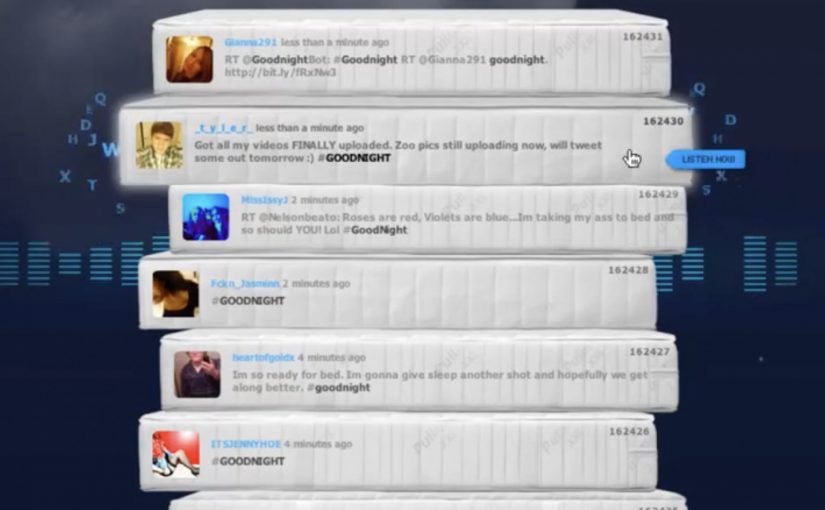
Around the world, people say good night on Twitter, often with #goodnight. Jung von Matt/Elbe collected those tweets for mattress manufacturer Fey & Co and turned them into a daily, shareable sleep ritual.

Every good night tweet automatically became part of the campaign. With a simple retweet, users were invited to www.lullaland.net, where short tweets were converted into melodic “lullatweets” for the world. Fey & Co positioned itself as an ambassador for good sleep inside the bedtime behavior of a digital generation.

How Lullaland turns tweets into lullabies

The mechanic is a tight translation loop. Capture tweets containing the hashtag. Convert the letters into tones to generate a simple melody. Store and present the results as a browsable collection, so each new tweet becomes both content and invitation. That works because the system turns an existing bedtime signal into branded content without adding effort.

In consumer categories built on comfort and routine, attaching the brand to an existing nightly habit is a durable way to earn repetition without forcing a new behavior.

Why it lands

It respects the moment. “Good night” is already intimate and low-energy, so the idea stays lightweight and fits the mood. The conversion from text to sound also makes participation feel magical without requiring people to do anything beyond what they already do, tweet.

Extractable takeaway: When you want to own an emotional territory, do not only advertise the feeling. Embed the brand into a recurring micro-ritual, then turn real audience behavior into the content that keeps the ritual alive.

What the brand is really buying

This is not a mattress demo. It is salience at the exact time the category is most relevant, right before sleep. Each contribution expands the library, each retweet can recruit new contributors, and the campaign accrues credibility because it is built from real messages rather than brand copy.

The real question is how a sleep brand earns a place in the bedtime habit before the purchase decision is even active.

What to steal from Lullaland

  • Use an existing verb. Build on a habit people already perform daily, then add one small layer of transformation.
  • Translate data into emotion. Turning text into music creates feeling fast, even when the input is mundane.
  • Make participation automatic. Lower friction by letting normal behavior qualify as entry.
  • Create a browsable archive. A growing collection gives the idea longevity beyond a launch spike.

A few fast answers before you act

What is Lullaland in one sentence?

A campaign that collects #goodnight tweets and converts them into short lullaby-like melodies, linking Fey & Co to a nightly digital ritual.

Why does converting tweets into music matter?

It turns a familiar social action into an emotional artifact, which makes the participation feel more meaningful than a normal hashtag post.

What makes this effective for a mattress brand?

It shows up at bedtime, uses real “good night” behavior, and reinforces sleep as a cultural moment rather than a product feature list.

What is the main risk with ritual-based campaigns?

If the experience is slow, confusing, or repetitive, people do it once and stop. The conversion has to feel instant, and the output has to feel varied enough to revisit.

What should brands copy from this idea?

Start with a recurring user behavior, add one simple transformation that creates emotion, and make the output easy to browse or share so the system keeps renewing itself.