

NIVEA: Deo Stress Test

NIVEA: Deo Stress Test

A woman waits in an airport lounge. A newspaper lands nearby. Her face is on the cover, framed as a dangerous suspect. Seconds later, a TV broadcast repeats the same “wanted” story. The room shifts. People stare. The pressure spikes.

This is the “Stress Test” prank used to launch NIVEA Deo Stress Protect in Germany. The set-up covertly photographs real passengers, then inserts their images into a rapid sequence of believable media moments. A fake front page. A fake news segment. A looming “security” approach. Then the reveal. The suitcase opens and the product appears as the punchline.

Prankvertising is a brand activation that creates a real-world surprise for unsuspecting participants, then packages the reaction as content. It is only worth doing when the prank is tightly controlled, the audience understands the logic, and the reveal cleanly connects the stress to the product promise.

Turning “stress sweat” into something you can feel

Stress-induced sweating is hard to demonstrate in advertising without sounding clinical. This campaign solves that with one blunt translation. Make stress visible. Make it public. Make it uncomfortable. Then position the deodorant as the relief valve.

In European FMCG launches, where functional claims are easy to ignore, a live stunt can turn a product benefit into a story people retell.

The real question is whether the stress you trigger is in service of the product truth, or just spectacle that turns the audience against you.

Why this landed, and why it drew criticism

The mechanism is instantly legible, so viewers stay for the reactions. But that same realism creates a risk. If the line between tension and harm feels too thin, the brand gets attention for the wrong reason. Trade coverage at the time noted both the viral momentum and the backlash, which is the trade-off with high-intensity stunts.

Extractable takeaway: When you use real-world tension to dramatize a benefit, the reveal has to resolve that tension fast, and make the product the clear relief.

Borrow the stunt without inheriting the downside

  • Anchor the stunt to a single product truth. Here it is stress. Everything in the sequence reinforces it.
  • Make the reveal unmissable. The product has to arrive as the resolution, not as an afterthought.
  • Design an ethical escape hatch. Keep the duration short, avoid escalating beyond what you can safely control, and ensure participants are cared for immediately.
  • Pre-plan the criticism. If you choose fear as a lever, you must be ready to justify it and explain safeguards.

A few fast answers before you act

What happens in the NIVEA Deo “Stress Test” airport prank?

Unsuspecting passengers are covertly photographed and then confronted with fake media outputs that portray them as “wanted”. The tension builds until the reveal introduces NIVEA Stress Protect as the relief and the message.

What product benefit is this trying to dramatize?

Stress-induced sweating. The activation makes stress feel immediate and physical, then frames the deodorant as protection in high-pressure moments.

Who created the campaign?

Trade write-ups commonly credit Felix & Lamberti (Hamburg, Germany), with production credits listed in trade write-ups. Labamba is also mentioned as a partner in some execution notes and case material.

Why do stunts like this go viral?

They compress a clear story into a few minutes. Viewers understand the situation instantly, then watch for human reactions and the reveal.

What is the biggest risk with prankvertising?

Brand damage from perceived cruelty or unsafe escalation. If the audience thinks you harmed people for clicks, the message flips from “clever” to “reckless”.
Exito: Flossbook

Exito: Flossbook

Over the last year or so I have seen numerous brands use the basic website functionalities of Twitter and Pinterest to reach out and engage with their audiences.

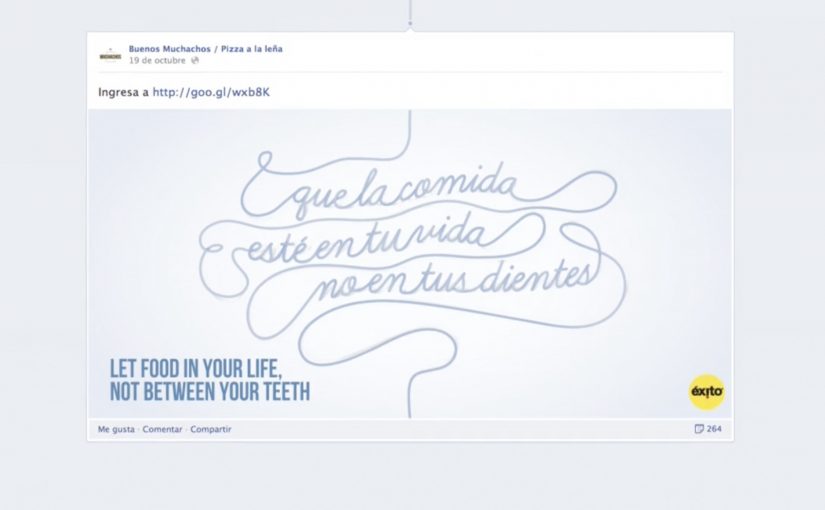
In this example, Sancho BBDO from Colombia creates a “banner” that promotes Exito dental floss by taking advantage of the Facebook Timeline. In the case video below you can see how the banner behaves like dental floss, sliding between pictures of food posted on restaurant fan pages.

The campaign reports that the Exito website received 30% more traffic and that the banner collected more than 200,000 likes across restaurant fan pages.

A banner that borrows the feed’s own grammar

The idea works because it treats the feed as the medium, not as a placement surface. Instead of shouting for attention, the unit inserts itself where the problem actually happens. Between the food and the teeth.

How the mechanism works

The execution uses a Timeline-format ad unit designed to appear between consecutive image posts, creating the visual metaphor of floss moving through a meal-heavy feed. It is still advertising, but it behaves like an interaction with the stream rather than a block sitting next to it. That matters because when the ad uses the stream’s own sequencing, the metaphor reads instantly and needs less explanatory copy.

In social platform marketing, the most durable executions are the ones that act like native feed behavior instead of interrupting it.

Why it lands

It lands because the metaphor is immediate and the placement is earned. If you are scrolling through indulgent food photography, you are already in the mental space where “maybe I should floss” makes sense. The banner does not have to convince you with copy. It just has to show up in the right gap, in the right moment, with a visual that explains itself.

Extractable takeaway: When a platform has a strong, repetitive content pattern, design your unit to exploit the “gap” between posts. The gap is where attention resets, and where metaphors can do more work than claims.

The business intent behind the trick

The real question is not whether a banner can get seen, but whether it can make its relevance obvious in the exact moment people are already primed for it.

This is efficient attention engineering. It makes a low-involvement product feel relevant by tying it to a high-frequency behavior. Scrolling food photos. That linkage is what turns a standard banner into a feed-native reminder you actually notice. Here, feed-native means the ad works inside the platform’s normal flow and spacing instead of fighting it.

What oral-care brands can lift from this

  • Start with the platform pattern. Identify what people repeatedly do and what they repeatedly see.
  • Build a metaphor that uses placement as part of the idea. Here, “between photos” is the point.
  • Keep the unit visually self-explanatory. If it needs instructions, it loses the feed moment.
  • Target the most relevant content contexts. Food imagery is the natural trigger for oral care.
  • Measure beyond clicks. Engagement and downstream site lift can be the real win for a feed-native format.

A few fast answers before you act

What is “Flossbook” in one sentence?

A Facebook Timeline-format banner that visually acts like dental floss by appearing between food photos in the feed.

Why is the Timeline placement essential to the idea?

Because the meaning is created by the gap. The banner becomes “floss” only when it sits between two posts like something threading through them.

What makes this feel native instead of intrusive?

It uses the feed’s own rhythm and spacing. The unit behaves like a piece of the stream, not an unrelated rectangle alongside it.

What is the biggest risk with “platform mechanic” ideas?

If the platform changes the format, the idea can break overnight. These executions need contingency planning for UI shifts.

How can other brands apply this without copying the metaphor?

Find the repeatable content pattern in your audience’s feed, then design an insertion that only makes sense in that exact pattern and moment.

Cape Town Tourism Facebook Holiday

Cape Town Tourism Facebook Holiday

Cape Town Tourism wanted to promote the unexpected side of Cape Town. All the small communities, never-heard of places and unearthed gems that can’t be found on Trip Advisor, Lonely Planet, Expedia, or even Google.

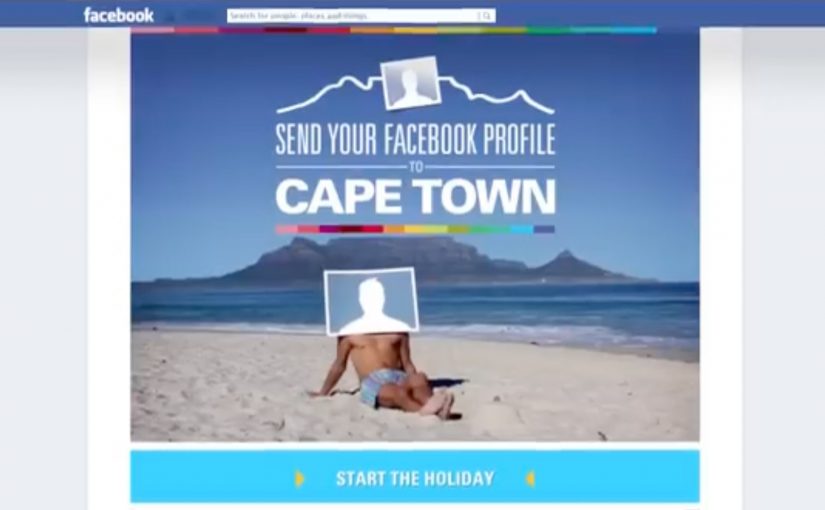
Since everyone could not be sent to Cape Town, people were allowed to send their Facebook profiles instead. Through a Facebook app users were given a virtual, tailor-made Cape Town holiday that exposed them to all the unexpected places. A few lucky winners even got to experience their Facebook profile’s holiday for themselves.

Why this idea fits tourism marketing right now

This is a smart twist on an old travel problem. Most destination marketing ends up showcasing the same highlights, using the same guidebook shorthand. Here, the hook is the opposite. The campaign is built around what standard lists miss, and it uses a person’s own Facebook profile as the input to make the recommendation feel personal. This is the right strategy for destination marketing because it turns generic discovery into personal discovery. That matters because using a person’s own profile as the input makes the destination feel more relevant before any trip is booked.

Extractable takeaway: When the audience becomes the input, discovery feels less like promotion and more like a recommendation built around personal relevance.

The pattern to steal is simple

For tourism brands trying to move beyond the same predictable shortlist, the challenge is making discovery feel personally relevant. The real question is how to make overlooked places feel worth exploring before someone ever books. If you want people to care about a place, product, or experience, give them a way to picture themselves inside it. This campaign does that in a very direct way. It takes something people already maintain daily, their Facebook profile, and turns it into a personalized route into discovery.

It also helps Cape Town Tourism promote the long tail. By long tail here, that means the lesser-known communities and hidden gems that do not show up in the usual places. Those places can finally get airtime because the experience is not optimized for the “top ten.” It is optimized for relevance.

A similar proof point from last year

Similarly last year, Obermutten a little and lovely mountain village from Switzerland was put on the world map through a very simple Facebook campaign. Check that out here.

What to steal for destination marketing

  • Let the audience be the input. Using a Facebook profile as the starting point makes the output feel personal, not promotional.
  • Sell the long tail, not the postcard. A personalised route gives “small communities and hidden gems” a real chance to surface.
  • Create an output people can compare. “Your Cape Town holiday” invites sharing because it is inherently personal and discussable.
  • Add a real-world payoff for a few. A small number of winners makes participation feel consequential, not just entertaining.

A few fast answers before you act

What is the Cape Town Tourism Facebook Holiday campaign?

It is a destination marketing idea that used a Facebook app to turn a user’s Facebook profile into a virtual, tailor-made Cape Town holiday.

What problem was Cape Town Tourism solving?

They wanted to promote the unexpected side of Cape Town. Smaller communities and hidden gems that are not easily found on mainstream travel platforms and guidebooks.

How did the Facebook profile app work at a high level?

Users submitted their Facebook profiles through the app, and the experience generated a personalized “holiday” that surfaced unexpected places based on that profile.

What made it shareable?

The user is part of the idea. The output is framed as “your” Cape Town holiday, which naturally invites comparison and conversation.

What is the broader takeaway for digital marketers in 2013?

Personal data can be turned into a story engine. When the audience becomes the input, relevance increases and discovery moves beyond the same predictable highlights.