
Frijj: You LOL You Lose

Frijj: You LOL You Lose

Frijj, a UK-based milkshake brand, and Iris Worldwide developed a campaign to help people build their tolerance to the unexpected. The aim was to make Frijj’s new flavours, Honeycomb Choc Swirl, Jam Doughnut, and Sticky Toffee Pudding, feel like a challenge worth trying.

So they created an advergame, a branded game designed to promote a product through play. It pits you against friends from your social networks in a challenge of who can keep a straight face for the longest period of time while the web app serves up funny and weird YouTube videos.

A “don’t laugh” game that sells flavour confidence

The mechanic is straightforward. You start a session, the site throws escalating clips at you, and you try not to crack. The moment you smile, you lose. The format turns passive viewing into competitive viewing, which is exactly what makes it sticky. Here, “flavour confidence” means making unusual flavours feel safe and fun to try rather than risky or strange.

In FMCG launches, simple competitive mechanics are a reliable way to turn a product message into repeatable social behavior.

Why it lands

This works because it reframes product novelty as a playful test. Instead of saying “these flavours are bold”, it says “prove you can handle bold”. Social comparison does the rest. You want a better score than your friends, so you replay, you share, and you bring others into the same loop. The use of face tracking is also a smart constraint. If the system can “catch” a smile, the challenge feels fair and measurable rather than self-reported.

Extractable takeaway: If your product promise is “unexpected”, build a mechanic where the audience has to demonstrate composure or control. The brand benefit becomes the rule of the game, not the line of copy.

What Frijj is really buying with this advergame

This is a strong launch mechanic because it turns trial curiosity into repeatable social play at scale. The real question is whether the product promise can become a rule people want to test with friends. The game creates time spent, repeat visits, and a socially distributed invitation mechanic, all while keeping the brand message consistent. New flavours that might feel risky in a supermarket become a badge of fun online.

Design rules worth borrowing from Frijj

  • Make the rule binary. Smile equals lose. Simple rules travel.
  • Use content people already understand. YouTube “weird and funny” clips need no explanation.
  • Turn replay into the product benefit. Each retry reinforces “unexpected” as the brand’s territory.
  • Design social competition as the default. Friends, scores, and bragging rights beat generic “share this”.
  • If you use webcam detection, be explicit. Clear consent and clear on-screen feedback keep trust intact.

A few fast answers before you act

What is the core idea of “You LOL You Lose”?

A straight-face challenge where the “payment” is composure. You watch funny clips and try not to smile longer than your friends.

What is an advergame?

An advergame is a branded game designed to promote a product by turning the message into gameplay rather than traditional advertising.

How does the game know you “lost”?

It is described as using face tracking through your webcam to detect a smile. When you smile, the session ends.

Why is this a good fit for launching unusual flavours?

Because it converts “new and unexpected” into a playful challenge, which makes novelty feel fun instead of risky.

What should you measure if you run something similar?

Repeat plays per user, share and invite rate, average session duration, and any lift in branded search or retail trial during the launch window.
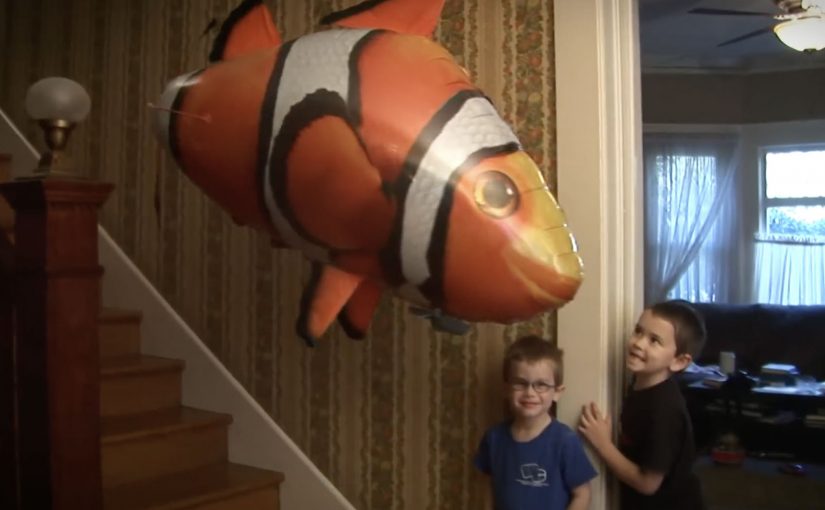
Air Swimmers: Flying Shark and Clownfish

Air Swimmers: Flying Shark and Clownfish

Have you ever seen a fish that can swim in the air with smooth, life-like motion. Air Swimmers is a US-based company that developed these remote controlled, helium-filled flying fish.

They are designed for indoor fun even in small rooms. Air Swimmers describes them as running on four AAA batteries, one in the body and three in the controller, with up, down and 360 degree turning control.

How it works

The mechanism is lighter-than-air buoyancy plus simple steering controls. The helium does the lifting. The controller provides direction and small adjustments that make the movement read as “swimming” rather than “flying”. The technology fades into the background, and the illusion becomes the product.

In consumer retail for playful tech products, the fastest path from curiosity to purchase is a demo that looks impossible at first glance, but becomes obvious after ten seconds of watching it move.

The real question is how quickly your demo turns “that can’t be real” into “I want to try that”.

Lead with the impossible-looking motion first, and let the explanation come second.

Why it lands

It delivers a clean emotional sequence. Surprise first. Then control. The viewer sees it drift like a creature, then realises someone is steering it with precision. Because buoyancy handles the lift, small steering inputs read as effortless, which makes the motion feel alive and shareable. That makes it instantly shareable because the value is visible without narration or specs.

Extractable takeaway: If your product’s value is delight, design a demo that creates a visible illusion, then reveal just enough control to make people want to try it themselves.

Guerrilla activation lessons from Air Swimmers

  • Make the demo the message. If the value is visual, build your marketing around one clip that proves the experience in seconds.
  • Use “living motion” as the hook. Here, “living motion” means movement that reads like a creature rather than a machine, so people treat it as a moment worth filming.
  • Turn everyday space into a stage. Air Swimmers were also used as a guerrilla execution for SEA LIFE Speyer in Germany. Reported coverage describes Leo Burnett Frankfurt sending “flying sharks” through Frankfurt, including public locations and public transport, to turn the city into a temporary “aquarium” and build awareness for the aquarium in the Rhein-Main region.
  • Design for spectators, not only users. The best stunts create a second audience. Passers-by who do not control the object still get the full story.

A few fast answers before you act

What is an Air Swimmer?

A helium-filled balloon “fish” you steer indoors with a handheld controller, designed to move with a swimming-like motion through the air.

Why does it feel more impressive than other RC toys?

Because buoyancy handles the “floating,” so the control inputs translate into smooth, creature-like movement rather than noisy, mechanical flight.

What makes a product like this easy to market?

The demo is the message. One short clip communicates the full value without specs, because the motion is the proof.

Why was this a good fit for a SEA LIFE guerrilla execution?

Because it is thematically aligned with marine life, instantly attention-grabbing in public spaces, and it creates a moving spectacle people want to film and talk about.

What should the first ten seconds of the demo show?

Start with the “impossible” floating motion, then reveal the steering control quickly, so people understand it is real and want to try it.

Newcastle Brown Ale: Shadow Art Billboard

Newcastle Brown Ale: Shadow Art Billboard

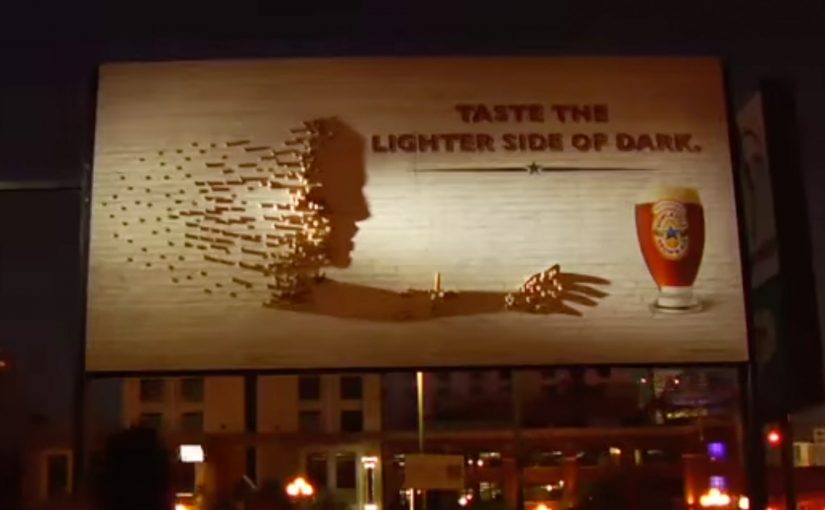
Newcastle Brown Ale’s Shadow Art has debuted in San Diego’s nightlife hub, the Gaslamp district, now through the end of September. Using only a single light source and thousands of Newcastle Brown Ale bottle caps, two New York shadow artists partnered with Newcastle to bring to life a shadow sculpture spanning 128 square feet. Shadow art is an installation that reads abstract until a specific light angle casts a deliberate image.

How it works when the sun goes down

By day it reads like an abstract field of caps. By night, the light angle does the magic. The caps become a pixel grid, and the shadow resolves into a clear image that connects directly to the brand world and the “Lighter Side of Dark” idea. Because the image only resolves under the right light angle, it invites a second look and conversation in a noisy street.

In dense entertainment districts where outdoor media competes with movement, neon, and noise, physical interactivity that rewards a second look beats anything that needs time to decode.

The real question is whether your outdoor idea earns a second look without asking for extra attention.

Why it lands

It makes the reveal the reward. The billboard does not shout at you. It waits until the conditions are right, then surprises you with an image that feels like you discovered it.

Extractable takeaway: Out-of-home becomes memorable when the medium changes state based on real-world conditions like light and viewpoint. If the message only appears when the environment cooperates, the audience feels like they unlocked it.

It uses the product as raw material. Bottle caps are not a metaphor. They are literally the building blocks, which makes the craftsmanship feel inseparable from the brand.

It turns a static surface into a time-based experience. You do not just “see an ad”. You experience a transformation. That shift is what creates talk value in public spaces. Talk value here means it gives people a simple reason to bring it up to others in the moment.

Borrow from Shadow Art billboards

  • Design for a two-stage read. First glance should intrigue. Second glance should reward with clarity.
  • Make the material part of the story. When the build uses brand-native ingredients, the proof feels baked in.
  • Choose locations where “stop and stare” is natural. Nightlife zones work because people are already scanning, wandering, and socializing.
  • Anchor the payoff to one simple brand line. The reveal should resolve into a message people can retell in a sentence.

A few fast answers before you act

What is “shadow art” in an advertising context?

An installation that looks abstract from one angle or in one lighting condition, but becomes a clear image when a specific light source and viewpoint create the intended shadow.

Why use bottle caps instead of printed graphics?

Caps add texture, depth, and authenticity. They also turn the build into a craft story that people talk about, photograph, and share.

What makes this work in a place like the Gaslamp district?

Because it competes with nightlife the right way. It creates a moment people can discover and show to friends, rather than trying to out-shout the environment.

What is the business intent behind an installation like this?

To generate earned attention and brand distinctiveness by creating a public experience that feels “worth a look”, then “worth a share”.

What is the most transferable lesson?

Build a reveal that is conditional on the real world. Light, angle, and time can do the targeting for you without any data.