Starbucks love project

Starbucks love project

At exactly 8:30 a.m. ET on Monday, December 7th, Starbucks joined forces with (RED) and creative agency BBDO to coordinate a global sing-along. Musicians worldwide performed The Beatles classic “All You Need Is Love” at the same moment, positioning the Love Project as a proof point for how connected the world is and how a small decision by one person can make a grand difference elsewhere.

The performance was broadcast live via the internet from far reaches such as Gabon and Fiji, with participation spanning over 100 countries. The initiative raised money and reinforced awareness for Africa’s fight against AIDS, while giving people a clear way to take part in the solution.

The campaign. A global moment that lives online

The performance was streamed live online at starbucksloveproject.com and acted as the anchor moment. Here, “anchor moment” means the single shared live event that gives the campaign a timestamp and a reason to gather.
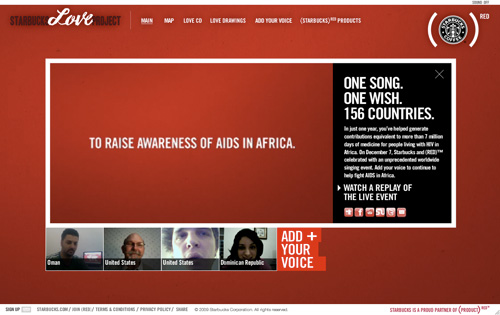
Homepage of starbucksloveproject.com

After the live sing-along, people continued the campaign by going to the Starbucks website and uploading their own:

  • versions of “All You Need Is Love” videos
  • love drawing sketches

Each uploaded performance generated a donation from Starbucks to the cause, supporting (RED) and the Global Fund’s work.

In global consumer brands, the hardest part of cause marketing is turning a feel-good message into a repeatable participation mechanic.

The real question is how you design participation so it feels personal, public, and causally linked to impact.

Why it lands: participation that feels causal

This works because the mechanism makes the “how do I help?” step obvious and measurable. When contribution is triggered by a specific user action, scale stops being a vague aspiration and becomes a compounding loop that people can explain to each other.

Extractable takeaway: If you want a cause campaign to travel, make the participation act simple, visible, and directly tied to a concrete contribution.

The distribution layer. Partnering with Facebook

Starbucks partnered with Facebook to spread the message through the social network. The campaign was positioned as the largest global campaign ever for both Facebook and Starbucks.

The commercial layer. Turning participation into a product

The song was also commercially sold in stores on Starbucks’ Love CD, extending the fundraising and awareness beyond the live moment and the online uploads.

The scale signal. A record for global participation

A Guinness World Record was set for the “Most Nations in an Online Sing-Along,” reinforcing the Love Project as a massive organizational task that reaped the benefits of integrated marketing. Here, “integrated marketing” means the same idea expressed through a live anchor event, social distribution, and a product extension.

Steal this for your next global cause moment

  • Stage one timestamped anchor moment: Give the world a single time to show up, then let everything else ladder back to that moment.
  • Make participation generate impact: Tie a clear user action (uploads) to a concrete contribution (a donation) so people can explain the loop.
  • Design for sharing as distribution: Pick a network layer (Facebook here) that makes participation visible without extra effort.
  • Extend beyond the moment: Add a second way to participate (the Love CD) so the campaign does not end when the livestream ends.
  • Use proof signals carefully: If you claim scale (records, “largest ever”), ensure the mechanism and operations actually support it.

A few fast answers before you act

What is the Starbucks Love Project?

A global sing-along campaign with (RED), coordinated with BBDO, anchored by a simultaneous performance of “All You Need Is Love.”

How big is it?

The campaign described participation spanning over 100 countries, with performances broadcast live online from locations including Gabon and Fiji.

How does participation continue after the live event?

People upload their own “All You Need Is Love” videos and love drawing sketches on Starbucks’ campaign site.

How does it drive donation impact?

Each uploaded performance generates a donation from Starbucks to the cause, supporting (RED) and the Global Fund.

What role does Facebook play?

Facebook is presented as the distribution partner used to spread the message and participation through the social network.

What else extends the campaign beyond the moment?

The song is also sold commercially on Starbucks’ Love CD in stores.

Jameson: Are You Talking To Me?

Jameson: Are You Talking To Me?

“Are you talking to me?” becomes a real question when a wall talks back. This month, people in high foot-traffic areas across New York and Los Angeles react to Jameson Irish Whiskey as if the city itself has started a conversation.

The idea defies the downturn mood by shifting from broadcast to banter. The wall does not just show a message. It performs a social moment with whoever walks past.

How the talking wall works

The mechanism is described as a projected interactive ad. A large-scale wall projection delivers conversational prompts and responses that feel directed at individuals in the crowd, turning a static surface into something closer to a street-level character than an ad unit. That works because the projection frames the encounter as a social exchange people instinctively want to resolve.

In urban brand marketing, interactive out-of-home can behave like a social channel when it turns passersby into participants rather than impressions.

Why it lands

It flips the usual power dynamic of outdoor media. Instead of you watching an ad, the environment appears to notice you. That creates a tiny moment of surprise and self-conscious humor, which is exactly what people share with friends standing next to them.

Extractable takeaway: If you want out-of-home to travel beyond the street, give it a social script, meaning a prompt people naturally know how to answer or perform. When the medium feels conversational, people perform it, and performance becomes distribution.

What Jameson is really buying

The business intent is to make the brand feel present in the city’s social fabric, not just visible on its surfaces. A “talking” installation creates memory through interaction, which can outperform pure reach when budgets are tight and attention is scarce.

The real question is whether the interaction makes Jameson feel socially present enough to be retold after the moment ends. Jameson is right to use interactivity here as a behavior engine, not a decorative layer.

What to steal from conversational out-of-home

  • Write for interruption. A short line that sounds like it belongs in real life earns the first glance.
  • Design for group reactions. Outdoor works best when it creates a moment that strangers can share in real time.
  • Make the medium feel alive. Interactivity is not a feature. It is the reason people stop.
  • Keep the proof simple. A single video that shows the reaction is often the most scalable artifact.

A few fast answers before you act

What is the core idea here?

Turn a wall into a conversational brand moment, using a projected interactive execution that feels like it is speaking directly to people on the street.

Why does “talking” out-of-home get attention?

Because it breaks expectation. Outdoor is usually passive. When it behaves like a person, people pause to resolve the surprise.

What makes this more than a stunt?

The interaction itself is the brand experience. The wall creates a repeatable feeling, and that feeling is what people remember, record, and retell.

What should a brand copy from this?

Start with a line that sounds native to the street, then make the interaction readable from a distance. If the setup triggers a shared reaction, the format can extend beyond the physical site.

What is the main pitfall to avoid?

If the interaction is unclear from a distance, people will not stop. The hook must read instantly, even before someone understands the tech behind it.

Microsoft Office Project 2007: Mega Woosh

Microsoft Office Project 2007: Mega Woosh

Microsoft created a viral featuring Bruno Kammerl, described as building the biggest waterslide on earth. The test run was more than successful, and the film leans into that “did I just see that” energy from the first second.

A stunt film that behaves like a project story

The mechanism is classic viral bait. A bigger-than-life engineering build. A simple premise. A single high-risk moment. Then just enough mystery around “who is this” and “why does this exist” to make people share it while they debate whether it is real.

In enterprise project-management software marketing, a bold proof-like narrative can communicate “we make impossible plans doable” faster than feature lists ever will.

Why it lands

It uses constraint and payoff. The build feels specific enough to be plausible, and the jump delivers an instant, physical climax. Even if viewers suspect it is staged, the film still works because the emotion is the product. Surprise, disbelief, and the urge to forward it.

Extractable takeaway: If you want a product that sells “capability” to feel memorable, show one exaggerated outcome, then let the audience connect the dots back to the promise.

What this says about the brand

The strategic intent is to borrow the energy of ambitious personal projects and map it onto a tool used for complex planning. The viral creates a mental shortcut. Big plan. Bold execution. Managed outcome.

The real question is whether this kind of spectacle makes enterprise planning feel ambitious enough to remember. It does, because the campaign turns project management into a visible, shareable outcome instead of a software demo.

What to steal from Mega Woosh

  • Make the promise physical. If your product sells “capability”, dramatize it with a single, extreme outcome people can picture instantly.
  • Lock one simple story rule. Big build. One test. One payoff. The simpler the rule, the easier the share.
  • Use specificity to create plausibility. Named protagonist, concrete build details, and a clear “test run” moment make the film feel real enough to debate.
  • Let the audience connect the metaphor. Do not over-explain the product. Give them the leap from “impossible project” to “project management”.
  • Design the talk trigger. The best virals are built around a single question people argue about. “Is this real” is a distribution engine.
  • Keep the brand cue clean and minimal. Too much branding breaks the spell. Too little branding loses the credit.

A few fast answers before you act

What is Mega Woosh in one line?

A viral stunt film built around an oversized waterslide jump, used to signal “anything is possible” as a metaphor for managing big projects.

Why does this work as marketing for project software?

Because it dramatizes planning and execution as a single, bold narrative. The story does the positioning work without needing specs.

What makes it so shareable?

One premise, one payoff, and a high-disbelief moment that triggers debate and forwarding.

What is the risk of this approach?

If the audience feels tricked rather than entertained, trust can take a hit. The framing needs to stay playful, not deceptive.

What should marketers copy from this format?

Use one extreme, easy-to-explain outcome to embody the promise, then keep the branding light enough for the spectacle to travel.