

Volvo C70: The Wife-Swapping Parody Spot

Volvo’s new C70 comes with an available “wife-swapping feature”. That is the joke this video runs with, presented in the familiar language of a premium car commercial, then pushed into outright parody.

The gag: take the feature list seriously, then break it

The mechanism is simple. Use the polished grammar of an automotive feature demo, then introduce one outrageous “benefit” that clearly does not belong. The contrast does the work. It is recognizably a car ad in format, and obviously not a car ad in intent.

In premium automotive marketing, parody “feature demo” films can be a fast way to generate word-of-mouth when the real product story risks blending into category sameness.

Why it lands as a shareable clip

It is short, instantly legible, and built around one line people can repeat. It also plays on a familiar consumer pattern: most of us have seen enough car advertising to recognize the tropes, so the subversion is easy to process and easy to pass on.

Extractable takeaway: If your category is saturated with similar promises, a single sharp subversion can earn more recall than ten more seconds of conventional feature narration.

What this kind of spoof is really useful for

This is not about explaining the car. It is about attention and memory.

The real question is whether the joke reinforces the brand you want to be remembered for, or just the joke.

Satire can do that well because it gives people a reason to share that is social, humor, surprise, and “you have to see this,” rather than “here is a product message.”

How to borrow the spoof “feature demo” safely

  • Use a familiar format. Parody works best when the audience recognizes the template immediately.
  • Anchor it in one repeatable line. If people can quote it, they can share it.
  • Keep the craft “too good” for the joke. High production language makes the twist hit harder.
  • Know your boundary. Satire travels fast, but it can also polarize. Decide what you will not joke about.

A few fast answers before you act

What is this Volvo C70 video actually doing?

It uses the structure of a premium car commercial, then inserts an absurd “feature” to turn the entire piece into satire.

Why does parody often outperform a straight product film online?

Because the share incentive is emotional and social. People share what makes them laugh or surprises them, not what feels like a brochure.

What is the main creative risk with spoof ads?

Confusion and brand harm. If the joke reads as mean-spirited or unclear, people remember the controversy instead of the point.

When is parody a bad idea?

When your product requires trust-first communication, or when the joke could be interpreted as targeting a group of people rather than a marketing trope.

What is the transferable lesson for marketers?

Format hacking. Start with a template the audience already understands, then flip one element to create surprise and talkability.
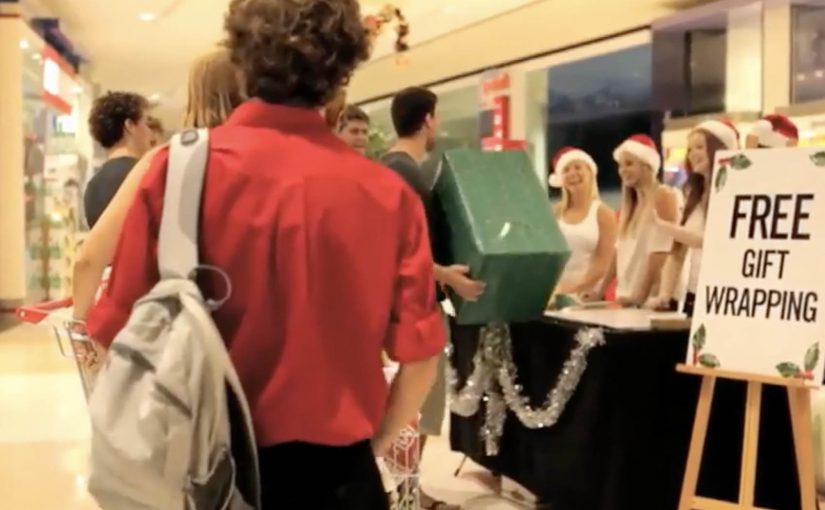

Hyundai A-League: Gift Wrapping Swindle

Getting people into a stadium rarely starts with sport. It starts with habit. Lowe in Sydney uses the pre-Christmas rush to put a match invitation into a moment people already care about, without needing another ticket ad.

A Christmas “service” that flips into promotion

The activation doesn’t fight for attention in a new media slot. It borrows an existing ritual, getting gifts ready, when people are already in a generous, social mindset and open to small surprises.

The smart part is the order of operations. It feels like help first, marketing second, which lowers resistance and makes the message easier to carry into conversation afterwards.

The reveal is the media

Once people opt in, the experience pivots. What looks like a straightforward offer becomes a playful con, and that pivot is the part people remember and retell.

That retelling is the distribution engine. It converts passive reach into a personal anecdote, and personal anecdotes are what move a friend group from “I saw something” to “we should go.”

In crowded sports and entertainment markets, attendance is often won at the everyday decision points where people choose what they will do with their next free evening.

The real question is whether you can turn an attendance ask into a story people want to retell, not just a message they notice.

Why the idea lands so well

The “swindle” framing does two jobs at once. Here, “swindle” simply means a playful bait-and-switch, the wrapping offer flips into a match invite. It creates tension and emotion in the moment, and it makes the participant feel involved, not targeted. The reaction is the content, and the retelling is the distribution.

Extractable takeaway: If you can attach your message to a real-world ritual that people already care about, you don’t need to “earn attention” from scratch. You simply redirect it, then give people a story they can repeat without you.

This is also listed in Effie Awards Australia reporting as a winner in the “Most Original Thinking” category, which fits the design: a small behavioural hack, not a big media buy.

What the league is really buying

The hidden win is not just awareness. It’s habit disruption. You take a non-football moment and reframe it as football-adjacent, then you push the idea of attending into a context where people are already planning social time around the holidays.

A ritual-first activation like this beats incremental ticket messaging because it recruits people’s social planning habits, not just their attention.

That’s how you move from “I saw an ad” to “we should go”. The campaign manufactures a nudge that feels organic because it is embedded inside a familiar activity.

Ritual-based attendance nudges to copy

  • Pick a ritual with built-in foot traffic: shopping, commuting, queues, checkouts, waiting rooms.
  • Make the reveal the message: the twist should be the reason people talk, not an extra layer you explain after.
  • Design for retelling: if the story can be repeated in one sentence, it will travel further than the experience itself.
  • Keep the CTA implicit: the best outcome is that people decide to act while they are still talking about what happened.

A few fast answers before you act

What is “The Great Christmas Gift Wrapping Swindle”?

It’s a holiday-season activation that turns gift wrapping into a surprise promotional stunt, engineered to spark conversation and drive attendance.

Why is gift wrapping a smart channel for sports marketing?

Because it’s a ritual people willingly engage with. The message travels physically with the gift, and the moment is social by default.

What makes this more effective than a standard ticket ad?

The participant becomes the messenger. A prank-style reveal produces a story, and stories outperform slogans when it comes to getting people to act.

What’s the main risk with prank mechanics?

If the reveal feels mean-spirited or wastes people’s time, you get backlash without benefit. The tone has to stay playful, and the participant has to feel “in on it” quickly.

How do you adapt the pattern outside sports?

Attach your offer to a real-world ritual in your category. Then design one clear twist that transforms the ritual into a story people want to repeat.

AXE: Clean Your Balls

Denese Saintclaire and Monica Blake explain how to clean your balls with AXE Detailer.

The joke is the product demo

This is a classic late-night infomercial parody, built around a single mechanism: a straight-faced product demonstration that keeps sliding between “sports balls” and the innuendo it clearly wants you to hear. The longer it holds the tone, the funnier the tension gets.

Here, the mechanism is the repeatable comic device: a deadpan demo that keeps turning a product explanation into a double-meaning gag.

In men’s grooming marketing, humor works best when it demonstrates a real usage truth and makes the explanation repeatable in one sentence.

Why it lands

It lands because the format is instantly familiar, and the creative twist is instantly obvious. Viewers do not need context, and they do not need to like the brand to share the joke. The film also earns attention by overcommitting. It plays the parody long enough that it feels like a “real” segment, not a 15-second gag.

Extractable takeaway: When your product benefit is simple, consider a long-form demo that overexplains it in a familiar TV format, then add one clear comedic mechanism people can retell without quoting your copy.

What the brand intent is

The real question is not whether the joke is crude, but whether the product demo stays clear enough to survive the joke.

This works because the product stays visible and the humor never overwhelms the selling point.

The intent is to make a shower tool feel like a necessary piece of male kit, not an optional accessory. The humor is doing the distribution work, while the “tool” positioning gives the brand something more ownable than another body wash claim.

What to steal from the infomercial parody

  • Borrow a trusted format. Infomercial grammar is universal and fast to understand.
  • Commit to one mechanism. Here it is the double-meaning demo, repeated and escalated.
  • Make the product visible early. The joke never hides what is being sold.
  • Let tone do the targeting. The people who laugh are the people who share.

A few fast answers before you act

What is the AXE “Clean Your Balls” video?

A branded infomercial-style parody promoting the AXE Detailer shower tool, using “ball” cleaning as a repeated double-meaning product demo.

Is this mainly an awareness play or a conversion play?

Primarily awareness and shareability, with product education folded into the entertainment so the viewer still understands what is being sold.

What makes the mechanic effective?

It is instantly legible. A familiar TV format plus one obvious comedic twist that escalates without needing explanation.

What is the biggest risk with humor like this?

Polarization. The same innuendo that drives sharing can also turn off parts of the audience, so placement and brand fit matter.

How can a brand replicate the effect without sexual humor?

Keep the structure. Use a familiar demo format, then introduce one clear, repeatable twist that shows the benefit in an exaggerated but understandable way.