
Ikea PS 2014 Instagram Website

Ikea PS 2014 Instagram Website

You open Instagram and land on Ikea_ps_2014. The grid does not look like a typical brand feed. Each tile behaves like a navigation button. Benches. Tables. Storage. You tap a category image, reveal hidden tags, and jump straight into product views. Instagram becomes the website.

The idea. A catalog built inside Instagram

Ikea has made a name for itself as a trustworthy and affordable source of stylish home decor. In Russia, to promote the PS 2014 collection, Ikea teams up with Moscow-based agency Instinct to approach Instagram in an entirely new way.

How it works. Categories in the grid, products in the tags

The Ikea_ps_2014 Instagram account serves as the campaign website. Each post represents a product category like benches or tables. When you tap a category image, hidden tags reveal “links” to the products within that category.

Here, “hidden tags” are simply Instagram photo tags used as tap targets, so navigation stays inside native Instagram behavior.

Every one of the 34 items in the collection also receives its own Instagram account. For example ps_laptop_station and ps_side_table.

The real question is whether you can turn a platform habit into structured product discovery without forcing people out of the app.

In consumer brands promoting a collection across many items, this pattern uses a social grid as a lightweight category tree.

Why it matters. An app used beyond its intended design

The Instagram app is certainly never meant to be an Ikea catalog website. The mechanism is simple: category posts behave like menu tiles, and tags behave like links, so thumbs do what they already do in Instagram. That is why the experience feels like browsing, not “clicking out”. This is worth copying when the native UI can carry the journey end-to-end, not when you need heavy comparison, configuration, or checkout.

Extractable takeaway: If a platform already has a grid, a tag system, and a tap habit, you can repurpose those primitives into navigation and keep discovery inside one familiar surface.

Where it connects. Earlier “feed as experience” examples

Earlier this year, Mazda and JWT Canada turned the car-maker’s Instagram feed into an interactive road trip, replacing specs with images and videos that followed the vehicle on an epic adventure. Over the course of four months, the campaign “Long Drive Home” helped grow Mazda Canada’s Instagram following by more than 300%.

Similarly, the Toronto Silent Film Festival turned its feed tsff2014 on its side, creating an interactive timeline complete with factoids and video clips to celebrate Charlie Chaplin’s 100 years on film.

What to copy from this build

  • Start with categories. Treat the grid as a menu so users can self-select a path.
  • Use tags as links. Turn existing tap targets into jumps to deeper product views.
  • Keep the journey native. Let the platform’s follow, view, and tag behaviors do the work.
  • Design for scan first. Make each tile legible as navigation, not just as content.

A few fast answers before you act

What is the Ikea PS 2014 Instagram website?

A campaign that uses an Instagram account as a navigable catalog. Grid posts act as categories, and photo tags act as links to product accounts.

How do people navigate it?

Users tap category images in the grid, reveal the photo tags, and jump to specific product pages inside Instagram.

What is the key execution detail?

Each PS 2014 product gets its own Instagram account, so exploration happens via Instagram’s native follow, view, and tag behaviors.

Why does this work on mobile?

It turns a familiar mobile habit, browsing a feed, into structured discovery without forcing users into a new interface.

What is the transferable pattern?

Treat platform constraints as UI elements. Build navigation out of what the platform already provides instead of fighting it.
Grolsch: The Movie Unlocker

Grolsch: The Movie Unlocker

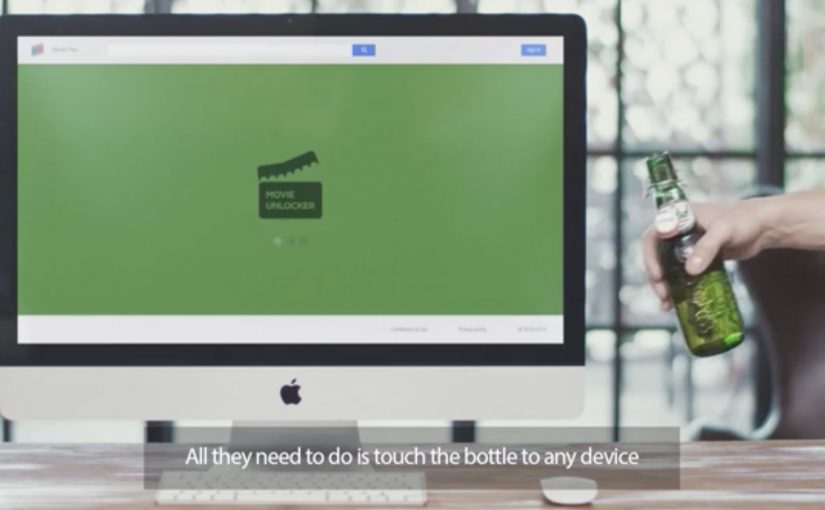
Paying for movies with a credit card is framed as yesterday’s behaviour. Grolsch positions a new alternative as “Movie Unlocker” technology, letting consumers use the beer bottle itself as the key to watch movies online.

The bottles are described as being fitted with custom Bluetooth beacons that transmit a unique code when brought close to a laptop or smartphone with Bluetooth Low Energy, or BLE, enabled. That code verifies the user and unlocks access to the chosen movie.

How the bottle becomes the checkout

The mechanism is a proximity-based redemption flow. Open the beer. Bring the bottle near your phone or laptop. The beacon transmits an identifier. The partner website receives it, validates it, and then grants access.

Functionally, it’s the same “code under the cap” idea, but moved from manual entry to a one-touch interaction triggered by distance and Bluetooth.

In consumer promotions, frictionless redemption mechanics often outperform bigger media spend because they turn the product into the access token.

Why “bottle-as-ticket” works

This lands because the value exchange is immediate and physical. The bottle is proof-of-purchase, and the unlock moment happens in the same context as consumption. At-home. On-device. With minimal steps. That makes the reward feel like a feature of the product, not a separate campaign hoop.

Extractable takeaway: If you want high participation in a reward mechanic, eliminate typing and logins where possible. Use a physical trigger that makes redemption feel like a natural extension of the product ritual.

What the brand is really optimizing

The real question is how to make purchase verification feel like part of the product experience rather than a separate redemption step.

Beyond “cool tech,” this is about repeat preference. It attaches a digital entertainment benefit to a beer purchase, creating a reason to choose Grolsch again the next time someone is deciding in-store.

What to steal from bottle-as-ticket

  • Turn proof-of-purchase into a trigger. Let the product initiate the unlock, not a coupon field.
  • Design for the living room moment. Redemption should work where consumption happens.
  • Keep the exchange legible. “Beer near device equals movie” is easy to explain.
  • Make authentication invisible. Users should feel the magic, not the plumbing.

A few fast answers before you act

What is Grolsch Movie Unlocker?

It’s a promotion mechanic where a beer bottle transmits a unique Bluetooth Low Energy code to help unlock a movie online.

What does BLE do here?

BLE enables low-power proximity communication so a nearby bottle can pass an identifier to a phone or laptop without pairing like a normal accessory.

Is this replacing payment or replacing a promo code?

It functions like replacing the promo code step with a proximity trigger. The “payment” is effectively the purchase of the beer tied to the unlock.

Why is this better than typing a code?

It reduces friction. Fewer steps usually means higher completion and less drop-off in promotional redemptions.

What’s the biggest practical risk?

Reliability and onboarding. If Bluetooth is off, compatibility is unclear, or the unlock flow is confusing, the perceived magic disappears fast.

TD Canada Trust: Automated Thanking Machine

TD Canada Trust: Automated Thanking Machine

Start with the smile. Then design backwards

Start with the smile of your audience, then work back from there. That is the key to many of the marketing campaigns people actually share. Coca-Cola has done a great job with their various happiness campaigns, followed by WestJet’s Christmas campaign where they surprised passengers with gifts.

When an ATM stops being a machine

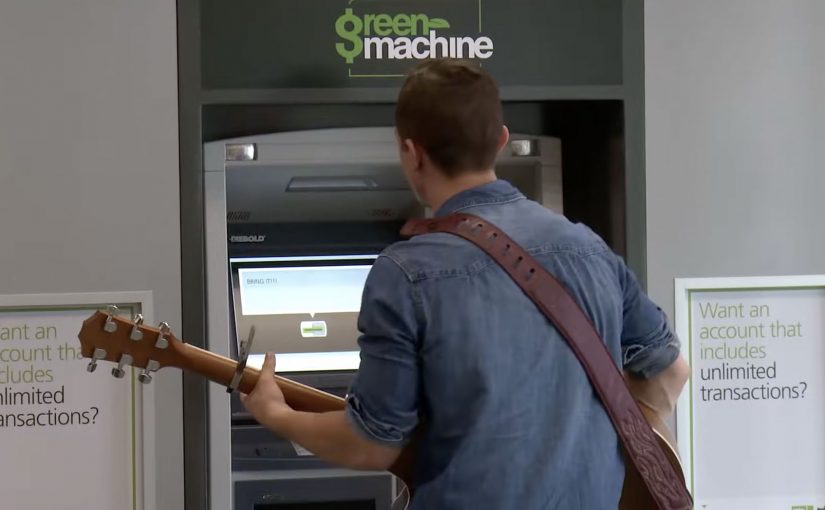
TD Canada Trust, for its “TD Thanks You” campaign, converts select ATM machines in Toronto, Montreal, Calgary and Vancouver into special Automated Thanking Machines. Twenty hand-picked customers are invited to test them.

The twist is that the ATM behaves like a person. It knows their name, talks back, and responds in ways a standard ATM never would. Then it escalates into the payoff: unexpected, genuinely personal gifts that feel tailored to the customer, not to the bank.

In retail banking and other trust-based categories, surprise-and-delight, meaning an unexpected human response inside a standard service moment, works best when it turns a routine transaction into personal recognition that feels operationally real.

The video is the distribution layer

The reactions are the asset. This is less about the ATM technology than about capturing the moment people realize a faceless institution is paying attention. The real question is how a trust-heavy brand makes gratitude feel personal without making it feel fake. As reported, the video has racked up millions of views in days because the story is instantly legible: a familiar interface becomes human, and the customer response does the persuasion.

Why it lands

Banks are trained to look serious, consistent, and slightly distant. This flips that expectation without abandoning credibility, because the setting stays “bank-real” and the interaction starts from a normal ATM flow. The experience also scales conceptually. Any service brand with a repetitive touchpoint can imagine doing a version of this.

Extractable takeaway: If your category is low-emotion or low-trust, pick a familiar moment, introduce one human signal that feels impossible in that context, then let the customer reaction carry the message.

What to steal from an ATM that says “thanks”

  • Use a familiar interface as the stage. The more ordinary the starting point, the bigger the perceived magic when it shifts.
  • Personalization beats scale. One moment that feels truly “for me” outperforms ten generic giveaways.
  • Escalate in steps. Name recognition. Conversation. Then reward. The ramp makes the payoff believable.
  • Design the filming around authenticity. A hidden-camera feel is part of the proof, even when the experience is planned.

A few fast answers before you act

What is TD’s “Automated Thanking Machine”?

It is a TD ATM adapted to greet and interact with select customers, then deliver surprise gifts as part of the “TD Thanks You” campaign.

Why does the ATM format work so well?

An ATM is the definition of impersonal service. Making it behave personally creates instant contrast and instant story value.

What’s the real mechanism behind the idea?

Not the screen. The mechanism is staged personalization at a routine touchpoint, captured on video, where real customer reactions become the proof.

What makes this shareable beyond banking customers?

The narrative is universal: a machine becomes human, then gratitude becomes tangible. You do not need product context to feel it.

How can another brand apply this without copying it?

Pick one repetitive customer moment, add one unexpected human signal, then reward the customer in a way that is clearly based on who they are, not who you want them to be.