One of the oldest and most effective ways to sell a product is with a good demonstration. Leo Burnett Brussels takes that approach and gives it a fresh spin for the Jeep Compass by turning the demo into a journey people can follow.
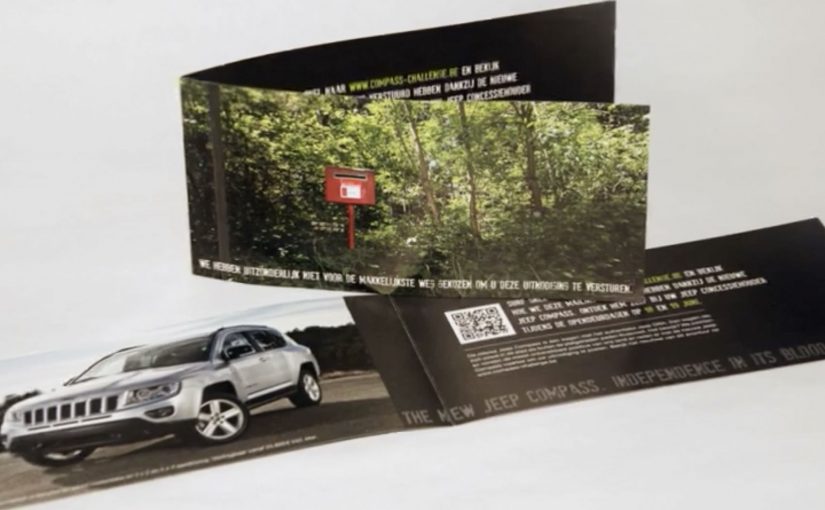
Cameras are strapped onto a few Jeep Compasses, and the team sets out to find the most remote post locations they can. Direct mailers are then shipped from these far-flung places, pointing recipients to a site where they can follow the trip and see the Compass in action.
Remote postcards as proof, not promise
The mechanic is simple. Put the product in the environment that proves the claim, document it, then send a physical artifact from the place itself. The postcard becomes evidence that the vehicle actually got there, not just a line in a brochure.
In automotive marketing, demonstrations land best when the proof is embedded in the distribution, so the message and the evidence arrive together.
The real question is how to turn an off-road capability claim into proof people can hold, trust, and retell. This is stronger than a spec-led demo because the proof is built into the medium itself.
Why this lands
This works because it collapses storytelling and verification into one object. A postcard from a remote location is inherently credible. Add footage from the route, and the demonstration feels earned rather than staged, even for people who only skim the campaign.
Extractable takeaway: If your product benefit is “go anywhere” or “handle more,” make the medium carry the proof. Send something that could only exist if the product performed as claimed.
What the campaign is really optimizing for
Beyond awareness, this is built to move the vehicle into active consideration. It gives prospects a concrete reason to re-evaluate the vehicle, and it creates a narrative that sales teams and enthusiasts can retell without needing technical jargon or spec sheets.
How to adapt this demonstration pattern
- Turn proof into an artifact. Physical mail can signal effort and credibility.
- Design a followable journey. A route with checkpoints is easier to remember and share than a one-off stunt.
- Keep the CTA tight. One action. Follow the trip. See the product perform.
- Make the environment do the persuading. Terrain and remoteness communicate capability faster than copy.
A few fast answers before you act
What is the core idea of the Jeep Compass remote postcards?
Use real remote locations as the demonstration, then mail postcards from those locations and direct recipients to follow the journey and watch the vehicle perform.
Why use direct mail instead of only video?
A postcard from a remote post office feels like proof. It is a physical signal that the journey happened.
What makes this a product demonstration, not just content?
The route and the mailer are consequences of the capability claim. The campaign structure is built around showing the vehicle doing the work.
What kind of products benefit most from this pattern?
Products with a capability claim that is easy to show in the real world. Durability, reach, range, off-road, endurance, or access.
What’s the biggest risk if you copy this approach?
If the “proof” feels manufactured or the journey is hard to follow, the credibility advantage disappears. The checkpoints and documentation need to be clear.