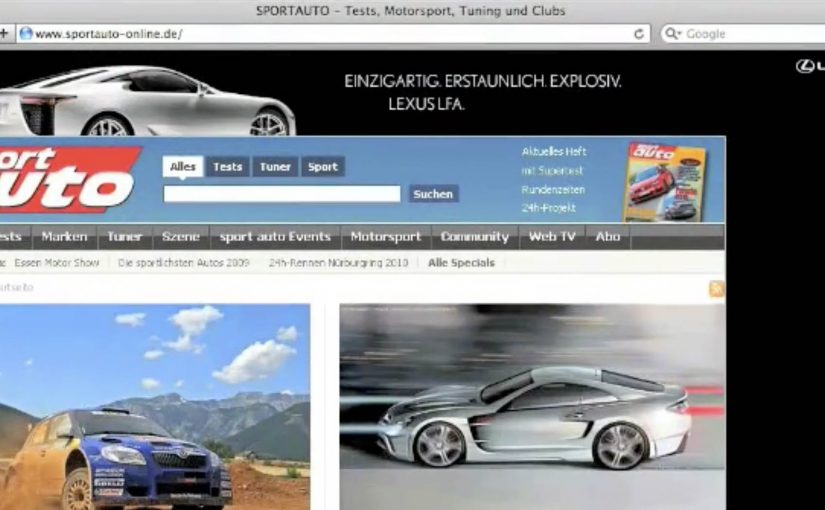
Saatchi & Saatchi Germany has created a clutter-breaking execution for the Lexus LFA on the Sport Auto website by turning a familiar interface element into the ad itself.
When the ad is the interface
The idea is disarmingly simple. Instead of fighting for attention inside a banner slot, the execution is described as a custom scrollbar experience on Sport Auto, shifting the user’s focus to the one thing everyone touches when they move through a long page.
How “Scrollbroaaaar” works
Mechanically, the work hijacks the expected behavior of scrolling and reframes it as a brand moment for a high-performance car. The name “Scrollbroaaaar” signals the point. Here, “Scrollbroaaaar” means the scrollbar itself becomes the branded ad unit. Scrolling becomes a sensory cue for speed and engine attitude, not just a way to navigate content.
In performance automotive marketing, using interface behavior as media can outperform traditional display formats because the user triggers the moment themselves.
The real question is whether you can turn a default UI habit into branded sensation without stealing time from the content.
Why it lands as clutter-breaking
This works because it does not ask for permission. It meets the user inside muscle memory. A scrollbar is invisible until it changes. The second it does, attention spikes. That moment of surprise is the whole value exchange.
Extractable takeaway: If you can attach your product truth to a UI habit the audience already performs, you get attention without demanding a click.
What the brand is really buying here
Beyond impressions, the intent is distinctiveness. Lexus gets a “did you see this” story that is native to the environment where car enthusiasts already browse. The experience also borrows the credibility of a specialist publisher context while keeping the brand in control of the punchline. This is a smarter bet than buying another standard display slot and hoping anyone notices.
What to steal for your own digital creative
- Make the interaction the media. If a user action triggers the payoff, recall tends to be higher than passive formats.
- Choose the smallest possible hack. One altered UI element can be more powerful than a page full of widgets.
- Design for surprise, then exit fast. The novelty works best when it is immediate and does not overstay.
- Match the mechanic to the product truth. Speed, sound, and control cues belong to a halo performance car.
A few fast answers before you act
What is “Scrollbroaaaar” in one line?
A web takeover that turns the page’s scrollbar into the ad, so scrolling itself becomes the Lexus LFA moment.
Why is it considered clutter-breaking?
Because it bypasses banner blindness by changing a core interface behavior users already rely on, creating instant surprise and attention.
What is the main creative principle behind it?
The principle is viewer control. The user’s action triggers the brand payoff instead of asking them to click away from what they came to do.
When should you use this pattern?
When you have a simple product truth that can be expressed through a single behavior change, and you want memorability more than message density.
What is the biggest risk with interface-as-ad?
If the mechanic slows the page, breaks expected controls, or feels like it traps the user, the surprise turns into frustration and the brand pays for it.