
LEGO France: Creativity Forgives Everything

LEGO France: Creativity Forgives Everything

A child gets caught mid-creation. The scene looks like trouble at first glance, then the line flips the judgement: “We forgive everything to their creativity”. LEGO has recently launched this campaign in France around that exact tension between mess and imagination.

Click here to watch the video on AdsSpot website.

Turning “naughty” into proof of imagination

The core mechanism is a simple reframe. Instead of defending play as “educational”, the work leans into the moments parents normally correct. The child’s act is still a transgression, but it is also a creative act. The signature gives parents permission to smile first, and judge later.

In brand advertising for physical toys competing with screens, the fastest way to win attention is to make imagination look like something happening right now in the room.

Why the line sticks

“Creativity forgives everything” works because it treats creativity as a social contract, not a product feature. Here, “social contract” means an unspoken trade-off: parents tolerate the mess because it signals imagination at work. Parents recognise the micro-drama instantly. You want boundaries, but you also want your child to be bold, curious, and inventive. The campaign positions LEGO as the tool that triggers that boldness, even when it comes with collateral damage.

Extractable takeaway: If your category is crowded with functional claims, choose a human tension your audience already lives with. Then write a line that resolves the tension emotionally, and let the product become the enabler of that resolution.

What LEGO is protecting

This is brand defence disguised as humour. The real question is how LEGO stays culturally distinctive when screens can deliver endless entertainment without leaving any real-world evidence. It keeps LEGO out of a specs battle and away from “learning toy” cliches. By celebrating the messy edge of creativity, the brand claims a territory that is hard for digital entertainment to steal. Real-world play that leaves evidence.

What brands can borrow from LEGO here

  • Use a permission-giving signature. A great brand line does not just describe. It authorises a feeling or behaviour.
  • Stage recognisable “caught in the act” moments. When the scenario is instantly familiar, the audience supplies the backstory for you.
  • Make the brand the ally. The work does not lecture parents. It makes them complicit, which is more persuasive.
  • Let the theme travel across formats. This idea naturally fits film, print, and outdoor because the tension can be captured in a single moment.

A few fast answers before you act

What is LEGO’s “Creativity forgives everything” campaign?

It is a LEGO France brand campaign built around the idea that adults can forgive children’s small “misbehaviours” when they are clearly driven by creativity and imaginative play.

What is the core idea in one sentence?

Reframe mischief as imagination, then position the product as the trigger for that imagination.

Why does this positioning work for LEGO specifically?

Because LEGO is a physical system for building anything. The campaign connects that open-endedness to real, observable behaviour rather than abstract “learning” benefits.

How do you adapt this approach to another category?

Identify a daily tension your audience recognises, write a line that gives emotional permission, then demonstrate the product as the enabling tool inside that tension.

What should you avoid when copying the pattern?

Avoid moralising. The power comes from empathy and recognition, not from telling the audience how they should behave.

Recruitment: Pirates and Cyber Warriors

Recruitment: Pirates and Cyber Warriors

Since 2010 I have covered how different agencies around the world have been innovating with their recruitment campaigns. Now here are the latest two to join the list.

Two modern filters for hard-to-hire talent

Both ideas avoid broad “we’re hiring” noise. Instead, they place the offer inside the candidate’s real behavior, then use a simple mechanism to separate curiosity from capability.

The better recruitment move is to screen for behavior before you screen for polish.

The real question is not how to attract more applicants, but how to surface people whose behavior already matches the role.

Pirate Recruitment

Young web designers often need expensive application suites to create, and many end up downloading them from illegal pirate websites. Ogilvy Brussels uses that insight by uploading a file that appears to be the “wanted” application suite.

When designers download it, they do not find the software. They find a stronger offer: a job opportunity, delivered right inside the moment of intent.

In competitive digital talent markets, the hardest problem is not reach but signal.

Why this one works

The delivery is the targeting. If you are not the kind of person who looks for pro tools, you never see it. If you are, the offer lands as a wink that proves the agency understands your world. Because the message appears inside a live tool-search moment, it feels relevant instead of interruptive.

Extractable takeaway: Put the offer where the target audience already goes to solve a real problem. The closer your message sits to a “work moment”, the higher the relevance and the lower the waste.

Cyber Warriors Challenge

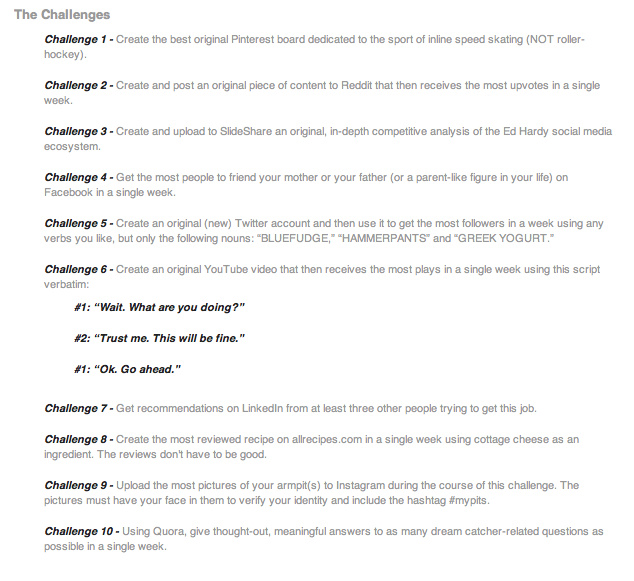
Wieden+Kennedy wants to recruit community managers for its client Old Spice, so it creates a deliberately crazy set of challenges. Candidates get five days to complete one or more tasks and submit proof of their exploits.

Cyber Warriors Challenge

Why this one works

It forces the right kind of effort. Community management is not just “posting”. It is speed, judgment, creativity, and resilience under ambiguity. A challenge-based entry filters for people who can actually do the work, not just describe it.

A small, time-boxed demonstration of the craft makes the screening signal stronger than a generic application form.

What to steal for your own recruitment

  • Recruit inside real behavior: distribute where the audience already acts, not where recruiters usually post.
  • Make the first step self-selecting: the wrong candidates should bounce naturally.
  • Keep the proof simple: “show me” beats “tell me”, but it has to be feasible in limited time.
  • Respect the audience: clever targeting works when it feels insightful, not exploitative.
  • Optimize for quality, not volume: fewer applicants can be a feature if they are better matched.

A few fast answers before you act

What is “pirate recruitment” in one line?

A job offer is packaged as a fake software download on pirate sites, so the right web designers discover the recruitment message at the moment they search for pro tools.

What is the Cyber Warriors Challenge?

A time-boxed set of tasks used as a screening step to recruit Old Spice community managers by requiring candidates to submit proof of real-world exploits.

Why do these tactics outperform standard job ads?

They target behavior, not demographics. Both approaches reach people in-context and require a small demonstration of motivation or capability.

What is the biggest risk when copying these ideas?

Trust and ethics. If the tactic feels deceptive, unsafe, or disrespectful to the audience, it can damage the employer brand faster than it attracts applicants.

How do you measure success?

Not by raw applicant volume. Track qualified applicants, interview-to-offer ratio, time-to-hire, and early performance or retention of hires sourced through the mechanic.

IKEA: Catalogue Countdown Room

IKEA: Catalogue Countdown Room

You walk into IKEA and find a room that is not finished. It is counting down. Each day the space changes again, styled with new catalogue products, like the store itself is teasing what is about to arrive.

That is the idea behind IKEA’s in-store Catalogue Countdown Room in Singapore and Malaysia. After previously re-imagining the 2013 catalogue with visual recognition technology that brought pages to life, this launch moment focuses on anticipation and theatre inside the store. It turns the catalogue release into a daily event that people can watch, not just pick up.

In practice, the countdown room is refreshed repeatedly as the countdown progresses, then broadcast live via IKEA’s Facebook presence so the excitement travels beyond the store floor.

Why a countdown room beats “catalogue is here”

Catalogue launches usually arrive with a shrug. Everyone expects them, so attention is low. A countdown reframes the arrival as something you can miss, and that creates urgency. The room format also makes the catalogue feel less like a book and more like a living set of ideas you can step into.

Extractable takeaway: If you can show visible progress on a reliable rhythm, routine product drops start to feel like a story people choose to follow.

What the mechanism is really doing

The room is a content engine. In this context, a content engine is a repeatable setup that produces fresh, shareable moments on a schedule. Each refresh creates a new “moment” for store visitors and a new visual for social, which is why the idea keeps earning attention. It can host small performances, demos, and micro-events without needing a different concept every day. The catalogue becomes the raw material.

The real question is: can you turn a catalogue release into a daily moment people choose to follow?

In omnichannel retail marketing, the most repeatable “launch” pattern is to make one physical moment behave like media, then let social distribution carry it further than paid reach alone.

What to steal for your next retail launch

  • Build one stage that can change. A single physical space that transforms repeatedly generates content without extra production locations.
  • Turn “arrival” into anticipation. Countdowns make routine drops feel like events.
  • Design for shareable proof. The room should look different enough each day that people want to show the change.
  • Let the store be the hero. When the in-store moment is genuinely interesting, social becomes documentation, not advertising.

A few fast answers before you act

What is the IKEA Catalogue Countdown Room?

It is an in-store installation that changes during a countdown to the new IKEA catalogue launch. The room is repeatedly restyled using catalogue products, and the changes are shared through social channels.

Why does a countdown create more engagement than a standard catalogue drop?

A countdown adds scarcity and rhythm. People know something is happening each day, so they return, check in, and talk about what changed instead of treating the catalogue as background noise.

What makes this an integrated campaign?

The same story runs across the store, social distribution, and supporting communications. The room creates the physical event. Social extends it beyond store visitors. The catalogue provides the content foundation.

What is the key lesson for retailers launching many new products at once?

Do not try to communicate everything at once. Create a single repeatable format that can spotlight different products over time, so attention compounds across multiple touchpoints.

What is the biggest risk with “live” retail content?

If the daily payoff is weak, people stop checking. The room needs visible change and a reason to watch each day, otherwise the countdown becomes decoration.