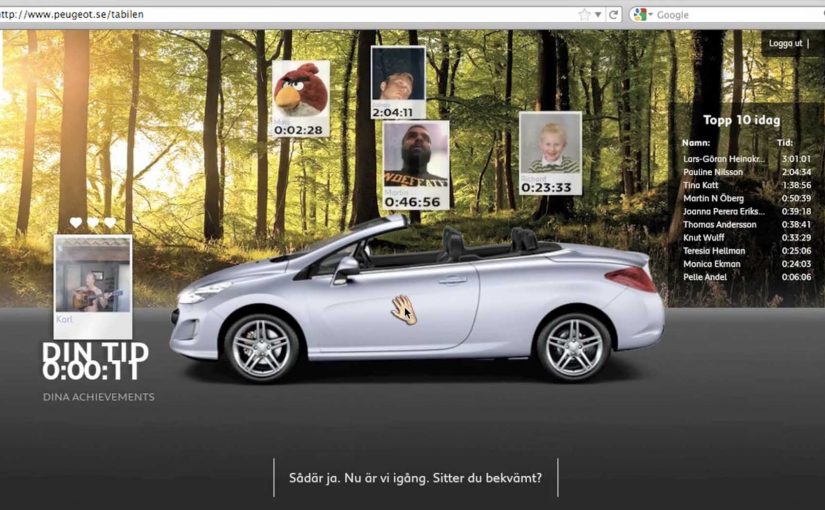
Peugeot takes the old “Touch the Car” endurance contest and drags it into the browser. Pick a model. Hold your mouse down. Stay in the game longer than everyone else. Win a week with the car you chose.
It is a simple mechanic, and that is the point. Once you connect via Facebook, you are in a live competition that rewards stubbornness more than skill, which makes it easy to understand and oddly hard to quit.
Turning a showroom stunt into a global endurance game
The mechanism is click-and-hold. A basic endurance loop that measures how long a participant can keep the mouse button pressed without letting go.
As new people join, their profile picture appears on the car in real time, so the “field” becomes visible and personal. You are not fighting a faceless counter. You are watching rivals stack up on your chosen model while the timer keeps running.
In automotive marketing, the hardest job is converting fleeting interest into a specific model preference.
The real question is whether that forced dwell time can turn into model preference before the participant quits.
Why it lands when it could have been annoying
The hook is competitive tension, but the persuasion is repetition. While contestants are locked in for hours, the site is described as feeding out thousands of words of product and sales information, turning the waiting game into a sustained exposure session.
Extractable takeaway: If you can keep someone in a voluntary “endurance” state, you can teach them a product story through repetition without it feeling like a lecture, because the learning piggybacks on a goal they already care about.
This is also a rare case where boredom is useful. The longer the challenge runs, the more a participant starts scanning details, comparing trims, and rationalizing why their chosen car is the “right” one, even if that commitment began as a game.
What the idea is really buying for the brand
At the surface, the prize is a week with a car. Underneath, the activation is building high-intent attention, first-party identity via sign-in, meaning a known participant profile tied to the challenge, and a self-selected pool of people willing to spend time thinking about a specific model.
Even if most participants drop out, they leave having stared at a car, watched other people compete for it, and absorbed a steady stream of reasons to want it. That is a strong trade versus a short pre-roll.
What to steal for your next interactive launch
- Use a one-line rule. If you cannot explain the game in a sentence, it will not scale globally.
- Make competitors visible. Real-time social proof increases stickiness and raises the cost of quitting.
- Pair the loop with education. Use the “dead time” to drip product truths and comparisons.
- Reward commitment, not mastery. Endurance mechanics attract broad participation and generate long dwell time.
A few fast answers before you act
What is Peugeot’s Take The Car Challenge?
It is an online endurance contest inspired by “Touch the Car.” Participants connect via Facebook, choose a model, and click-and-hold to stay in the competition for the chance to win a week with their selected car.
Why show competitors on the car in real time?
It makes the contest feel social and immediate. Seeing rival faces creates pressure to keep going and turns a passive timer into an active competition.
What marketing job does the endurance mechanic solve?
It manufactures dwell time. With enough time, a participant moves from casual interest to familiarity with a specific model, which is closer to purchase intent than simple awareness.
How do you adapt this pattern without making it feel like a gimmick?
Keep the rule simple, keep the reward credible, and use the time participants voluntarily give you to teach one clear product story, repeated in different angles rather than shouted once.
What makes an endurance mechanic feel fair?
Keep the rule and timer transparent, make competitors visible, and tie the reward to the product so the effort feels proportional rather than arbitrary.