Heineken Departure Roulette

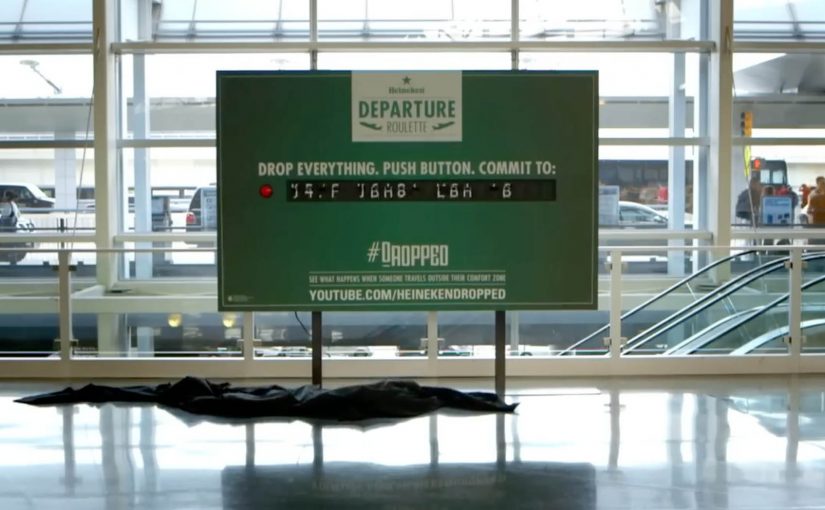
Board at JFK Terminal 8. A single red button. A real decision. To embody Heineken’s adventurous spirit, Wieden + Kennedy in New York sets up a Departure Roulette board at JFK’s Terminal 8 and dares travelers to play. If they press the button, they drop their existing plans and go somewhere totally new and exotic.

The commitment is real. The travelers who take the dare receive $2,000 to cover expenses and get booked into a hotel for two nights at the new destination. This is the recently released video of how it unfolds at JFK.

The stunt links to a broader idea. The game draws inspiration from Dropped, a Heineken campaign launched from W+K Amsterdam in which four men get sent to remote destinations, and the adventure of getting back gets filmed.

In global FMCG brand marketing, high-traffic moments like airports make public, irreversible choices unusually effective at turning a value into proof.

Why this stunt works

The power is not the prize. It is the forced, public decision moment that turns “adventurous” from a claim into an observable act.

Extractable takeaway: If your brand stands for a value, design one visible, irreversible choice that makes people either live it or walk away.

It makes spontaneity measurable

Most people can say they are spontaneous. Departure Roulette forces a binary choice in public. Press or walk away. The brand promise becomes an observable action. Because the choice is binary and public, it creates proof people can retell without needing extra context.

It raises stakes without needing complex rules

The mechanic is simple. Here, the mechanic is the single red-button press that swaps your itinerary on the spot. The tension is high. You do not need a long explanation to understand what is at risk: your plan.

It turns a brand value into a story people retell

The red button is a prop with meaning. It compresses the entire narrative into one symbol that is easy to remember, share, and debate.

The real question is whether your brand promise can survive a real, irreversible choice in front of people.

This pattern is worth copying only when the commitment and the logistics are truly real in the moment.

What to measure beyond views

  • Participation rate. How many approached travelers agree to play.
  • Completion rate. How many press the button after hearing the rules.
  • Story lift. How often people retell the mechanic correctly.
  • Brand linkage. Whether the audience connects the act to “adventurous spirit,” not just “free trip.”

Steal the red-button blueprint

  • One irreversible trigger: Reduce the experience to a single action that cannot be half-done.
  • Visible trade-off: Make what they give up as clear as what they gain.
  • Decision-first filming: Capture the seconds before and after commitment, not just the outcome.
  • Operations as creative: Treat booking, payout, and handoff as part of the story, because failure kills believability.

A few fast answers before you act

What is Departure Roulette?

A physical airport activation where travelers can press a red button and immediately swap their planned trip for a surprise destination.

Where did the activation take place?

At JFK Airport, Terminal 8, where the Departure Roulette board invited travelers to press the red button and swap trips.

What is the core mechanic?

One irreversible choice that turns a brand value into an action people can witness.

How does it connect to Heineken’s Dropped campaign?

It borrows the premise from Dropped, where participants are sent to remote destinations and the journey back becomes the story that gets filmed.

What makes it repeatable for other brands?

The format is not travel. It is a high-stakes choice with a simple trigger, a clear trade-off, and a real reward.

What is the biggest failure mode?

When the commitment is not credible, or the operations cannot deliver the promise.
Molson Canadian: The Beer Fridge

First various brands created campaigns with red buttons, then came one with a pink phone, and now Molson, a Canadian beer brand, revolves a whole campaign around bright red refrigerators.

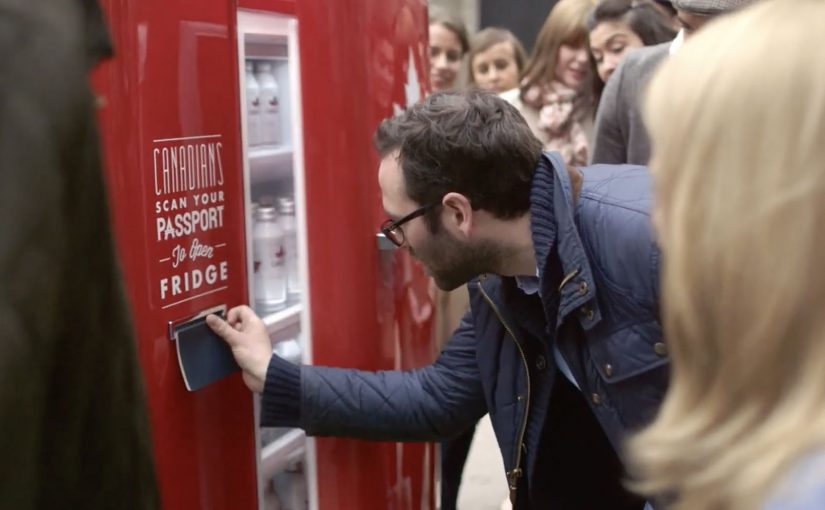
These eye-catching fridges were filled with Molson Canadian beer and strategically placed across a variety of European locations to attract crowds. The catch is simple. The fridge can be opened only by scanning a Canadian passport.

The campaign was created by Rethink Canada to bring back the classic tagline, “I Am Canadian.” The footage collected from the different locations was then cut into a longer online film and a shorter TV ad, described as running during the Stanley Cup Finals.

A gate that turns identity into a moment

The mechanism is a physical “access rule” everyone understands. Here, the access rule is simple: only a scanned Canadian passport opens the fridge. A fridge full of free beer is a magnet. The passport scan turns that magnet into a social filter, because the only way anyone drinks is if a Canadian is present and willing to open it. In one move, the crowd goes from spectators to collaborators.

In multinational brand building, national identity can easily become abstract. This makes it concrete in public, in seconds, with a prop people instinctively gather around.

Why it lands

It works because the restriction creates a mini-drama with a friendly payoff. People try. People fail. Then the “right” person arrives, the door opens, and the whole crowd benefits. The brand gets an emotional signature without needing to over-explain heritage, or wave flags on screen.

Extractable takeaway: If you want a brand idea to travel, design a simple rule that forces strangers to interact. Make the rule easy to understand, visibly enforced, and rewarding for everyone, not only the “qualified” participant.

What Molson is really reviving

The fridge is the stunt, but the strategic job is memory refresh. “I Am Canadian” is not a new line. The activation re-earns the right to say it by staging a situation where being Canadian is the key that unlocks a shared experience.

The real question is whether a legacy national tagline can earn fresh relevance without sounding like a rerun. Molson gets this right because the stunt turns identity from a slogan into a shared public reward.

What brand teams can take from it

  • Use a physical object as a social trigger. Fridges, doors, vending machines, and switches pull people in because they promise an outcome.
  • Let the rule do the storytelling. One constraint can communicate positioning faster than a paragraph of copy.
  • Make the payoff collective. If only one person wins, the crowd turns cynical. If everyone wins, the crowd turns into distribution.
  • Film what the rule creates. The best “campaign video” is documentation of real behavior the mechanic generates.

A few fast answers before you act

What is Molson Canadian’s “Beer Fridge” campaign?

It is an activation built around bright red fridges placed in public locations. The fridge opens only when a Canadian passport is scanned, turning identity into the key that unlocks free beer.

Why require a Canadian passport?

The passport requirement creates instant tension and a clear story. It forces a social moment where Canadians become the enablers, and everyone around them shares the reward.

What does this have to do with “I Am Canadian”?

The mechanic makes “Canadian-ness” functional rather than symbolic. The tagline lands as a conclusion the crowd just witnessed, not a claim the ad simply states.

Why place the fridges in Europe?

Because it creates contrast and visibility. A Canadian-only key in a non-Canadian setting produces curiosity, crowds, and a stronger “identity unlocks access” narrative.

How can another brand apply this pattern?

Choose one brand truth, translate it into an access rule, and attach a collective payoff. Then design the experience so the resulting human interactions are worth filming.

Coca-Cola: Sharing Can That Splits in Two

When “share” is built into the can

With summer coming up and an ice cold soda in your hand, people around you are bound to hope that you will share the soda with them. The normal way of doing so would be to sip from the same opening.

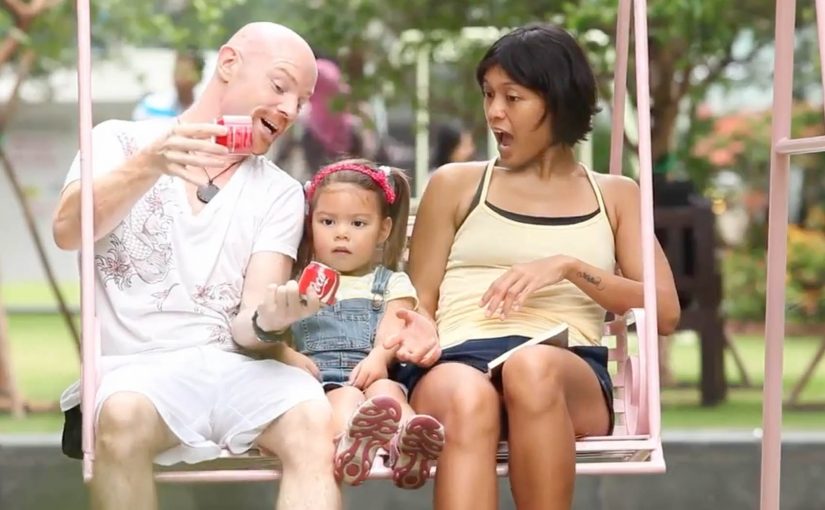
Now in an attempt to create another way of sharing happiness, Coca-Cola teamed up with Ogilvy in Singapore and France to create a shareable can of Coke that splits into two and creates two half pints. The results.

The packaging hack: one can becomes two

The can does not just contain the drink. It choreographs the moment. Split it. Hand one half over. The product becomes the gesture.

In global FMCG brands, packaging is often the fastest way to turn “share” from a line of copy into a behavior.

If the behavior matters, design it into the object. Because the can physically divides into two drinkable halves, the social negotiation disappears and the gesture becomes obvious.

Why it changes the social moment

The post nails the truth. People want a sip. This design turns that awkward micro-negotiation into a simple ritual that feels natural in the moment. Here, “ritual” means a tiny repeatable sequence anyone can copy. Split, hand one half over, drink.

Extractable takeaway: When the friction lives in a shared micro-moment, redesign the object so the desired behavior is the default, not a negotiation.

The job it solves

Create another way of sharing happiness in summer, without two people sipping from the same opening. Here, “sharing happiness” is not abstract. It is one can producing two separate openings, so two people can drink without swapping sips.

The real question is how to make sharing feel effortless and hygienic at the exact moment someone is holding the drink.

Steal the split-and-share ritual

  • Encode the behavior: If the behavior matters, build it into the object, not only the message.
  • Remove micro-friction: Design for the real scenario, then remove friction inside that moment.
  • Make the ritual portable: Create a repeatable ritual. The best ones travel without explanation.

A few fast answers before you act

What is the “sharing can” concept?

A Coke can engineered to split into two drinkable halves, creating two half pints from one can.

Who was involved?

Coca-Cola partnered with Ogilvy. The post associates the work with Singapore and France.

What moment does it target?

The everyday situation where someone has a cold drink and others around them hope they will share it.

What is the core creative move?

Turning “sharing happiness” into a physical product feature rather than a line of copy.