
Heineken Carol Karaoke

What if you were singing holiday carols to a few friends at a karaoke bar, when suddenly your performance became a concert broadcast before thousands on the Jumbotron at a professional basketball game, in Times Square and on the screens of nearly every New York City taxicab. Would you keep singing?

That is the setup behind Heineken’s Carol Karaoke. It starts as a small, friendly singalong, then flips into a “will you or won’t you” decision in seconds. Keep going and you are suddenly performing for strangers at scale. Stop and you walk away from the moment.

How the stunt works

The mechanism is deliberately clean. Invite people to sing. Reveal the twist. Put a choice in front of them with no time to overthink. The broadcast layer is what raises the stakes, but the real content is the decision itself. Because the choice arrives before people can script themselves, the reaction reads as real, which is why the clip holds attention. The real question is whether you keep singing once the room suddenly becomes the city.

It is also built for the social era without relying on a hashtag to do the work. The reaction is the story. The story becomes the share unit. Here, the “share unit” is the few seconds where the singer realizes the stakes and chooses.

In big-city holiday campaigns, the fastest route to earned attention is a simple public challenge that people can imagine themselves facing.

Why it lands

Karaoke is already a controlled embarrassment. The campaign simply stretches that discomfort from “friends in a booth” to “a city watching”. That tension creates instant empathy and instant curiosity, because nearly everyone knows what it feels like to sing badly, and nearly everyone has imagined what it would feel like to be exposed. Heineken positions itself as the catalyst for crossing that line, not the judge of the performance.

Extractable takeaway: If you want a stunt to travel, engineer one visible, time-pressured choice that viewers can feel, then make the brand the enabler of that choice, not the evaluator.

Business intent

This is branded entertainment built around social courage. It connects Heineken with celebration behavior, and it manufactures a holiday moment that people will retell, because the premise is easy to repeat and the outcome is emotionally satisfying.

Steal these levers from Carol Karaoke

  • Use a decision, not a slogan. Put real choice in the frame and you get real reaction.
  • Make the twist explainable in one sentence. If the idea cannot be retold instantly, it will not travel.
  • Raise stakes with environment, not complexity. Big screens and public broadcast do more than extra rules.
  • Cast ordinary people. Relatability is what turns “a stunt” into “I can picture myself there”.

A few fast answers before you act

What is Heineken Carol Karaoke?

It is a surprise karaoke activation where people singing holiday carols are suddenly offered a choice. Keep singing and be broadcast publicly to a much larger audience, or stop and walk away.

Why does the “will you or won’t you” structure work?

Because the content is the decision under pressure. That creates tension, authenticity, and a clear emotional arc that viewers follow in seconds.

What role do out-of-home screens play in the idea?

They turn a private performance into a public moment instantly. The scale shift becomes the stakes, and those stakes are immediately legible to anyone who has ever felt stage fright.

What makes this kind of stunt shareable?

The setup is retellable in one line, and the payoff is emotional and human. People share it to relive the moment of courage, not to explain a complicated mechanic.

How can a brand adapt this idea without a Jumbotron?

You can swap the “big screen” for any sudden jump in visibility that feels real. For example, a live in-venue feed, a public projection, a partner-owned network of screens, or an unexpected “broadcast” to a larger nearby audience.
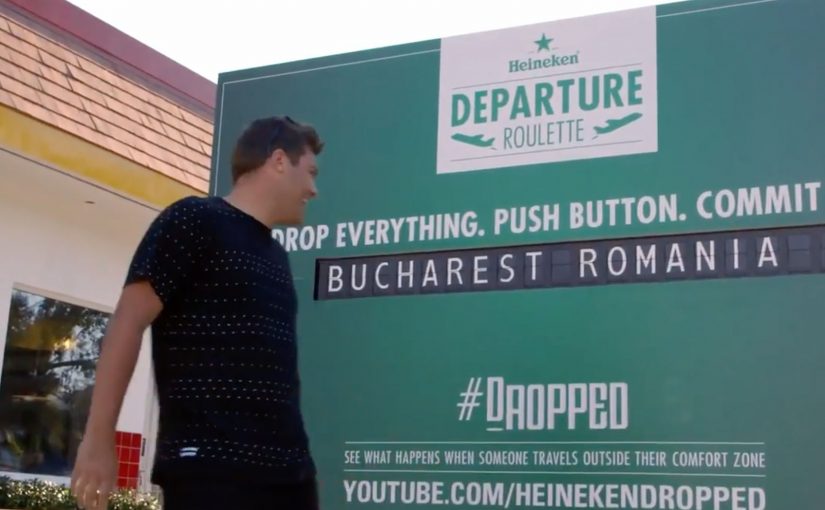

Heineken Departure Roulette En Route

Heineken spots the tweets. Then they make them real. People watch the original Departure Roulette stunt and post the inevitable line on Twitter: “I’d press the button.” Heineken takes that public intent seriously. They track down a few of the people who tweet about wanting to play. Then they offer them the chance to play Departure Roulette on the spot. Real time, real commitment, no rehearsal.

If you want the backstory first, the original Departure Roulette activation sets the frame: a physical roulette board at JFK Terminal 8. One red button. Press it and you accept a new destination immediately. Read about the original here.

What “En Route” gets right: it turns social intent into action

The smartest part of this follow-up is not the surprise. It is the mechanism. Heineken treats social conversation as a live signal of willingness, not just commentary. Here, “social intent” means an explicit public statement like “I’d press the button,” not passive engagement. By acting on that signal fast enough to feel connected, the brand turns curiosity into a credible story of commitment.

Extractable takeaway: When people declare intent in public, treat it as an opt-in trigger. Respond fast with a real commitment moment, and make the decision itself the content.

The real question is whether you can turn “I’d do that” intent into a real commitment fast enough to feel causal, while keeping consent and safety airtight.

If you cannot deliver the commitment reliably in real time, you should not run this pattern.

It rewards declared intent in public

A tweet is a lightweight commitment. Heineken upgrades it into a real decision. The gap between “I would” and “I did” becomes the content.

It closes the loop from earned media to owned experience

The original stunt earns attention. The follow-up re-enters the stream where that attention lives. Social becomes a trigger for a real-world activation, not just a distribution channel.

It stays consistent with the campaign’s core promise

Departure Roulette is about spontaneity and courage. The follow-up keeps the same proposition, just delivered to a different moment and audience.

In global consumer brands running real-time social and experience programs, the advantage comes from turning explicit public intent into a safe, opt-in moment of commitment.

What to measure beyond views

  • Intent volume. How many people explicitly say they would do it.
  • Conversion rate. Percentage of selected participants who actually commit when approached.
  • Time-to-response. How quickly you move from trigger to activation.
  • Amplification quality. Replies and quote-posts that debate “would you do it,” not just “nice video.”
  • Brand linkage. Whether the audience repeats the core idea (spontaneity, adventure), not just the prank.

Risks and guardrails that matter

  • Consent and privacy. Do not approach people in a way that feels extractive. Keep it clearly opt-in.
  • Safety and duty of care. High-stakes travel stunts need hard boundaries, support, and contingencies.
  • Credibility. The offer must be unquestionably real, or the story collapses into suspicion.
  • Operational readiness. The logistics are the product. If ops fail, the story turns.

How to reuse this pattern without copying the stunt

  1. Define the “press the button” moment. Pick one unmistakable action that proves intent.
  2. Listen for explicit triggers, not vague sentiment. Look for “I would,” “I want,” or “If you did this I’d…” rather than likes alone.
  3. Respond fast enough that it feels connected. If the follow-up arrives too late, it reads like a promotion, not a story.
  4. Make the commitment real, but safe. Build constraints on timing, eligibility, logistics, and consent.
  5. Capture the decision, not just the reward. The moment of choice is the asset. The prize is the justification.

A few fast answers before you act

What is Departure Roulette En Route in one line?

It is a social-powered follow-up where Heineken turns “I’d press the button” tweets into a real-world chance to do exactly that.

Why does it spread?

Because it stages a high-stakes, relatable decision in public: keep your plan, or choose the unknown.

What is the reusable strategy?

Treat public intent as a trigger for action. Then deliver a real experience that proves the brand promise.

What is the minimum viable version for a brand without travel budgets?

Reward declared intent with an immediate upgrade: surprise access, exclusive drop, instant appointment, or fast-track service.

Where does this go wrong fastest?

When it feels like surveillance, or when the logistics do not deliver on the promise.

Media Markt “Money Trucks”

A security team clears the street in a quiet neighborhood. Neighbors step outside. Then a tiny convoy rolls in. 193 miniature “money trucks”, each loaded with 1-cent coins, drives up to the winner’s home and unloads one million cents into a growing pile in the driveway. It is a cash delivery staged like a movie scene, except the payoff is real.

The idea in one line

Celebrate a social milestone by turning “one million” into a physical spectacle people can watch, share, and retell.

What Media Markt does to mark 1 million Facebook fans

Over the last couple of years I have seen a handful of brands reach the 1 million fans milestone. To celebrate, most of them create really nice and innovative thank-you videos. A good example is Tic Tac “Likes” Matt. Media Markt hits the same milestone, but takes a very different route. It turns the number into a physical stunt people can watch, share, and retell.

Media Markt on reaching 1 million fans on Facebook launched a contest: “How many small trucks do you need to transport 1,000,000 cents?” The activation was created by Ogilvy & Mather Frankfurt.

The business intent is simple: turn a fan milestone into participatory attention that travels beyond the Facebook page itself.

How the campaign plays out

Step 1. Start with a guess that feels simple and sticky

The mechanic is deliberately basic: one question, one number, one prize framed as a million small units. It is easy to participate, and easy to share.

Step 2. Make the prize physically absurd

The winner does not receive a bank transfer. She receives €10,000 as 1-cent coins, delivered using the exact number of miniature trucks the contest asks people to estimate.

Step 3. Turn delivery into content

The delivery is filmed as a “cash-in-transit” moment: security clearing streets, convoy arriving, coins dumped into a heap. The documentation becomes the story asset that travels beyond Facebook.

In retail and mass-market marketing, milestone campaigns travel further when the audience can see the scale in the real world, not just read the number on a screen.

The numbers that make it feel “earned”

  • The correct answer is 193 trucks.
  • The winner is in Saßmicke (western Germany), and the stunt is played as a neighborhood event, not a private handover.

Why it works

This works because the mechanic turns an abstract fan count into a visible, countable spectacle people can grasp in seconds.

Extractable takeaway: If a brand milestone matters to you, convert it into a physical event with one simple unit people can instantly understand and retell.

It converts an online number into a physical reality

“One million fans” is abstract. One million coins is instantly legible, and the convoy makes the number feel even bigger.

The stunt is engineered for repeatable media beats

Announcement. Guessing phase. Winner selection. Convoy “journey” updates. Final delivery video. The campaign creates multiple moments people can follow, not one single post.

It is brand-consistent in one glance

Electronics retail competes in a world of deals and hype. This behaves like a deal, but acts like a story. The spectacle fits the loud, “big gesture” brand posture without needing product claims.

The deeper point

The real question is how to turn a passive social milestone into a public event people want to witness and retell.

This is a better move than another thank-you video because it makes participation and spectacle do the distribution work.

If you want people to care about a community milestone, do not announce the number. Stage the number. Make it participatory, then make the payoff visual enough that the community wants to distribute it for you.

How to stage a milestone people retell

  • Turn a milestone into a game: “1 million fans” becomes a concrete challenge with one guessable number.
  • Make the prize a proof object: Delivering “1 million cents” as physical trucks makes the claim visual and press-friendly.
  • Use a single, memorable unit: “Cents” is simple. People instantly understand the scale without explanation.
  • Let the reveal be the content: The answer plus the delivery moment is the story, not a brand speech.
  • Design for retelling: If someone can summarize it in one sentence, it will travel.

A few fast answers before you act

What is the campaign mechanic?

A Facebook contest asks fans to guess how many miniature trucks are needed to transport one million cents.

What is the actual prize?

€10,000 delivered as 1,000,000 one-cent coins, transported by 193 miniature trucks.

Why does the “193 trucks” detail matter?

Because it closes the loop. The answer is not just “correct”. It becomes the logistics and the spectacle of the payout.

Who creates the campaign?

Ogilvy & Mather Frankfurt.

What is the reusable pattern?

Turn a social milestone into a simple prediction game, then make the reward delivery so visual that it becomes the main distribution asset.