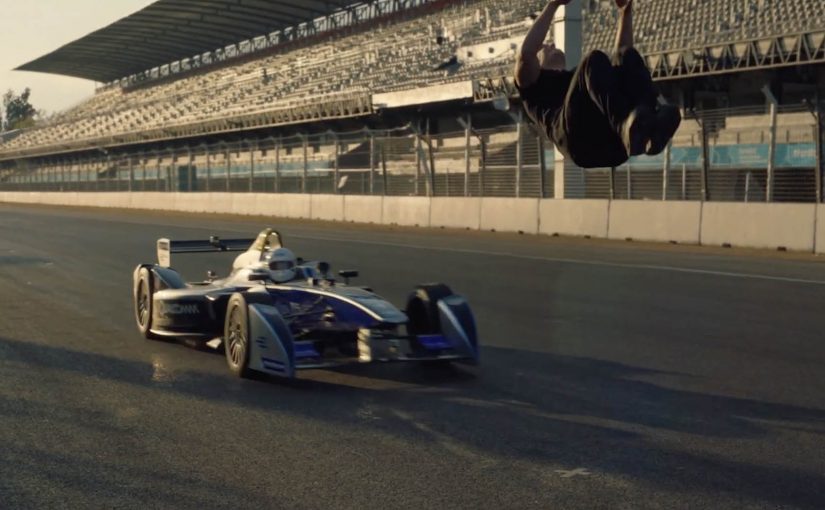
A race car comes up fast from behind. Damien Walters cannot see it. He commits anyway, throwing a backflip that clears the car at speed, landing as if it is routine.
Watch the perfectly synchronised leap below.
One trick, built on timing discipline
The mechanic is simple to describe and hard to execute. A blind backflip over a moving Formula E car. What makes it work is timing control. The driver holds a consistent approach speed, and the stunt is triggered off a repeatable timing reference so the flip happens at the exact moment the car reaches the take-off zone.
In sports branded content, the cleanest way to earn attention is to stage a single, unmissable proof where human skill and the sport’s technology meet in the same frame.
Why it lands
This is a spectacle with a clear question and a clear answer. Can he do it. Then, there it is. The real question is whether the stunt can make precision feel visible rather than merely claimed. The “blind” constraint adds tension because it removes the most obvious safety cue, and the viewer instinctively runs the risk calculation while watching. The payoff is the feeling of precision, not chaos. It reads less like danger for danger’s sake and more like controlled performance.
Extractable takeaway: If your story is “this is high-performance and precise,” build a moment where the viewer can see precision as a binary outcome, and keep the framing uncluttered enough that nobody misses the proof.
What Formula E gets out of it
The stunt borrows the language of elite motorsport. Speed, control, engineering, nerve. It also gives Formula E an easily shareable “you have to see this” asset that travels beyond core racing fans, while still feeling native to the category.
What to steal from the stunt
- Make the promise visible. Translate “precision” into a single, legible pass or fail moment.
- Add one constraint that increases tension. Blind, one-take, fixed distance, single attempt. Keep it understandable.
- Keep the shot honest. The simpler the framing, the more the audience trusts what they are seeing.
- Design for replay. If the moment is short and clean, people will rewatch and repost without needing context.
A few fast answers before you act
What is “Leap of Faith” in one sentence?
A branded stunt film where Damien Walters performs a blind backflip over a speeding Formula E car with tight timing synchronisation.
What makes the stunt feel different from a normal trick shot?
The car approaches from behind, so the timing has to be pre-controlled rather than visually adjusted, which raises tension and makes precision the headline.
Why does this format work for a sports brand?
It communicates the sport’s core attributes, speed and control, in a compact proof that is understandable even to non-fans.
What is the main creative risk?
If the production feels over-edited or overly cinematic, audiences question authenticity and the share impulse drops.
When should you use a “single proof moment” idea like this?
When your brand story is performance-based and you can express it as one unmistakable action that holds attention in the first three seconds.