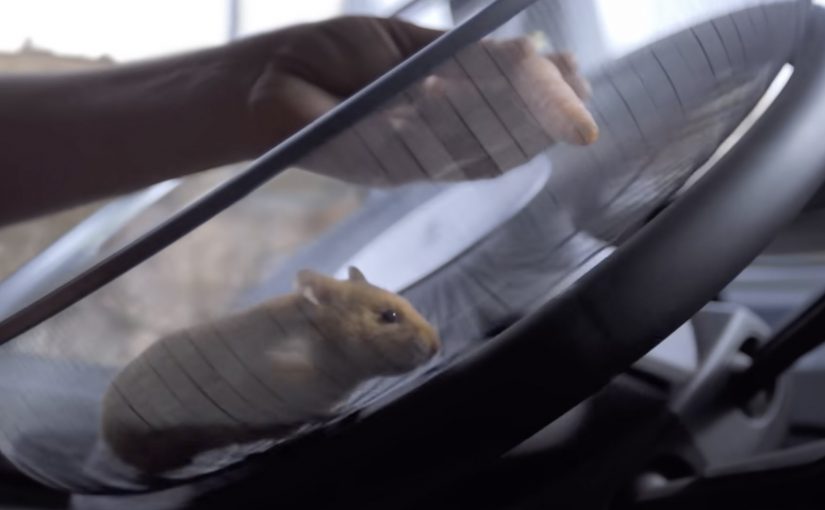
Brands everywhere are chasing branded content. Volvo Trucks picks a sharper route: it turns a technical feature into a spectacle by letting a hamster “steer” a Volvo FMX out of a quarry using Volvo Dynamic Steering.
The gag is simple to explain and hard to ignore. A hamster wheel is mounted to the steering wheel, and a precision driver handles pedals and safety while guiding the hamster with a carrot. The result feels like a ridiculous idea that somehow still proves something real.
When the product proof is the entertainment
Volvo Dynamic Steering is not an easy feature to dramatize in a way non-truck buyers want to watch. This film solves that by making “light steering” visually absurd, then grounding it with a credible live-test frame. A live-test frame is a visibly real setup that keeps the demonstration believable even when the idea is silly.
In global B2B and industrial marketing, this is a clean blueprint for turning an engineering benefit into mass-reach content without losing the proof.
The real question is whether your product proof can be watched by people who will never buy the thing.
B2B brands should bias toward demos that carry the claim in the image, not explanations that require patience.
Why the hamster works as a device
The hamster is not just cuteness. It is a proxy for “minimum force.” If a tiny animal can move the wheel, the viewer instantly understands the claim before any explanation arrives.
Extractable takeaway: If you can embody your benefit in a single visual proxy, the claim lands before the explanation.
That is the key branded-content trick: build an image that carries the message on its own, then let the technical story catch up afterwards.
Reported reach, and the deeper lesson
Volvo Trucks reports the film drew millions of views quickly, and industry press echoes that early momentum. The bigger point is not the number, it is the audience expansion. A feature aimed at fleet operators becomes something broadly watchable because the demonstration is designed like a story, not a spec.
What to copy from the hamster stunt
- Turn the benefit into a visual impossibility that still stays true.
- Keep the proof readable without narration, the image should carry the claim.
- Use a live-test frame so entertainment does not undermine credibility.
- Design a one-sentence retell, “a hamster steers a truck” is instant recall.
A few fast answers before you act
What feature is Volvo proving here?
Volvo Dynamic Steering, positioned as making the steering feel unusually light and precise even in demanding conditions.
Is the stunt “real” or purely visual effects?
It is presented as a controlled live test executed in a managed environment, with safety handled by a precision driver while the hamster influences the steering wheel.
Why does this count as strong branded content?
The product truth is inseparable from the story. The plot only works because the feature exists, which makes the content feel earned rather than bolted on.
What makes this approach effective for B2B brands?
It recruits non-buyers as viewers. When the demo is entertaining on its own, reach grows beyond the immediate purchase audience, while still reinforcing the proof.
What is the biggest risk when copying this pattern?
If the spectacle overwhelms the claim, people remember the stunt but not the feature. The visual must map cleanly to the benefit.