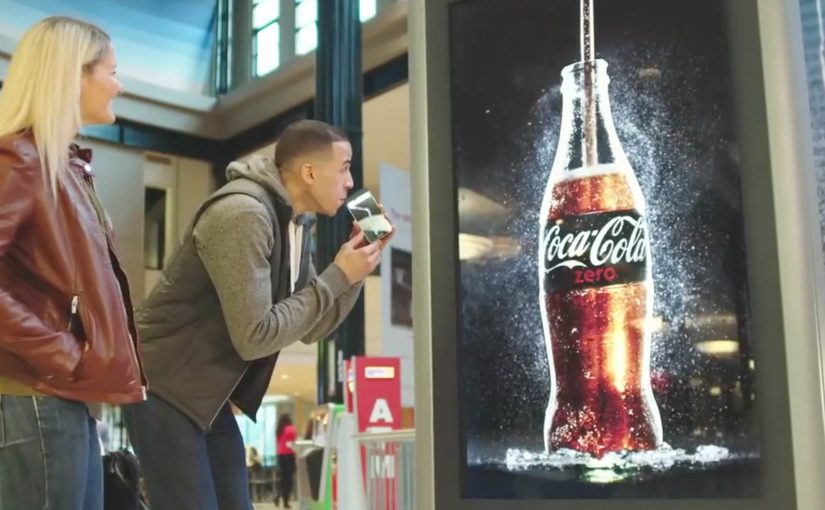
You are looking at a Coke Zero ad on a billboard, on TV, in print, or even on radio. Instead of just watching it, you Shazam it. On your phone, Coke Zero appears to pour into a glass on-screen, and that moment converts into a free Coke Zero coupon you can redeem at select retail stores across the US.
The premise is blunt and smart. Many people think they know the taste of Coke Zero, but they actually do not. So Ogilvy & Mather creates a campaign where the quickest route from awareness to belief is not another claim. It is immediate trial.
How “drinkable” advertising is engineered
This execution turns Shazam into a universal call-to-action layer across media. Here, “drinkable” means the ad triggers a mobile pour moment that turns into a redeemable coupon for immediate trial.
- Any channel can trigger the experience. Billboard. TV. Print. Radio.
- The smartphone becomes the conversion surface. Visual payoff first, then the coupon.
- The coupon bridges straight into retail. “Try it now” becomes a physical action, not a brand sentiment.
The important part is not the novelty of animation. It is the end-to-end path from message to product-in-hand, because the Shazam trigger and coupon make the next step unambiguous.
Why this works as shopper marketing, not just a stunt
The campaign is designed to reduce the classic friction points that kill trial. In performance-led shopper marketing, the fastest path from awareness to belief is reducing trial friction and making redemption immediate.
Extractable takeaway: If you want trial, design the interaction so it ends in redemption, not in more content.
- No guessing what to do next. Shazam is the behaviour.
- No abstract promise. The ad demonstrates “taste” by pushing you to the real thing.
- No delayed gratification. The reward is immediate and concrete. A redeemable coupon.
It is experiential marketing that does not require a pop-up installation or a live event. The experience travels with the media buy.
This is shopper marketing done right. It treats media as the first step of redemption, not as a detour into “engagement.”
The real question is whether your media can trigger immediate trial without adding steps or new infrastructure.
Steal this: Shazam-to-trial loop
If you are trying to drive trial at scale, this is a reusable model.
- One trigger across channels. Create a single interaction that works across channels.
- Mobile as the conversion surface. Use mobile to make the experience feel personal and immediate.
- Redemption, not delay. Close the loop with a retail mechanic that is simple to redeem.
Do that well, and “engagement” stops being a vanity metric. It becomes a measurable bridge to purchase.
A few fast answers before you act
What makes this advertising “drinkable”?
Shazaming the ad triggers a mobile experience that ends in a free Coke Zero coupon. It is designed to turn exposure into real-world trial.
Why use Shazam in the first place?
It provides a consistent interaction across media formats, including channels where clickable links do not exist.
What business problem is this solving?
Driving immediate trial for a product where many people assume they already know the taste, but have not actually experienced it.
What is the key CX detail that makes it work?
A simple, familiar action. One step to trigger, then a clear reward that can be redeemed in-store.
How do you prove this is more than a stunt?
Measure Shazam activations and coupon redemptions, then compare trial impact against a similar media buy without the redemption mechanic.