
Apotek Hjärtat: Blowing in the Wind

Apotek Hjärtat: Blowing in the Wind

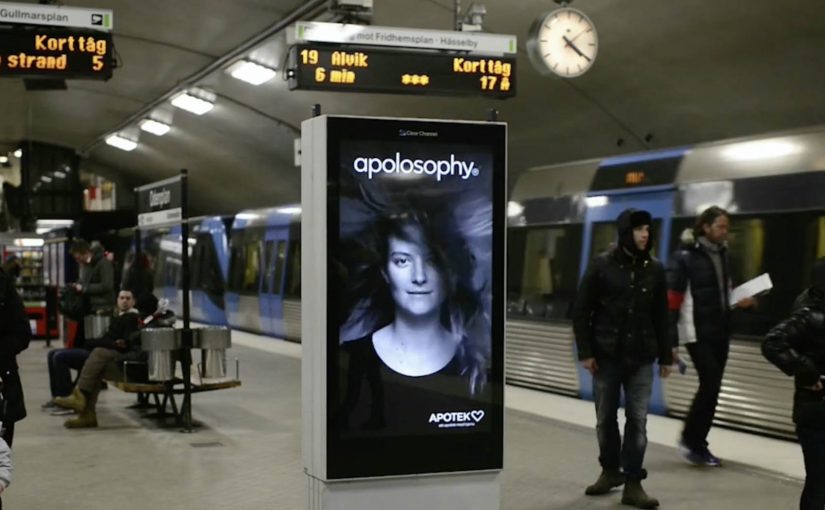
A subway platform in Stockholm. A digital screen. A model with a lush mane. Then the train arrives and her hair starts to whip around, perfectly timed to the rush of air you can feel on the platform.

To introduce a new line of hair products, Swedish pharmacy Apotek Hjärtat worked with Åkestam Holst to fit the platform screens with ultrasonic sensors. When those sensors detect an incoming train, the film switches into a “blowing in the wind” sequence, creating the illusion that the turbulence from the train is affecting the model on the screen.

The trick behind the timing

This is reactive outdoor done with restraint. Here, reactive outdoor means the screen responds to a real environmental trigger instead of running the same sequence on a fixed loop. There is no complex interface and no extra instruction for commuters. The environment provides the trigger, the sensor provides the cue, and the creative provides the payoff. The moment is over in seconds, which is exactly how long you get on a platform before attention snaps back to schedules and crowds.

In high-traffic transit environments where attention is scarce, reactive outdoor works best when it synchronizes with a real-world moment everyone already notices.

Why commuters stop

The effect feels “impossible” because it is contextual and precise. People experience the wind and see the wind at the same time. That sensory alignment is what makes it memorable, and it makes the product claim feel physical instead of cosmetic.

Extractable takeaway: If you want outdoor to earn attention, link the creative to a shared environmental trigger, and make the response immediate enough that viewers can connect cause and effect without being told.

What the brand is signaling

The story is not really about sensors. It is about vitality. The real question is whether the public moment makes the product promise feel physically true before the commuter moves on. The ad implies the product brings hair to life, then proves that idea through a living, timed reaction in a public space. You remember the feeling first, then the brand name attached to it.

What to steal for reactive outdoor

  • Pick a trigger that already exists. Trains arriving, doors opening, crowds gathering.
  • Make the payoff instantly legible. One glance should be enough to get it.
  • Use craft to hide the tech. The illusion matters more than the explanation.
  • Design for repeat viewing. Platforms are perfect for loops, because people wait.

A few fast answers before you act

What is “Blowing in the Wind”?

A reactive DOOH installation for Apotek Hjärtat where ultrasonic sensors detect an approaching subway train and trigger a film effect that makes the model’s hair appear to blow in the train’s turbulence.

What is the core mechanism?

Sensor detects train arrival. Creative switches at the same moment the real airflow hits the platform. The viewer experiences both together, which sells the illusion.

Why does it feel more persuasive than a normal screen ad?

Because it is synchronized with the physical environment. That alignment makes the message feel like something happening, not something being played at you.

What is the most common mistake when copying this pattern?

Overbuilding the interaction. If viewers need instructions, or if the trigger is unreliable, the magic disappears and the screen becomes just another screen.

Why does the product claim feel more real than in a standard beauty ad?

Because the demonstration is tied to a real physical cue on the platform. That makes the benefit feel observed in the moment, not merely claimed in the creative.
British Airways: #lookup points to planes

British Airways: #lookup points to planes

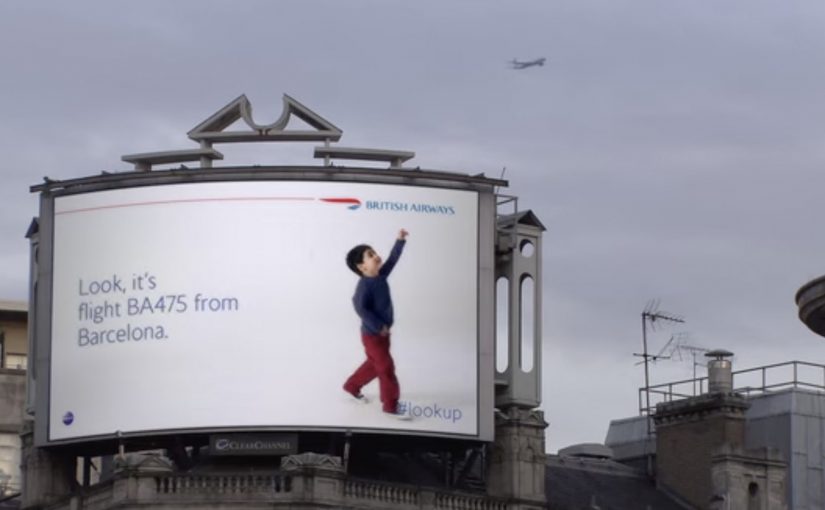
Last month, British Airways set up an interactive digital billboard in London’s Piccadilly Circus. It uses custom-built “surveillance technology” to track British Airways flights passing overhead. Here, that means identifying aircraft and matching them to British Airways flights in real time, not tracking individuals on the street.

On detecting a BA flight, the boy in the ad gets up and points to the plane. An accompanying message displays the flight number and the place it is arriving from.

In high-traffic city centres, digital out-of-home works best when it reacts to the environment rather than shouting at it.

Interactive advertisements are getting more popular with brands. In May, a Spanish organization called ANAR used lenticular printing to show different messages to kids and adults in their campaign for anti-child abuse.

How #lookup works (and what “surveillance” means here)

The magic is simple. The screen stays “normal” until the exact moment a British Airways aircraft is in view. Then the creative switches to a scene that makes you do what the boy does. You look up, spot the plane, and connect the brand to the real object above you.

“Surveillance technology” sounds heavier than what’s happening in practice. In this execution, it is reported as hardware and software used to identify aircraft and match them to British Airways flights in real time. The storytelling trigger is the aircraft, not the crowd.

Definition you can reuse: Context-aware DOOH is outdoor creative that changes based on live signals from the environment (location, time, weather, movement, or public data feeds). It works when the signal is instantly understandable and the change earns attention rather than interrupts it.

In European city-centre media buys, context-aware DOOH is one of the few formats that can earn attention without relying on volume.

Why it lands: a micro-surprise that answers a real question

Most outdoor advertising asks for attention first, and only then offers meaning. #lookup flips that order. It gives you meaning first. A child pointing at something real. Then it rewards your curiosity with an answer you cannot get from a static poster. What flight is that, and where has it come from? Because the trigger is a plane you can actually see, the data reveal feels like an answer to curiosity, not an interruption.

Extractable takeaway: If the environment makes people ask a question, your creative should answer it instantly with one human-readable data point that completes the scene.

The real question is how you turn ambient curiosity into a brand-credit moment people choose to share.

This is the rare “brand moment” where the interface and the emotion line up. A real plane prompts real curiosity. The billboard supplies the missing information. The brand gets credited for the experience.

What British Airways is really buying with this idea

At one level, it’s a smart stunt. At a deeper level, it’s a reframing of air travel. Instead of selling price, routes, or amenities, it sells the feeling of possibility and the breadth of the network.

It also turns a passive medium into an earned-media engine. When a billboard reacts to reality, people record it, talk about it, and share it because it feels like “proof,” not persuasion.

How to borrow the #lookup pattern

  • Pick a signal people already notice. Planes, trains, weather shifts, match scores, queue length, local landmarks. The trigger should be obvious without explanation.
  • Make the reaction immediate and legible. If the audience needs to read a paragraph to understand the mechanic, the moment is lost.
  • Answer a question the environment creates. “Where is that going?” is stronger than “buy now.” Build the creative around curiosity.
  • Use data as a storytelling ingredient, not a dashboard. Flight numbers and origins feel human when they complete the scene, not when they look like telemetry.
  • Keep privacy optics clean. If you must use loaded terms like “surveillance,” clarify what is being detected and what is not.

A few fast answers before you act

What makes the British Airways #lookup billboard “interactive”?

It changes its creative in real time based on a live external trigger. A British Airways aircraft passing overhead. That trigger causes the billboard to play a scene and display flight details tied to the specific plane.

Is this the same as QR codes or touchscreens in outdoor ads?

No. QR codes and touchscreens require deliberate user input. #lookup is environment-triggered interaction. The “input” is a real-world event, not a tap.

Why does real-time data improve out-of-home advertising?

Because it turns a static message into a situated experience. When the content matches what is happening around you right now, attention feels earned and the brand feels more relevant.

What’s the simplest way to replicate this pattern without complex engineering?

Use a clean, reliable signal you can access easily (time of day, weather, local transit status) and design one dramatic creative switch that is instantly visible from a distance.

What’s the biggest risk with “reactive” outdoor ads?

Overcomplication. If the trigger is rare, hard to understand, or the creative change is subtle, the concept will not land. Optimise for clarity and frequency of payoff.

Sprint: Unlimited Love Billboard in Times Square

Sprint: Unlimited Love Billboard in Times Square

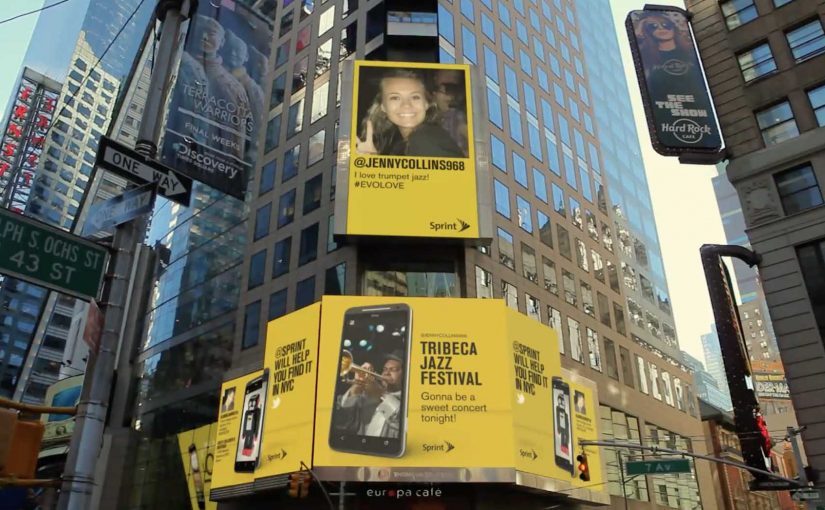
You are in Times Square and a billboard asks a simple question. What do you love. You tweet your answer with #EVOLOVE to @sprint, and the screen answers back with places in New York City where you can find it.

Sprint in the USA created an integrated advertising campaign for the launch of the HTC EVO 4G LTE phone on their network. To launch EVO in New York City they set up an interactive billboard in Times Square that encouraged visitors to tweet things they love with #EVOLOVE to @sprint. Then, with the help of local experts, the billboard re-tweeted locations of where these things of love could be discovered in New York City.

Why the mechanic works

The mechanism is a clean exchange. You give the brand a public signal. A tweet about something you love. The brand gives you an immediate, useful response. A location you can act on right now. That “reply with value” is what turns a hashtag prompt into participation.

Extractable takeaway: Interactive OOH works best when the public input reliably triggers a fast, specific reply that helps someone decide what to do next.

It also creates a visible social proof layer. The billboard is not only showing Sprint’s message. It is showing other people’s messages, which makes the campaign feel alive and current while you are standing there.

In consumer technology launches and telco marketing, a social-to-DOOH loop, where a social post immediately changes what the screen shows, turns a landmark screen into a real-time recommendation engine that people can influence from their own phones.

What Sprint is really buying

This is a launch tactic that behaves like service. It positions the EVO as a device you use to discover the city, not just a phone with specs. At the same time, it lets Sprint demonstrate “unlimited” as a lived experience. Always on, always connected, always responding in real time.

The real question is whether you can keep the reply layer fast, relevant, and brand-safe in public.

If you cannot operationalize that reliably, a simpler DOOH idea will outperform an “interactive” one that feels slow or generic.

Steal this reply-with-value billboard pattern

  • Make the input obvious. One hashtag. One handle. One sentence prompt.
  • Return something concrete. Maps, directions, a nearby place, a clear next action.
  • Curate the response layer. “Local expert” guidance beats generic automation for relevance and trust.
  • Design for the crowd and the clip. The street moment should be fun to watch. The video should still work without being there.

A few fast answers before you act

What is the Sprint #EVOLOVE Times Square billboard?

A digital billboard that invites people to tweet what they love with #EVOLOVE to @sprint, then responds by showing where in New York City they can find that thing.

Why connect Twitter to a billboard instead of running a normal DOOH spot?

Because participation becomes the content. The screen stays fresh, people feel seen, and the interaction creates a public spectacle that attracts more participants.

What is the “value exchange” in this campaign?

The user provides a public message and attention. The brand provides a timely, useful recommendation and makes the user visible on a high-profile screen.

What makes this different from simply displaying tweets on a screen?

The reply layer. The billboard does not only mirror tweets. It answers them with specific places and directions, which turns social chatter into utility.

What is the biggest execution risk?

If the responses feel slow, generic, or off-topic, people stop playing. The campaign only works when the replies feel genuinely relevant in the moment.