
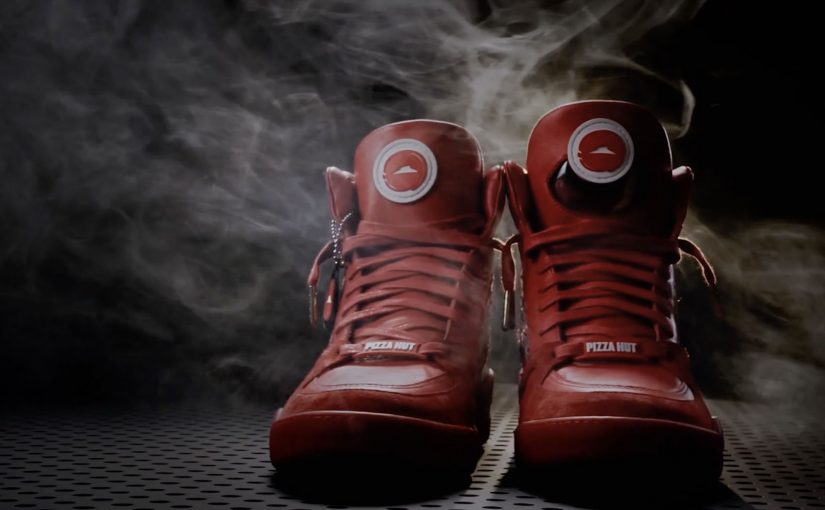
Pizza Hut: Pie Tops II

Pizza Hut is the official pizza of the NCAA, a men’s basketball tournament known informally as March Madness and played each spring in the United States.

For last year’s tournament, Pizza Hut created what was billed as the world’s first shoe that ordered a pizza. Now, to celebrate their second year as the official pizza of the NCAA, Pizza Hut, Droga5 and the Shoe Surgeon launched Pie Tops II. It is a limited-edition high top shoe that not only uses your geolocation to order the current Pizza Hut deal at the press of a button, but also allows users to pause the game while they receive their delivery.

A TV ad has also been released to highlight the new pause feature of these newly relaunched Pie Top shoes.

A sneaker button that behaves like a remote

The mechanism is deliberately simple. Put a single button on the shoe. Tie it to an app. Map the press to two jobs: order, then pause. The shoe becomes a physical shortcut for a very specific March Madness moment, when people want food but do not want to miss play. That works because it removes friction at the exact moment attention is highest.

In second-screen sports viewing, the strongest interactions reduce interruption while keeping attention on the live game.

Why it lands on game day

Pie Tops II works because it converts a familiar tension into a prop. Hunger versus attention. Convenience versus FOMO. The “pause” feature turns a delivery problem into a punchline, and the shoe format makes the whole thing instantly tellable.

Extractable takeaway: If you can turn a high-frequency habit into a one-action ritual, you make the brand feel like part of the event, not just an ad around it.

The real intent behind the novelty

This is not really about footwear. The real question is how Pizza Hut earns a place inside the live ritual instead of advertising around it. It is about owning a behavior loop during March Madness. By behavior loop here, I mean a repeatable sequence of trigger, action, and reward that keeps the brand attached to the moment. Pizza ordering, deal recall, and a reason to talk about Pizza Hut in the same breath as the game. The smart move here is not the gadget but the way it turns brand utility into event behavior. Limited-edition scarcity does the rest, because it makes the product itself a piece of shareable culture.

What brands can steal from Pie Tops II

  • Pick one moment to own: design for a specific tension that happens repeatedly during an event, not for “sports fans” in general.
  • One control, two outcomes: a single action that triggers both utility and delight is more memorable than a complex feature list.
  • Make the object do the storytelling: the product should explain the campaign in one sentence, even without a logo.
  • Build viewer control into the idea: letting people keep the game in their hands makes the brand feel helpful, not interruptive.
  • Scarcity as distribution: limited runs can function like media spend when the object is inherently talkable.

A few fast answers before you act

What are Pie Tops II?

They are limited-edition Pizza Hut sneakers designed for March Madness that let you order pizza via a button press and, as described, pause the game while you wait for delivery.

What problem is this campaign solving?

It dramatizes a familiar game-day problem. People want food without missing play. The stunt turns that tension into a memorable product feature and a shareable story.

Why does the “pause” feature matter more than the pizza-ordering feature?

Ordering is convenient. Pausing is emotionally resonant because it speaks directly to FOMO during live sports. It is the twist that makes the idea travel.

Is this wearable tech or brand entertainment?

It is primarily brand entertainment packaged as a functional shortcut. The utility makes it credible. The novelty makes it worth talking about.

What is the reusable pattern for other brands?

Create a physical or tactile shortcut for a high-frequency moment. Keep the interaction to one obvious action. Then tie it to an event where people already have strong emotions and repeat behaviors.
Bing: Decode JAY-Z

In a market dominated by Google, Bing wants to feel like a modern choice, and a younger audience is the fastest route to relevance. So it partners with JAY-Z for the launch of his book Decoded.

A book launch that shows up in the real world first

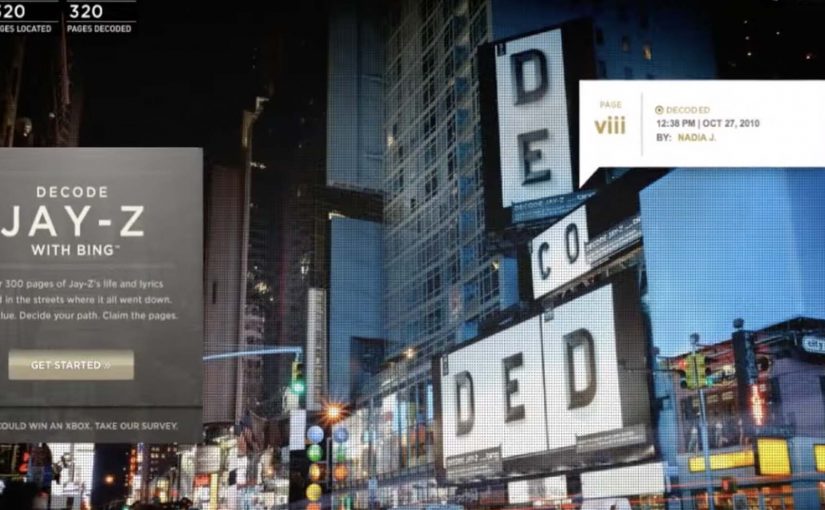
Instead of revealing the book in one place, pages are unveiled in locations referenced on those pages: a Gucci jacket, a restaurant, a hotel pool, a pool table, a car, a bus stop, and a subway. The stunt turns reading into a hunt, and turns “promotion” into something you can physically stumble into.

How the decode game works

Bing ties the physical reveals to an integrated game where fans assemble the book digitally using Bing Search and Bing Maps. Clues to page locations are released daily across Facebook, Twitter, and radio, pushing fans back into search behavior and map-based navigation as part of the entertainment.

In consumer search platforms, discovery mechanics that bridge real-world locations and digital navigation can turn a launch into participation.

Why it lands with a younger audience

The mechanics reward curiosity, speed, collaboration, and social proof. Finding a page is a story you can post. Decoding a clue is a micro-win. Watching the book come together feels like progress you helped create, not content that was simply handed to you. That works because each clue forces a Search and Maps action, so the product becomes the route to the reward.

Extractable takeaway: If you want a younger audience to adopt a utility product, tie progress to repeatable micro-wins that are easy to share.

The business intent hiding in plain sight

For Bing, the goal is not only buzz around Decoded. It is repeated usage of Search and Maps in a context where using the tools feels like play, not a utility task. The partnership borrows cultural gravity from JAY-Z, then converts it into product interaction.

The real question is whether your launch can force repeat product actions, not just cultural attention.

This is stronger than a celebrity endorsement, because it makes Search and Maps the game board instead of the backdrop.

Steal the decode launch mechanics

  • Make the “content” unlockable. People value what they have to discover, not what they are merely shown.
  • Anchor digital behavior to a physical trigger. Real locations make clues feel concrete and worth chasing.
  • Ship a daily cadence. Drip-fed clues keep attention warm without demanding long sessions.
  • Design for sharing as proof-of-work. Proof-of-work here means a visible signal that you did the effort, not just consumed the content.

A few fast answers before you act

What is “Decode JAY-Z” in one line?

A scavenger-hunt book launch where pages appear in real places, and fans use Bing Search and Bing Maps to find and assemble the book digitally.

What are the key mechanics?

Location-based page reveals, daily clues distributed through social and radio, and a digital assembly experience built around search and maps.

Why does this work better than a standard launch?

It converts passive awareness into repeat actions, and each action produces a shareable win that keeps the loop going.

What is the transferable takeaway for product marketing?

If your product is a tool (search, maps, utility apps), embed it inside a game where using the tool is the fun, not the homework.

What should you measure to know it worked?

Track repeat usage of the specific features you embedded in the game (search queries, map actions, and return visits), not only reach or mentions.

Puma: HardChorus for Valentine’s Match Day

When Valentine’s Day lands on match day

This year 14 February, Valentine’s Day, fell on a Sunday. For men everywhere this presented a dilemma. Love or football. Atletico Madrid vs Barcelona, Manchester City vs Liverpool, Napoli vs Inter, or romance with a loved one?

A love song delivered like a terrace chant

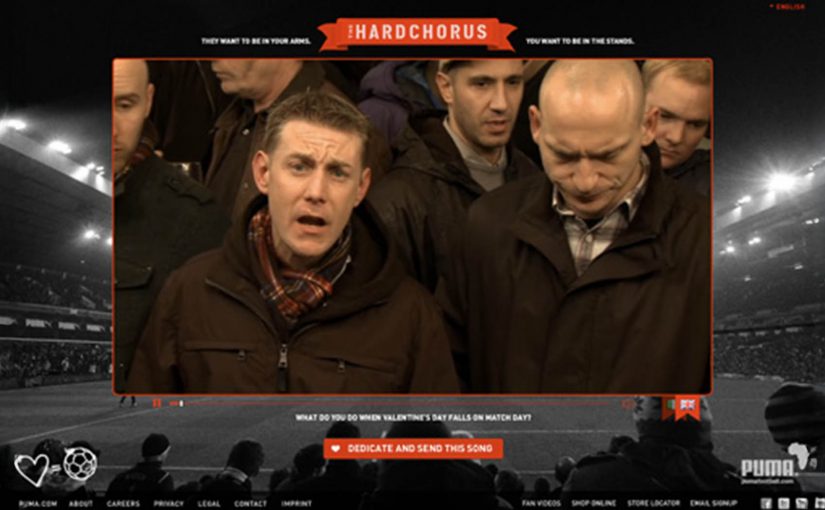
Puma recognized this dilemma as “They want to be in your arms. You want to be in the stands”, and so with Droga5 created the Puma HardChorus.

A crowd of football supporting men, assembled in a pub to sing Savage Garden’s Truly Madly Deeply, which then football fans could send to their loved ones while enjoying the game. An Italian version was also created where a similar group sang Umberto Tozzi’s 1977 hit Ti Amo.

Puma HardChorus English version:

Puma HardChorus Italian version:

In European football culture, match day is a ritual with its own language, loyalty, and emotion.

Why it works: it turns the conflict into a gesture

The genius is the tone swap. It takes the toughest-coded environment in the brief and makes it do something unexpectedly tender. That contrast creates surprise, and surprise creates shareability. It also gives the viewer control over the trade-off. You are not choosing between football and your partner. You are converting match-day energy into a message that says, “I’m here, I’m thinking of you, and yes, I’m still going to the game”.

Extractable takeaway: If a moment forces a binary choice, design a small, sendable action that turns the tension into a gesture, so the audience can keep what they love without neglecting who they love.

What Puma is really selling in the background

This is not about listing product benefits. It is about aligning the brand with a lived tension and resolving it in a way that feels culturally fluent. The real question is whether you can convert a culturally loaded trade-off into a message people are happy to send. This is a smart way to earn brand warmth without asking fans to abandon the game. Puma borrows the credibility of the stands, then uses it to deliver romance without embarrassment.

Steal the pattern: two audiences, one moment

  • Name the real conflict. This works because the tension is true, not manufactured.
  • Use a familiar cultural code. Stadium chanting is instantly recognisable and instantly readable.
  • Flip the code without mocking it. The humour is in the contrast, not in making fans look stupid.
  • Make it easy to pass along. If the output is meant to be sent, it needs to stand on its own.

A few fast answers before you act

What is Puma HardChorus?

A Valentine’s match-day idea where football supporters sing romantic songs like stadium chants, which fans can send to their loved ones while they watch the game.

What is the core mechanism in one line?

Turn terrace energy into a love message, then make it easy to share directly with the person who feels “second place” to football.

Why does the idea feel funny and effective?

Because it flips a tough-coded cultural setting into a tender gesture. The contrast creates surprise, and surprise creates shareability.

What is the audience “problem” it solves?

It resolves a real conflict between two priorities by converting match-day behaviour into a signal of care, rather than forcing a binary choice.

What is the most transferable takeaway?

If you have two audiences competing for the same moment, design a simple action that transforms the conflict into a gesture one person can send to the other.