
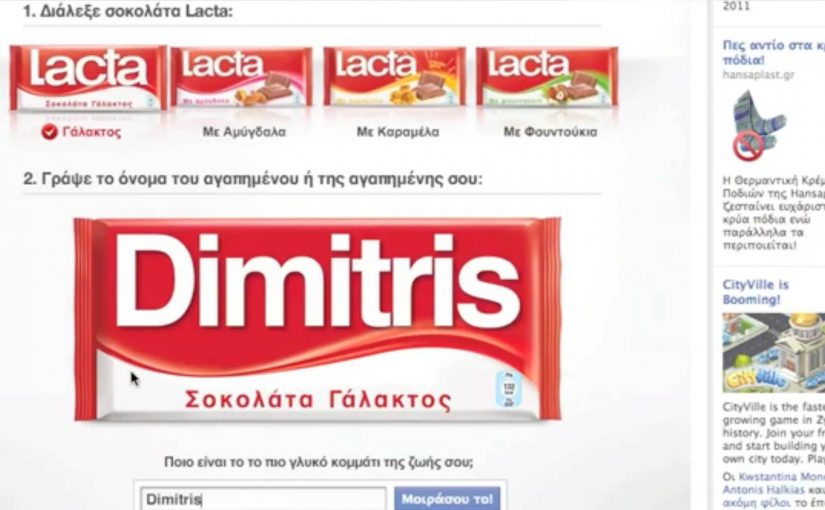
Lacta Chocolate Facebook App

You open the Lacta Chocolate Facebook app, type your loved one’s name, and customise a Lacta wrapper around them. The app matches them to a Lacta flavour, then you push it out as a wall-to-wall post. In seconds, your “love message” becomes something your friends can see, react to, and copy.

The app idea. Turn affection into something people want to publish

The app is built around a simple insight. People naturally compare their loved ones with chocolates. Lacta turns that behaviour into a lightweight creation tool, so the output is personal, visual, and instantly shareable.

Why some Facebook apps explode while others flop

Plenty of Facebook apps chase scale and get nothing. The difference usually comes down to three basics.

1) Simplicity

A couple of clicks to get to the app and to the point of action.

2) Shareability

All the standard sharing features that make it easy to spread.

3) Insight

Something a fan might actually use, comment on, and share.

Who builds it, and what the traction looks like

Once again OgilvyOne Athens gets into action and creates an app that lets people customise a Lacta chocolate wrapper in their loved one’s name and compare them to a particular Lacta flavour, before using the wall-to-wall post feature to get the message across.

In just over a month the app generates over 150,000+ fans, with thousands using personalised chocolate wrappers as profile pics.


A few fast answers before you act

What is the Lacta Chocolate Facebook app in one sentence?

It is a simple Facebook app that lets you personalise a Lacta wrapper with a loved one’s name, match them to a flavour, and share it as a wall-to-wall post.

Why does this app spread?

Because the output is personal and visual, the creation flow is fast, and the sharing mechanic is built into the final step.

What are the three success factors highlighted here?

Simplicity, shareability, and a real insight that people actually want to express publicly.

What is the key execution lesson to copy?

Make the “thing people share” the natural end product of the interaction, not an optional add-on after the fact.

Yellow Chocolate

The Yellow Pages Yellow Chocolate campaign in New Zealand has been recognised with a Gold Titanium/Integrated award, a Gold Media Lion, and a Bronze Cyber Lion at Cannes International Advertising Festival 2010.

The campaign began in August 2009 with a call for video entries for a mysterious quest of ambition. 28 year old surfer and actor Josh Winger was chosen to design, market and distribute a chocolate bar that tastes like the colour yellow, and to use only companies listed in the Yellow books, both online and mobile, in the process.

So Josh proved Yellow can help an ordinary bloke get an extraordinary job done. His was the fastest selling chocolate bar in New Zealand in ten years. People were paying $2 for what was actually a piece of direct marketing. Supermarkets were sold out and the bars were traded online for up to $320. There were 80,000 followers online, 16,000 Facebook fans, 800 Twitter followers. It was the most talked-about campaign in New Zealand with 61% recall and 27% of people talking about it in everyday conversations. Online usage grew by 9%.

Flashback Book Facebook App

You scroll through years of Facebook updates, realise how quickly your best moments disappear into the feed, then hit a button to turn them into something you can actually keep. Flashback Book takes your statuses and photos and produces a printed Facebook book you can hold.

The brief. Launch a Facebook platform without the usual gimmicks

Bouygues Télécom asks ad agency DDB Paris to come up with an idea to launch their Facebook platform. The goal is to go beyond using profile pictures in a funny way, or pranking friends with small jokes.

The insight. We post every day, then forget what we shared

DDB looks at the way we use Facebook and finds a simple truth. Even though we use the social networking site every day, we forget our favourite moments we share online. So they create an app that changes that, and keeps Facebook, in a book.

How the Flashback Book is created

Facebook ads engage people to participate in the creation of their books and receive a printed copy of their statuses and photos. You can also choose up to 10 friends to add into your book, as well as the desired timeframe, whether it is your birthday, your wedding, or from the very beginning of your profile.

Early traction

After only two days they receive 15000 fans, and the limited edition of 1000 books are gone in only an hour.


A few fast answers before you act

What is Flashback Book in one sentence?

It is a Facebook app concept that turns your statuses and photos into a printed book, so your favourite moments live outside the feed.

What choices does the user control?

You choose the timeframe and can include up to 10 friends, which makes the book feel personal and event-based rather than generic.

Why does a physical book work as a social idea?

Because it flips ephemera into permanence. It turns “endless scrolling” into a curated artefact you can keep, gift, and revisit.

What is the key execution lesson here?

Make participation lightweight and the output tangible. When the reward is a real object, the motivation to complete the flow increases.