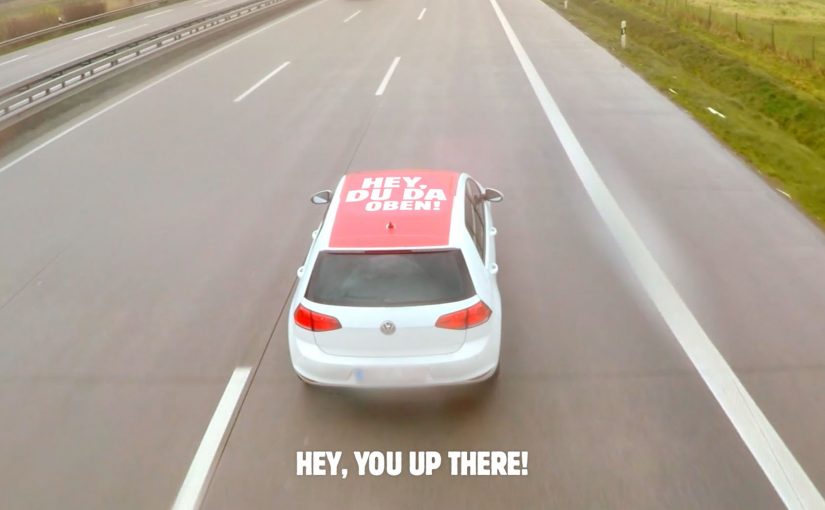
Due to strict laws, reportedly around 13,000km of the German motorway network is ad-free. So to convince truckers in Germany to buy freshly grilled Whoppers, Burger King and agency Grabarz & Partner create ads that only truckers can see. The ads sit on the roof of multiple cars that take turns overtaking trucks.
The cars do not just show an ad. They run a sequence of messages that feels like a conversation from the road:
- “Hey, you up there!”
- “You look hungry!”
- “Why don’t you try out the Whopper?”
- “Fresh and flame grilled”
Once the first few cars get the truckers’ attention, the remainder guides them to the next Burger King, turning the motorway into a moving funnel:
- “If yes, then wink”
- “Follow me to Burger King”
As a result, many truckers give in to temptation and follow the cars to the next XXL Burger King Drive-In.
The constraint that forces the creativity
The starting point is the limitation. Large parts of the German motorway network are ad-free, so the classic roadside billboard play is unavailable at scale.
The execution is “roof media” plus choreography
Here, “roof media” means ads mounted on the roofs of overtaking cars so truck drivers can read them clearly from above.
Burger King turns overtaking cars into a media surface and a delivery system. Roof placements ensure the message is visible from the truck cab. A rotating set of cars keeps the sequence going long enough to land.
The craft is the choreography. It is not one clever line. It is a paced interaction that escalates from attention, to appetite, to direction.
Why this works as shopper marketing in motion
The strength of this idea is that it turns media, message, and route into one conversion system. It works because the format, the sequence, and the physical route all point to the same next action: pull in at the next drive-in.
Extractable takeaway: When the audience is already moving toward a purchasable moment, the strongest creative system is the one that removes the need to interpret the ad and simply guides the next step.
In roadside retail and travel-heavy categories, the scalable advantage often comes from linking visibility, direction, and store access in one uninterrupted journey.
The real question is not how to make drivers notice the message, but how to turn that moment of notice into a low-friction detour.
The business aim is immediate drive-in visits from truckers who are already on the road and close to a Burger King location.
It also respects context. Truckers are not asked to scan, click, or search. They are asked to notice, react, then follow.
What to steal from Truckvertising
- Turn constraints into the brief: Start with a hard constraint and treat it as a design brief, not a blocker.
- Match the format to the moment: Use a format the audience cannot ignore in their context, in this case overhead visibility from a cab.
- Design a behaviour sequence: Build a sequence that moves from attention to action, not a single punchline.
A few fast answers before you act
What is “Truckvertising” in one line?
Car-roof ads overtake trucks on ad-free motorways, deliver messages to truckers, then guide them to the next Burger King drive-in.
Why put the ad on the roof?
The roof is the placement truck drivers can reliably read from the higher truck cab as cars overtake them.
What is the conversion mechanic?
A staged sequence of overtaking cars gets attention, builds appetite, then provides directions to the next Burger King.
Why does the sequencing matter?
The idea is not one static message. Repeated overtakes let the campaign move from attention, to appetite, to direction.
What is the underlying business aim?
The goal is immediate local store visits and Whopper purchase intent from a high-propensity audience already in transit.