Burger King Truckvertising

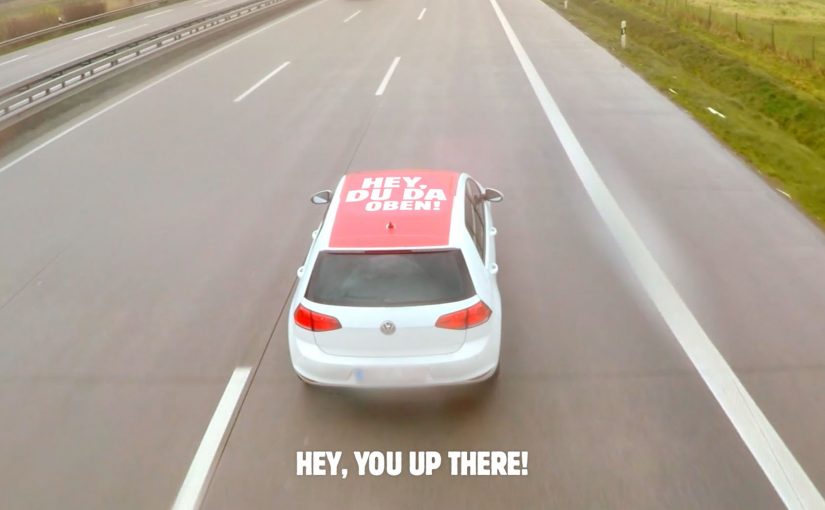
Due to strict laws, reportedly around 13,000km of the German motorway network is ad-free. So to convince truckers in Germany to buy freshly grilled Whoppers, Burger King and agency Grabarz & Partner create ads that only truckers can see. The ads sit on the roof of multiple cars that take turns overtaking trucks.

The cars do not just show an ad. They run a sequence of messages that feels like a conversation from the road:

  • “Hey, you up there!”
  • “You look hungry!”
  • “Why don’t you try out the Whopper?”
  • “Fresh and flame grilled”

Once the first few cars get the truckers’ attention, the remainder guides them to the next Burger King, turning the motorway into a moving funnel:

  • “If yes, then wink”
  • “Follow me to Burger King”

As a result, many truckers give in to temptation and follow the cars to the next XXL Burger King Drive-In.

The constraint that forces the creativity

The starting point is the limitation. Large parts of the German motorway network are ad-free, so the classic roadside billboard play is unavailable at scale.

The execution is “roof media” plus choreography

Burger King turns overtaking cars into a media surface and a delivery system. Roof placements ensure the message is visible from the truck cab. A rotating set of cars keeps the sequence going long enough to land.

The craft is the choreography. It is not one clever line. It is a paced interaction that escalates from attention, to appetite, to direction.

Why this works as shopper marketing in motion

This is direct response built into a live environment. The target is already in a vehicle. The call-to-action is a drive-in. The next best action is physically nearby, and the message literally leads the way.

It also respects context. Truckers are not asked to scan, click, or search. They are asked to notice, react, then follow.

What to steal

  • Start with a hard constraint and treat it as a design brief, not a blocker.
  • Use a format the audience cannot ignore in their context, in this case overhead visibility from a cab.
  • Build a sequence that moves from attention to action, not a single punchline.

A few fast answers before you act

What is “Truckvertising” in one line?

Car-roof ads overtake trucks on ad-free motorways, deliver messages to truckers, then guide them to the next Burger King drive-in.

Why put the ad on the roof?

Because the goal is visibility from the truck cab.

What is the conversion mechanic?

A staged sequence of overtaking cars that gets attention, then provides directions to the next Burger King.

What is the underlying business aim?

To drive immediate, local store visits and Whopper purchase intent from a high-propensity audience in transit.

100% Real Virtual Reality

A passerby in Tbilisi puts on a VR headset and starts touring Ireland. Irish countryside. The streets of Dublin. A traditional Irish bar. Then the headset comes off, and the “virtual” bar is suddenly real. A pop-up pub has been built around them in seconds, complete with actors and Irish stereotypes, and beer in hand. The reveal does not explain the slogan. It makes the slogan unavoidable.

The idea in one line

Use virtual reality as misdirection, then land the brand promise by turning the “virtual” experience into a physical surprise.

What happens in the stunt

Old Irish is a new craft beer entering Georgia. Leavingstone takes a line that could sound like every other beer claim, “100% real,” and makes it literal.

  1. Invite the public into VR
    People on the streets of Tbilisi are offered a VR “tour of Ireland,” including nature, Dublin streets, and a typical Irish bar.
  2. Build the punchline in real life
    While they are inside VR, a crew builds a pop-up Irish bar around them. The space is filled with actors performing how locals imagine Ireland.
  3. Reveal the brand promise as a lived moment
    The moment the headset comes off, the audience is already “in Ireland,” except it is physically there, and the product is part of the scene.

Why this works

Beer marketing often tries to borrow authenticity through language. This one manufactures it through experience.

The proof is theatrical, but the reaction is real

The campaign bets on ordinary people’s genuine surprise. That reaction becomes the content people want to share.

VR is not the product. VR is the setup

Virtual reality is used as a temporary attention lock so the physical transformation can happen without explanation. The innovation is the transition, not the headset.

The brand promise is delivered in one clean, repeatable beat

“100% real” is not argued. It is demonstrated when the environment jumps from virtual to physical.

Results the agency reports

Leavingstone states the video is posted with a modest placement budget, reaches more than 50% of internet users in Georgia, hits 1 million views in 72 hours, and is followed by first-month sales of 515,698 liters, described as 2x.

The deeper point

When a category leans heavily on claimed authenticity, the advantage goes to the brand that can turn authenticity into an event. This is not “VR marketing.” It is live communication disguised as emerging technology.


A few fast answers before you act

What is the core mechanic?

A VR tour of Ireland distracts participants while a real pop-up Irish bar is built around them, so the reveal converts “virtual” into physical.

Why use VR at all?

It creates a believable reason to pause someone in public, and it buys time to build the physical environment unnoticed.

What makes it shareable?

The surprise is immediate, visual, and human. Ordinary people’s reactions are the story engine.

What is the transferable pattern?

Use an emerging-tech interface as a controlled setup, then deliver the brand promise through a physical, social payoff people can experience together.

What is the biggest risk?

If the reveal does not map cleanly to the product truth, the stunt becomes spectacle with no belief gain.

Herta Knacki FootBall: The Football Machine

Herta, described as a Nestlé brand in Belgium, launched Knacki FootBall. Small meatballs designed to look like footballs. Instead of relying on standard sampling, the brand and BBDO Brussels turned a train-station moment into a game people could not ignore.

At Antwerp Central Station, a vending machine offered the product for free. Then came the twist. Press the button and the machine opened into a miniature football pitch, with Belgian football legend Leo Van Der Elst waiting inside. To walk away with the snack, you had to score.

In high-traffic commuter environments, the best sampling ideas turn “free” into a short challenge with a story-worthy payoff.

Free is easy. Earning it is memorable.

The mechanic is deliberately unfair in the right way. People approach expecting a quick handout. The reveal forces a choice. Walk away, or step in and play. That decision point creates tension, and tension creates attention.

Standalone takeaway: Sampling gets retold when it includes a moment of risk or effort. The product becomes a trophy, not a giveaway.

A vending machine that behaves like a stadium

The physical design does most of the communication. The moment the door opens, everyone nearby understands what is happening. It becomes a spectator event, which is crucial in a station setting where most people do not want to stop unless something is already happening.

Why the celebrity opponent matters

Leo Van Der Elst is not a generic “host.” He is the difficulty setting. His presence turns the activation into a genuine duel, and that makes the outcome feel earned whether you win or lose. It also gives the content a built-in headline when the story travels online.

What the brand is really reinforcing

Knacki FootBall is a novelty product, so the job is not deep education. It is instant association. Football. Fun. A quick bite. The machine makes those associations physical, then anchors them to a specific place and moment people remember.

What to steal from The Football Machine

  • Build a single, obvious action. Press the button. The rest happens to you.
  • Make the reveal legible from 10 meters away. If bystanders cannot decode it fast, you lose the crowd effect.
  • Turn sampling into a challenge. Effort increases perceived value and shareability.
  • Use a real “difficulty signal.” A credible opponent or constraint makes the game feel legitimate.
  • Design the exit. Winning should end with a clear reward and a clean photo moment.

A few fast answers before you act

What is Herta Knacki FootBall “The Football Machine”?

It is a vending machine activation where commuters expecting a free sample discover a miniature football pitch inside, and must score a goal to win Knacki FootBall.

Where did the activation run?

It is described as being installed at Antwerp Central Station in Belgium.

Why use a vending machine for a food launch?

Because it creates a familiar expectation. Then you can subvert it. That contrast generates surprise, crowd attention, and strong word of mouth while still delivering the product sample.

What makes this work in a train station specifically?

Stations are full of people who are time-poor. A reveal that is instantly understandable, plus a short game loop, can stop people without requiring explanation.

What is the biggest operational risk with this kind of live activation?

Throughput and safety. If the game takes too long, queues become friction. If the experience feels unsafe or embarrassing, people avoid participation and the crowd effect collapses.