
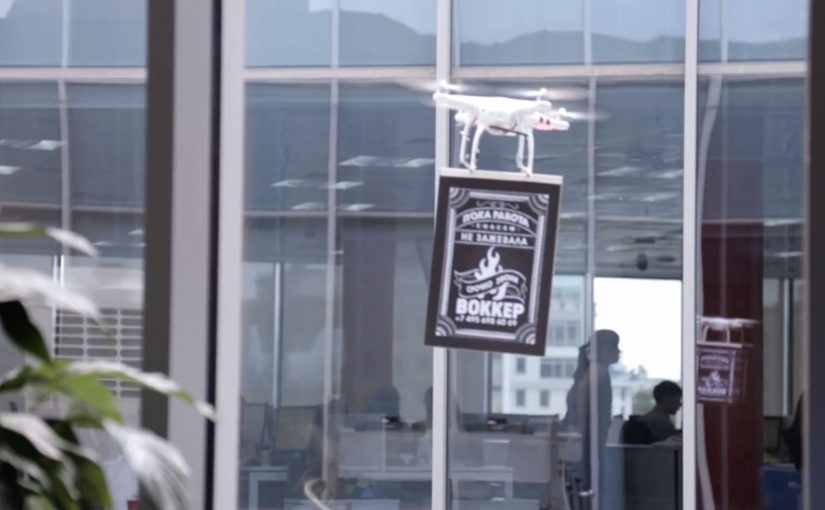
Drone-vertising: Wokker and Cup Noodles

Unmanned aircraft have been used to carry out military strikes, to film weddings, and are also being explored for product delivery from companies like Amazon, Netflix, Francesco’s Pizzeria and Flower Delivery Express.

Until the legalities of commercial use are cleared up by local governments, companies in Russia and Brazil go ahead with what are described as early drone-vertising campaigns. Drone-vertising is using drones as moving media, either by flying banners through high-attention locations or by staging a delivery moment that doubles as a filmed ad.

Airspace as a new media channel

The mechanism is straightforward. Put a message or a product on a drone. Fly it where the audience is already looking. Capture the moment on video so the stunt can travel beyond the people who witnessed it live. Because the drone enters an uninvited sightline, it creates surprise, which is why the filmed moment gets retold and replayed.

In dense urban districts where attention is scarce, brands keep searching for formats that create surprise without requiring new screen time.

The real question is whether the brand promise stays clear when the novelty fades, or whether the drone becomes the headline and the product becomes the footnote.

Russia

As ordinary advertising channels continue to be congested, Russian creative agency Hungry Boys uses drones to advertise noodle company Wokker.

Wokker banners are attached to drones and flown around high-rise business buildings in Moscow’s financial district, drawing the attention of office workers as the drones pass windows. The campaign is described as driving deliveries in the targeted area up by 40%.

Brazil

Cup Noodles, the instant ramen noodles snack from Nissin-Ajinomoto, is promoted in Brazil with drones dressed as cows, chickens, corn cobs and shrimps. A two-and-a-half minute film created for the brand’s online campaign uses drones to take Cup Noodles to surfers, skateboarders and highline walkers as they practise their sport.

Why drone-vertising gets noticed

This format works because it breaks the normal media contract. People do not expect ads to appear outside their window, and they do not expect “delivery” to arrive from above. The novelty is doing most of the work. The brand then benefits from the retelling, because the story is easy to summarise and the footage is inherently watchable. Drone-vertising is only worth doing when the brand meaning is unmistakable and the safety story is boring.

Extractable takeaway: If you are betting on a new attention surface, make the idea legible in one glance and one sentence. The stunt must communicate the category benefit instantly, otherwise the drone becomes the headline and the brand becomes a footnote.

Rules worth stealing before you fly ads

  • Target a context with a clear “why now”. Wokker links to lunch-time office hunger. Cup Noodles links to being hungry while out doing sport.
  • Design for cameras as well as eyeballs. You need a clean visual read at distance, plus a story that survives reposting.
  • Keep the stunt safe and bounded. The moment you look reckless, the conversation turns from clever to irresponsible.
  • Prove impact carefully. If you cite uplift, be ready to explain what changed, where, and for how long.

A few fast answers before you act

What is drone-vertising?

It is using drones as moving media. Either by flying banners through high-attention locations or by staging a delivery moment that doubles as a filmed ad.

Why does it work particularly well near offices or public hotspots?

Because the audience is concentrated and the environment is predictable. A drone appearing in a controlled corridor creates surprise without needing people to opt in.

What is the biggest brand risk?

Safety and permission. If the flight looks uncontrolled or disruptive, attention quickly becomes negative and the brand is blamed for the intrusion.

How do you keep the idea from becoming “tech for tech’s sake”?

Tie the drone to a simple product truth that the audience recognises instantly, like lunch delivery urgency or on-the-go convenience, then make that truth the focus of the footage.

What should you measure before you claim “uplift”?

Define the exact area and time window the stunt covered, choose a baseline for comparison, and separate what changed because of the flight itself versus what changed because the filmed story spread online.
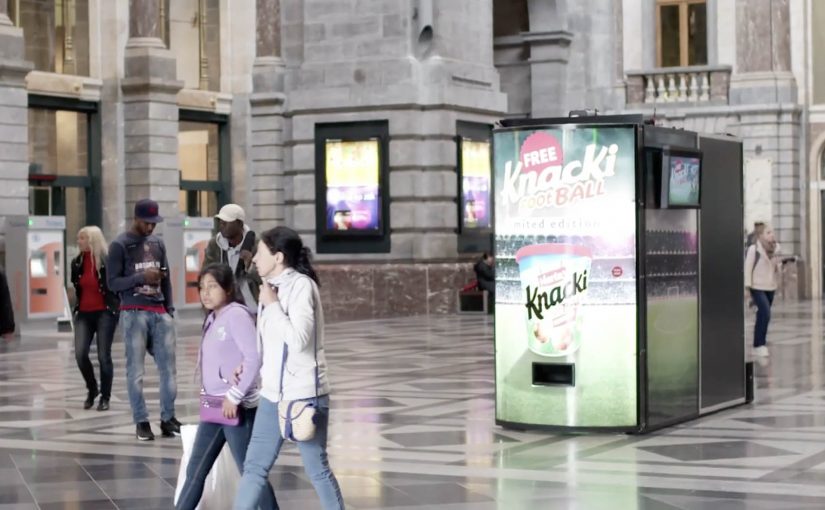
Herta Knacki FootBall: The Football Machine

Herta, described as a Nestlé brand in Belgium, launched Knacki FootBall. Small meatballs designed to look like footballs. Instead of relying on standard sampling, the brand and BBDO Brussels turned a train-station moment into a game people could not ignore.

At Antwerp Central Station, a vending machine offered the product for free. Then came the twist. Press the button and the machine opened into a miniature football pitch, with Belgian football legend Leo Van Der Elst waiting inside. To walk away with the snack, you had to score.

Free is easy. Earning it is memorable.

The mechanic is deliberately unfair in the right way. People approach expecting a quick handout. The reveal forces a choice. Walk away, or step in and play. That decision point creates tension, and tension creates attention. In high-traffic commuter environments, the best sampling ideas turn “free” into a short challenge with a story-worthy payoff. The real question is whether your sampling moment earns attention before it earns a bite.

Extractable takeaway: Sampling gets retold when it includes a moment of risk or effort. The product becomes a trophy, not a giveaway.

A vending machine that behaves like a stadium

The physical design does most of the communication. The moment the door opens, everyone nearby understands what is happening. It becomes a spectator event, which is crucial in a station setting where most people do not want to stop unless something is already happening.

Why the celebrity opponent matters

Leo Van Der Elst is not a generic “host.” He is the difficulty setting. His presence turns the activation into a genuine duel, and that makes the outcome feel earned whether you win or lose. It also gives the content a built-in headline when the story travels online.

What the brand is really reinforcing

Knacki FootBall is a novelty product, so the job is not deep education. It is instant association. Football. Fun. A quick bite. The machine makes those associations physical, then anchors them to a specific place and moment people remember.

How to copy The Football Machine

  • Build a single, obvious action. Press the button. The rest happens to you.
  • Make the reveal legible from 10 meters away. If bystanders cannot decode it fast, you lose the crowd effect.
  • Turn sampling into a challenge. Effort increases perceived value and shareability.
  • Use a real “difficulty signal.” A credible opponent or constraint makes the game feel legitimate.
  • Design the exit. Winning should end with a clear reward and a clean photo moment.

A few fast answers before you act

What is Herta Knacki FootBall “The Football Machine”?

It is a vending machine activation where commuters expecting a free sample discover a miniature football pitch inside, and must score a goal to win Knacki FootBall.

Where did the activation run?

It is described as being installed at Antwerp Central Station in Belgium.

Why use a vending machine for a food launch?

Because it creates a familiar expectation. Then you can subvert it. That contrast generates surprise, crowd attention, and strong word of mouth while still delivering the product sample.

What makes this work in a train station specifically?

Stations are full of people who are time-poor. A reveal that is instantly understandable, plus a short game loop, one attempt that takes seconds, can stop people without requiring explanation.

What is the biggest operational risk with this kind of live activation?

Throughput and safety. If the game takes too long, queues become friction. If the experience feels unsafe or embarrassing, people avoid participation and the crowd effect collapses.

Jung von Matt/Alster: The Trojan Font

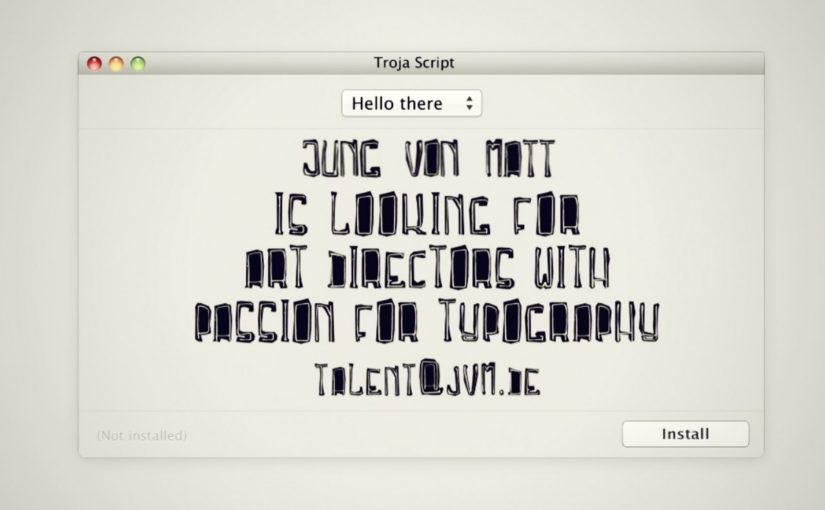
To reach designers with a passion for typography, Jung von Matt/Alster created a font of their own. Dubbed “Troja Script,” the typeface hides a recruitment ad where you’d normally expect the standard font preview.

Uploaded to free font websites, the font turned the download flow into a hiring funnel. Instead of “Aa Bb Cc,” the preview text itself carried the job pitch, so the first interaction with the product was the message.

Why the font format is the perfect carrier

Fonts are one of the few “free resources” designers actively seek out and evaluate with intent. That evaluation moment is intimate. You’re zooming in, testing, imagining usage. Replacing the preview with a recruitment message means the ad arrives when attention is already high and the audience is self-selected.

In creative industry hiring, embedding the application hook directly into a designer’s natural workflow can outperform broad employer-brand messaging.

Why this lands

This works because the medium is the filter. If you’re downloading free fonts, you’re likely the exact kind of person the agency wants to talk to. The message also feels earned rather than intrusive, because it appears inside a utility the user chose to access.

Extractable takeaway: If you’re recruiting for a specialist craft, place the pitch inside a tool or asset that specialists already pull into their process, so the channel itself does the targeting.

The business intent underneath

The stronger move is not to promote the vacancy more loudly, but to place it inside a behaviour that already signals fit.

The real question is how to turn a specialist asset into a self-qualifying hiring channel.

The campaign turns three steps into one. Discovery, qualification, and application. The reported outcome is a high ratio of signal to noise, because downloads come from the right community, and applications come from people who actually noticed and understood the move.

What this teaches about workflow-native recruiting

  • Make the artefact do the targeting. Put your message inside something only the right audience will seek out.
  • Embed the pitch in the default interaction. Use the “preview” moment, not an extra landing page.
  • Keep the twist legible. If the audience needs explanation, the hack loses momentum.
  • Measure the whole funnel. Track not just reach, but qualified actions (downloads) and outcomes (applications).

A few fast answers before you act

What is the “Trojan Font” idea?

It’s a font distributed through free font sites where the preview text is replaced with a recruitment message, turning a download into a hiring touchpoint.

Why target designers through free font websites?

Because that’s where typography-minded designers actively browse and evaluate resources, so attention and relevance are naturally high.

What makes this more effective than a normal job ad?

The audience is self-selected, and the message arrives inside a workflow moment, so it feels like discovery rather than interruption.

What result did the campaign report?

It was reported to generate around 14,000 downloads and 23 job applications for the open role.

How can other companies adapt the pattern?

Create a useful specialist asset, distribute it where specialists already look, and embed the hiring hook in the default usage or evaluation step.