
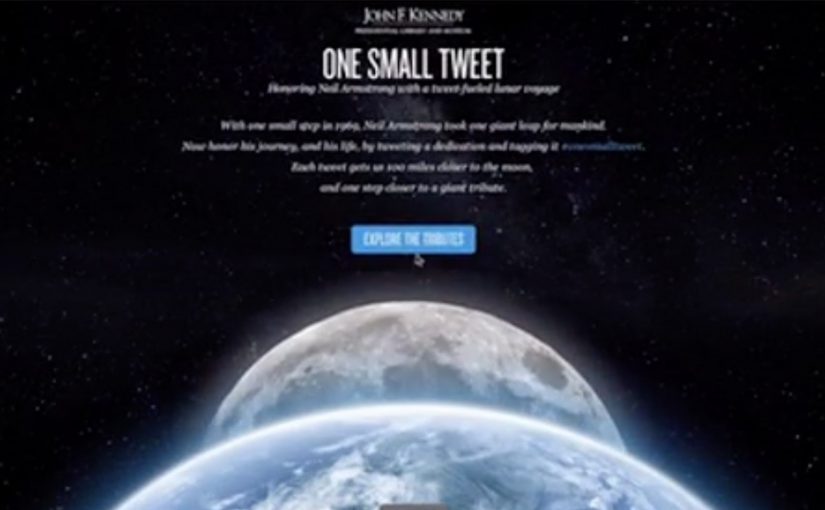
One Small Tweet: A Virtual Voyage to the Moon

A tribute that turns participation into progress

Neil Armstrong was the astronaut who took one small step for man and one giant leap for mankind. He was also the man who delivered on John F. Kennedy’s promise to be first to the lunar surface.

Neil passed away in August 2012. To honor his life, The Martin Agency created “One Small Tweet”. A roughly 238,900-mile virtual voyage to the moon powered by tweets written by admirers around the world.

Click here to watch the case video on the AdsSpot website.

How One Small Tweet works

People posted tributes tagged with #onesmalltweet. Those tweets were aggregated on www.onesmalltweet.com and used as “fuel” for the trip. Each tweet advanced the voyage by 100 miles, so the memorial was something you could watch move forward, one contribution at a time.

In cultural-institution storytelling, social participation becomes meaningful when individual contributions stack into a visible collective outcome.

Why it lands

The idea avoids the usual problem with online tributes. They are heartfelt but static. Here, the tribute has motion and a shared goal, which gives people a reason to join even if they do not know what to say at length. The real question is how to make remembrance feel collective instead of archival. This is a stronger tribute format than a static condolence wall. This works because every tweet visibly moves the same journey, turning private tribute into shared momentum. That progress mechanic, a visible journey meter that advances with each tweet, also makes the scale of remembrance legible. You can see the crowd forming, not just assume it exists.

Extractable takeaway: When you need mass participation, give people a simple action and attach it to a public progress measure. The progress becomes the story people return to and share.

What it teaches about social mechanics

  • Make the unit of contribution small. A tweet is low effort, so participation friction stays low.
  • Make accumulation visible. A journey meter turns separate tributes into one collective narrative.
  • Anchor the mechanic in meaning. The moon distance is not random. It is the symbolism that makes “100 miles per tweet” feel earned.
  • Design for global inclusion. Hashtags travel across borders faster than platform-specific formats.

A few fast answers before you act

What is “One Small Tweet”?

It is a tribute campaign that used tweets tagged #onesmalltweet to power a virtual journey to the moon, turning individual messages into visible collective progress.

How did tweets move the voyage forward?

Each tweet was treated as fuel. The mechanic advanced the trip by 100 miles per tweet, creating a progress narrative people could follow.

Why does a progress mechanic help participation?

It makes contributions feel consequential and connected. People can see their action add to something larger than a single post.

What’s the transferable pattern for other campaigns?

Use a small, easy action. Aggregate it in one place. Show cumulative progress in a way that reinforces the campaign meaning.

What is the main risk with this approach?

If the progress representation is unclear or updates feel unreliable, participation drops. The experience has to feel responsive and real.
Volkswagen #Polowers: Tweet-Powered Race

Volkswagen Polo is one of the most desired cars amongst the youth of Spain. To make a big entry DDB Spain created a Tweet based race that would make VW Polo the most trending topic on Twitter for that day.

A special hashtag #Polowers was created in order to give a name to the VW Polo Followers. Then to generate conversation amongst the Polowers a race was setup where each tweet took the follower to the first position. In this context, a tweet-based race means every tweet with the #Polowers hashtag updates a live leaderboard.

The real question is: how do you turn a low-effort social action into sustained participation during a short launch window?

This is a smart mechanic because it turns public rank into the content people return to influence.

When the Polo stopped at one of the 5 designated stops, the follower in the first position at that time would win a prize, iPad, Denon Ceol music system, Leica D-Lux 5 camera, VW Bike and eventually the grand prize VW Polo itself.

In terms of results, the campaign generated more than 150,000 tweets in 8 hours after launching, at a rate of 5 tweets per second and reached more than 10% of Twitter’s total audience in Spain. It also became the leading Top 10 trending topic and generated a record breaking amount of traffic to Polo’s product section on Volkswagen.es.

Last year Mercedes-Benz had created a tweet based race that had real life cars fueled by tweets. Check out that campaign here.

Why this mechanic works

This is a clean real-time loop. Tweeting is the action. Rank is the feedback. Prizes are the incentive. The “race” gives people a reason to keep going, because every new tweet can change the leader. Because rank shifts are immediate and visible, people keep tweeting to defend or steal the top spot.

Extractable takeaway: If you make the user action measurable and publicly visible in real time, participation grows because people can see their impact instantly.

  • Identity creates belonging. #Polowers turns followers into a named group.
  • Progress is instant. One tweet changes position immediately.
  • Time pressure drives volume. Five stops create multiple “now” moments.
  • Reward cadence sustains momentum. Smaller prizes build toward the grand prize.

In European launch campaigns that need fast, time-boxed social momentum, a live leaderboard loop like this helps convert attention into repeat action inside a single mechanic.

What to take from this if you run social campaigns

  1. Design a loop that explains itself. If the rule fits in one sentence, participation scales.
  2. Make the scoreboard the content. Rankings create a story people want to influence.
  3. Use milestones. Stops and deadlines create peaks instead of a flat timeline.
  4. Measure beyond buzz. Here the campaign also drove traffic to the Polo product section, not just tweets.

A few fast answers before you act

What was Volkswagen #Polowers?

It was a tweet-based race in Spain where participants used the #Polowers hashtag, and tweeting moved them into first position in a live competition for prizes and a chance to win a VW Polo.

How did the prize mechanic work?

When the Polo stopped at one of five designated stops, the follower in first position at that moment won a prize. The grand prize was a VW Polo.

What were the reported results?

More than 150,000 tweets in 8 hours, around 5 tweets per second, reaching more than 10% of Twitter’s total audience in Spain, plus Top 10 trending status and record traffic to Volkswagen.es Polo pages.

Why did the hashtag matter?

#Polowers gave the community a name and made participation visible, searchable, and easy to join.

What is the transferable lesson?

If you turn a simple action into a live competition with clear milestones and meaningful rewards, social participation can compound quickly.

Aldo: Ring My Bell

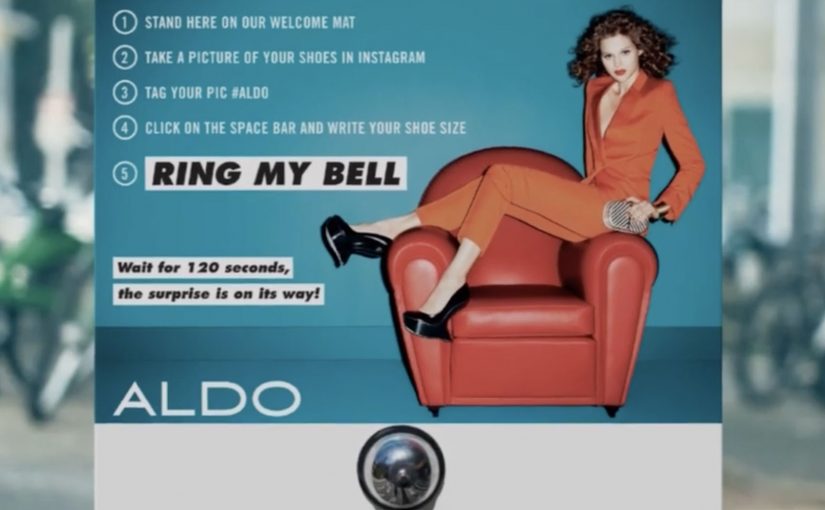
You stand on a welcome mat in the middle of the street, photograph your shoes, post to Instagram with #ALDO, add your shoe size, then ring a bell and wait 120 seconds. If you complete the steps, you get a surprise gift.

How the stunt turns a hashtag into a real-world trigger

The mechanism is a five-step participation script, a fixed sequence of actions that any passer-by can copy, that converts street curiosity into a trackable social action. The welcome mat marks the “stage”. The Instagram post captures proof and size data. The bell is the commitment moment. The 120-second wait creates tension. Then the brand pays off with a physical surprise delivered to the participant.

In high-footfall urban shopping streets where social posting is second nature, the fastest activations are the ones that turn a simple post into an immediate, tangible reward.

Why it lands

This works because it is friction-light and outcome-heavy. The instructions are short enough to follow at a glance, and the payoff happens quickly enough that the crowd stays to watch. The bell and countdown also make the moment public, which naturally pulls in the next participant.

Extractable takeaway: If you want social behaviour in the wild, write the participation flow like a street recipe. One clear prompt, one proof action, one suspense beat, one fast reward.

What the brand is really buying

The real question is not whether a hashtag can spread, but whether it can trigger a public action that proves the reward is real. This is less about reach in the abstract and more about engineered proof. By engineered proof, the brand makes the promised reward visible in real time so the next person believes it will work for them too. People do not just see a poster. They see someone trigger a reward in real time, which makes the campaign feel trustworthy and repeatable.

What to steal from a street-triggered reward loop

  • Make the call-to-action executable in under a minute. Anything slower loses passers-by.
  • Use a public commitment moment. A bell, button, or scan turns observers into a queue.
  • Time-box the suspense. The 120 seconds creates attention and crowd energy.
  • Design the payoff for spectators too. The best street rewards recruit the next person automatically.

A few fast answers before you act

What is “Ring My Bell”?

A street activation where pedestrians post a shoe photo to Instagram with #ALDO and their size, ring a bell, wait 120 seconds, then receive a surprise gift.

What is the core mechanism?

A simple participation script that links a social post to a physical reward, with a short countdown to keep attention on-site.

Why collect shoe size in the post?

So the reward can be prepared or matched quickly, and so the brand can fulfill immediately without follow-up friction.

What makes this work as OOH?

It turns signage into an interaction, and it makes the result visible to everyone nearby, which creates instant social proof on the street.

What is the safest reusable lesson?

Build an offline-to-online loop where the social action is the trigger, and the reward is fast enough to be witnessed in the moment.