
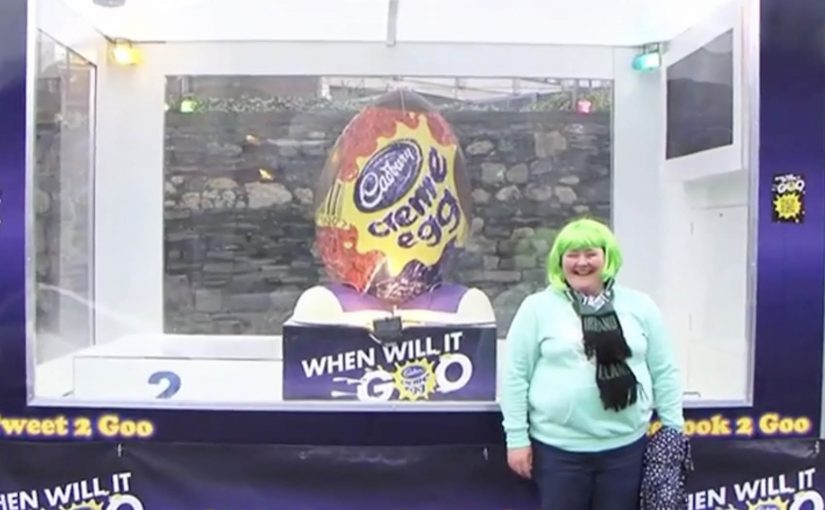
Cadbury Creme Egg: When Will It Goo

Cadbury, along with agency MCsquared Dublin, created an integrated campaign that enlisted the Irish public to help their giant Creme Egg release its Goo. Here, “Goo” is the campaign’s shorthand for the public release moment.

Eight rocking giant eggs, each protected in a transparent case, were placed around Dublin. Fans were asked to tweet “Goo” using #tweet2goo or enter via the campaign Facebook app. Every tweet and Facebook post made the egg get more “egg-cited” until it “egg-sploded”.

The entire Goo event was broadcast live on the Cadbury Ireland Facebook page, and participants were automatically entered into a draw to win tickets to the London 2012 Olympic Games.

From social input to physical payoff

The mechanic is a simple loop with a strong public proof moment. People post. The installation reacts. The reaction builds suspense. Then the payoff happens in public, with a clear “we did that” feeling for anyone who participated.

In Irish FMCG launches where seasonal products rely on impulse and talk value, turning participation into a shared street spectacle can earn attention that paid media cannot easily buy.

Why it lands

This works because it turns a familiar product truth, the goo, into a shared mission. Because people can see progress building toward a public release, each post feels consequential rather than disposable. The spectacle turns remote social actions into something you can physically witness, and the ticking progress effect gives people a reason to keep posting and to pull friends in. The live broadcast also gives the event a second stage, so even people not in Dublin can follow along and contribute.

Extractable takeaway: If you want social participation at scale, design a public system where every small action visibly moves a shared object toward an inevitable moment. The promise of that moment does the acquisition work.

What the campaign is really buying

It is not just awareness. It is repeat behavior during a short seasonal window. The real question is how to turn a short seasonal sales window into repeat participation instead of one-off attention. The hashtag and the Facebook entry mechanic reward persistence, and the prize draw adds a practical reason to participate even if you are not nearby.

What to steal for seasonal participation campaigns

  • Make the participation rule obvious. One hashtag, one word, one job.
  • Translate digital actions into physical feedback. That is what creates credibility and excitement.
  • Build suspense, not just a reveal. Progress is a stronger engine than surprise.
  • Give it two stages. Street spectacle plus a live stream extends the audience.
  • Add a lightweight incentive. A draw works best when the core experience is already fun.

A few fast answers before you act

What is “When Will It Goo”?

A Cadbury Creme Egg activation where tweets and Facebook entries drive giant public eggs toward a live “goo-splosion” moment.

Why does the physical installation matter?

It turns online participation into something visible and real, which increases belief, excitement, and sharing.

What is the role of the hashtag?

It is the simplest participation interface. It makes the action easy to repeat and easy to recruit others into.

What is the biggest execution risk?

If the installation feedback is slow, unclear, or unreliable, people stop participating because they cannot see impact.

How can a smaller brand replicate the pattern?

Use one shared object, one simple input, and one visible progress signal. The object can be smaller, but the loop must stay legible.
Disney: Mickey Mouse brings magic to NYC

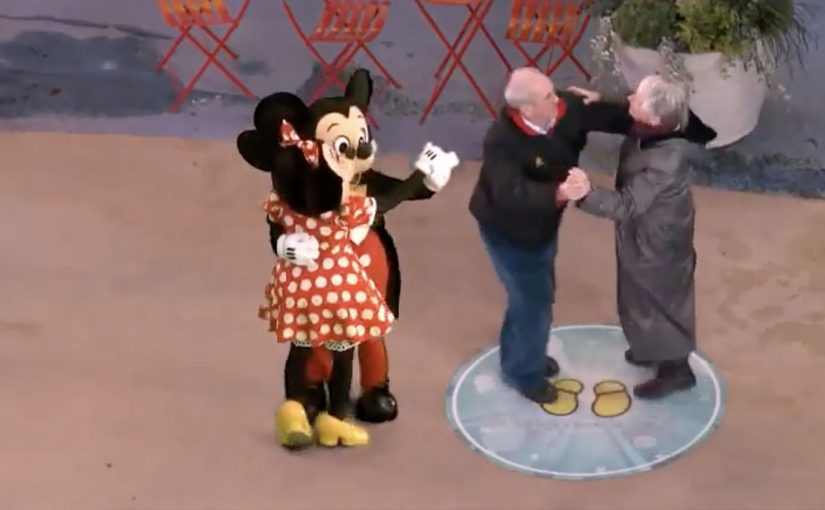
You step into the Disney Store in Times Square and suddenly you are “in” a Disney moment. A live screen blends you into a scene and Mickey appears alongside you, reacting in real time as the crowd watches.

Disney Parks uses the installation to celebrate Mickey Mouse’s 83rd birthday this month, turning a store visit into a small piece of theatre that people naturally photograph and share.

The mechanism is straightforward. A live camera feed captures guests, then an augmented reality layer places Disney characters and effects into the scene so it looks like the magic is happening around you, not only on a separate screen.

In flagship retail environments, live augmented reality installations convert foot traffic into shareable content by making the store itself behave like media.

The real question is whether the experience makes bystanders feel like they are watching a story, or watching a demo.

Disney is also using a Twitter hashtag #DisneyMemories to track the experiences at Times Square and the campaign, so the physical moment has a simple, searchable social trail.

Why this lands in Times Square

Times Square is already a stage. The installation does not fight the noise with more noise. It creates a personal moment inside the noise, where the viewer becomes part of the story. That shift from watching to participating is what earns the stop-and-stare crowd.

Extractable takeaway: In a loud environment, the winning move is not bigger spectacle. It is giving each guest a personal, camera-ready moment the crowd can understand instantly.

Hashtag as a lightweight amplification layer

The hashtag is not the idea. It is the plumbing. It lets Disney connect hundreds of individual “I was there” posts into one visible stream, without asking people to learn a new platform or download anything beyond what they already use.

The same live AR pattern shows up elsewhere

This style of live augmented reality is showing up more often in brand-led events, because it creates instant participation without complex instructions. You have already pointed to similar executions from National Geographic and Lynx, where the screen becomes a “portal” and the audience becomes part of the scene.

What to steal for your own live-event experience

  • Make the first second readable. People should understand what is happening from across the room.
  • Design for bystanders. The crowd experience matters, because the crowd is the distribution engine.
  • Attach one simple social handle. A hashtag or keyword is enough when the moment is already worth sharing.
  • Keep the tech invisible. The audience should remember the feeling, not the hardware.

A few fast answers before you act

What is the Mickey Mouse Times Square augmented reality installation?

It is a live in-store experience at the Disney Store in Times Square that places guests into a real-time scene with Disney characters using an augmented reality layer on a live camera feed.

Why does this work as a retail activation?

Because it turns a store visit into a participatory moment. People do not just browse. They become part of a scene worth filming and sharing, which extends reach beyond the store.

What role does #DisneyMemories play?

It creates a single social thread for many individual posts, helping Disney track and aggregate the shared experiences without adding friction to the in-store moment.

How is this different from a typical photo booth?

The difference is live spectacle. The experience is designed to be watched by a crowd in real time, so bystanders become part of the energy and the story travels further.

What is the most common failure mode for live AR event installs?

Confusion and delay. If people cannot instantly understand what to do, or if the experience queues too long, the crowd dissolves and the social output drops sharply.

Fey & Co: Lullaland

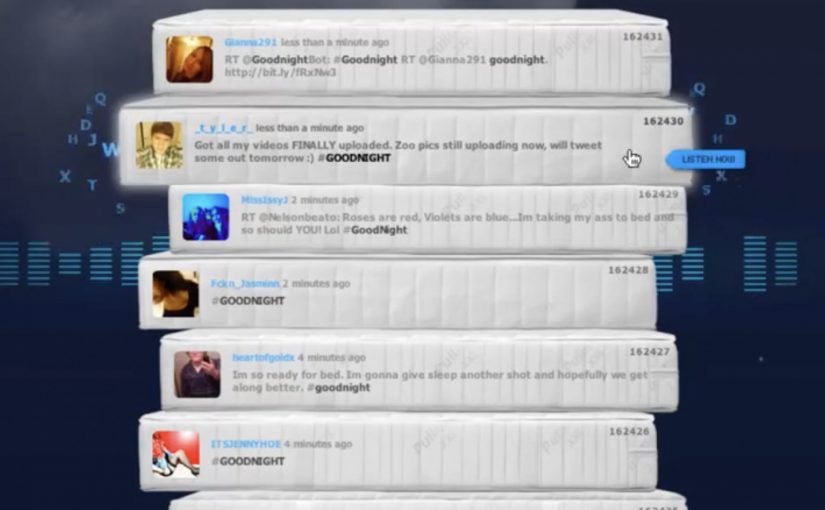
Around the world, people say good night on Twitter, often with #goodnight. Jung von Matt/Elbe collected those tweets for mattress manufacturer Fey & Co and turned them into a daily, shareable sleep ritual.

Every good night tweet automatically became part of the campaign. With a simple retweet, users were invited to www.lullaland.net, where short tweets were converted into melodic “lullatweets” for the world. Fey & Co positioned itself as an ambassador for good sleep inside the bedtime behavior of a digital generation.

How Lullaland turns tweets into lullabies

The mechanic is a tight translation loop. Capture tweets containing the hashtag. Convert the letters into tones to generate a simple melody. Store and present the results as a browsable collection, so each new tweet becomes both content and invitation. That works because the system turns an existing bedtime signal into branded content without adding effort.

In consumer categories built on comfort and routine, attaching the brand to an existing nightly habit is a durable way to earn repetition without forcing a new behavior.

Why it lands

It respects the moment. “Good night” is already intimate and low-energy, so the idea stays lightweight and fits the mood. The conversion from text to sound also makes participation feel magical without requiring people to do anything beyond what they already do, tweet.

Extractable takeaway: When you want to own an emotional territory, do not only advertise the feeling. Embed the brand into a recurring micro-ritual, then turn real audience behavior into the content that keeps the ritual alive.

What the brand is really buying

This is not a mattress demo. It is salience at the exact time the category is most relevant, right before sleep. Each contribution expands the library, each retweet can recruit new contributors, and the campaign accrues credibility because it is built from real messages rather than brand copy.

The real question is how a sleep brand earns a place in the bedtime habit before the purchase decision is even active.

What to steal from Lullaland

  • Use an existing verb. Build on a habit people already perform daily, then add one small layer of transformation.
  • Translate data into emotion. Turning text into music creates feeling fast, even when the input is mundane.
  • Make participation automatic. Lower friction by letting normal behavior qualify as entry.
  • Create a browsable archive. A growing collection gives the idea longevity beyond a launch spike.

A few fast answers before you act

What is Lullaland in one sentence?

A campaign that collects #goodnight tweets and converts them into short lullaby-like melodies, linking Fey & Co to a nightly digital ritual.

Why does converting tweets into music matter?

It turns a familiar social action into an emotional artifact, which makes the participation feel more meaningful than a normal hashtag post.

What makes this effective for a mattress brand?

It shows up at bedtime, uses real “good night” behavior, and reinforces sleep as a cultural moment rather than a product feature list.

What is the main risk with ritual-based campaigns?

If the experience is slow, confusing, or repetitive, people do it once and stop. The conversion has to feel instant, and the output has to feel varied enough to revisit.

What should brands copy from this idea?

Start with a recurring user behavior, add one simple transformation that creates emotion, and make the output easy to browse or share so the system keeps renewing itself.