
JetBlue: Nothing to Hide

JetBlue’s ground rule for the sky

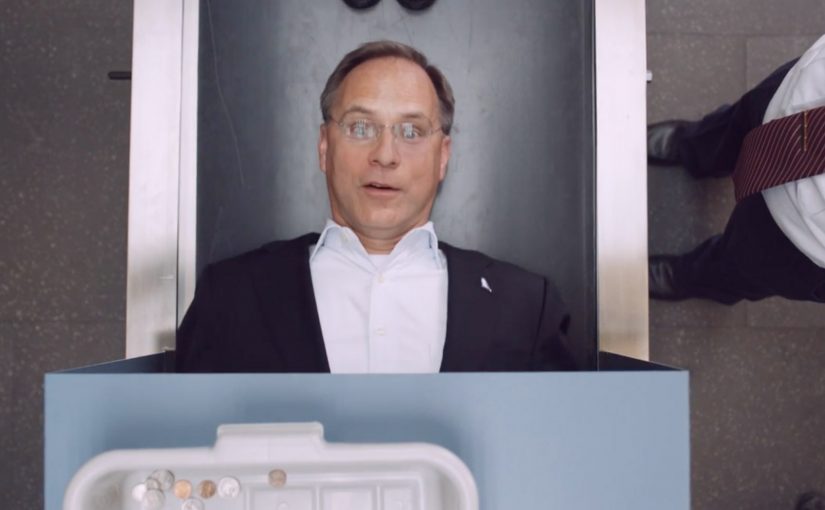
JetBlue has a new credo: “If you wouldn’t take it on the ground, don’t take it in the air.” The carrier’s first ads from Mullen were described at the time as using hidden cameras in Manhattan to illustrate the point. The clip that’s still available is the CEO version. JetBlue’s CEO, Dave Barger, has a lot to say and nothing to hide.

What this execution is really selling: transparency as a brand behavior

This is not a product demo. It is a credibility play. By “credibility play,” I mean a trust-building move where behavior and voice do the convincing, not feature claims. Putting the CEO front and center makes the promise feel like an internal standard, not just a campaign line. Because leadership voice is hard to outsource, the claim reads as accountable, not decorative.

When a service brand uses leadership voice in a short spot, it is trying to compress distance: less “corporate statement,” more “here’s what we stand for.”

In service categories where trust is fragile, a simple fairness test plus a human spokesperson can communicate differentiation faster than feature claims.

In high-frequency service categories, transparency only lands when it is expressed as a behavioral rule customers can reuse without you in the room.

Why the credo works

The line is a mental model. It creates a “ground test”: if a behavior feels unacceptable in a taxi, store, or restaurant, it should feel unacceptable in an airplane cabin too. That reframing lets people judge the category with everyday rules they already believe in.

Extractable takeaway: If you can turn your promise into a simple test people apply to new situations, you get a platform that travels faster than feature claims.

The business intent hiding in plain sight

This is competitive positioning disguised as common sense. The brand is implicitly calling out industry behaviors customers resent, then claiming the moral high ground by promising not to play those games.

The real question is whether you can name a rule customers can repeat and use to judge you.

Even if you never remember the details of the ad, you remember the test. That is the goal.

Moves behind a repeatable promise

  • Make the line a test, not a slogan. If people can apply it to new situations, it travels.
  • Put a real human behind the promise. A credible spokesperson turns positioning into accountability.
  • Keep the claim grounded in everyday fairness. “Would you accept this here?” is easier than explaining features.
  • Leave room for multiple executions. A platform is only useful if it can produce many spots without getting weird.

A few fast answers before you act

What is JetBlue’s “Nothing to Hide” spot about?

It uses a simple fairness credo. If you would not accept something on the ground, you should not accept it in the air. In this clip, CEO Dave Barger delivers that message directly.

Why use a CEO in an airline ad?

It signals accountability and reduces corporate distance. The promise feels like a leadership standard, not just a marketing claim.

What does “If you wouldn’t take it on the ground” actually do for the brand?

It gives customers a fast rule to judge airline behavior. That reframes category annoyances as unacceptable, and positions JetBlue as the alternative.

Is this a campaign line you can extend?

Yes. The “ground test” can be applied to many service irritations, which makes it a reusable platform rather than a one-off message.

What is the biggest execution risk?

If real experience does not match the fairness promise, the line becomes a liability. The clearer the credo, the higher the expectation it creates.

POWA: Waking Up the Neighbourhood

This social experiment was carried out using hidden cameras in a townhouse complex in Johannesburg. The message is pretty clear: “Don’t condone violence by doing nothing”.

It is structured as a test of what people will react to. When something is merely annoying, neighbors complain quickly. When something is genuinely harmful, the same neighbors often hesitate, rationalize, or stay silent.

How the experiment is engineered

The mechanism is simple and uncomfortable: place residents in a situation where intervention feels “socially costly”, then reveal how easily people default to inaction even when the signals are obvious. Here, “socially costly” means risking awkwardness, conflict, or reputational blowback with the people you live next to. That engineered discomfort is why the film persuades. It forces the viewer to notice the exact moment hesitation becomes a decision.

In close-quarter urban living, social friction often gets managed faster than serious harm because “not getting involved” is treated as the safest norm.

Why it lands

It attacks the real barrier. Many people do not support violence, but they also do not act. The work focuses on that gap between belief and behavior.

Extractable takeaway: Anti-violence communication changes behavior when it targets the bystander decision point. Make inaction feel like a choice with consequences, and intervention feel like the socially supported default.

It reframes intervention as normal. By showing how readily people mobilize for minor disturbances, it implies that speaking up about violence should be even more expected.

It removes the viewer’s excuses. The hidden-camera format makes “I wasn’t sure” feel less credible, because the audience sees the same signals and the same hesitation play out.

The real question is whether you want to be the neighbor who notices and still stays silent. Campaigns should be judged on whether they move bystanders into safe action, not on whether they earn agreement.

Design cues that wake bystanders

  • Design for the moment people freeze. Identify the exact instant where hesitation happens, then build the story around breaking it.
  • Use contrast to make the point undeniable. A “small problem” people act on is a sharp mirror for the “big problem” they avoid.
  • Keep the message actionable. A clear instruction beats a general plea, especially for behavior people are scared to perform.

A few fast answers before you act

What is the core message of this experiment?

That doing nothing enables violence. If you suspect abuse, silence is not neutral. It is permission.

Why use hidden cameras for a topic like this?

Because it captures real hesitation, not rehearsed opinions. The credibility comes from watching ordinary behavior under social pressure.

What behavior is the campaign trying to change?

It aims to reduce bystander inaction. The target is the moment someone hears or suspects violence and chooses not to intervene.

What makes this approach effective compared to statistics?

It is experiential. Viewers can imagine themselves in the same setting, which makes the moral choice feel immediate rather than abstract.

What is the most transferable lesson for brands or NGOs?

If you want action, dramatize the decision point, show the cost of inaction, and make the desired intervention feel socially acceptable and doable.

Burger King: Whopperface

Proof marketing at the counter, not in a tagline

In fast-food marketing, “fresh” claims are easy to say and hard to believe. Proof marketing means giving customers evidence at the point of purchase, not just a promise. Burger King’s Whopperface is a clean example of turning a claim into visible proof inside the restaurant.

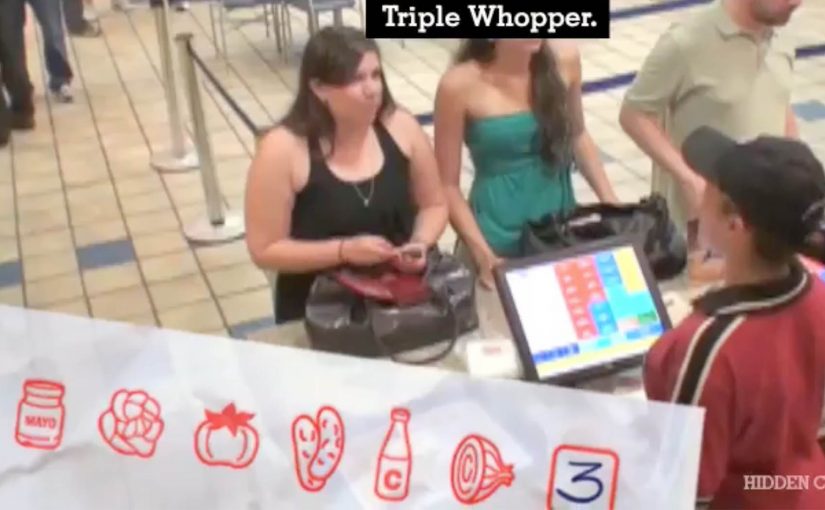
One cashier, one hidden cam, one printer. That is all Ogilvy Brasil needed to prove that Burger King sandwiches are made to order.

When a customer ordered a Whopper, they took a picture without anyone noticing. Then the customer got their freshly made sandwich with their face on it. Burger King proved that each sandwich is unique and made to order for each customer.

How Whopperface created “made to order” evidence

The mechanism is simple. Capture identity at the moment of order, then attach it to the product that comes out of the kitchen.

The hidden camera took the photo. The printer produced the personalized output. The handoff at the counter delivered the proof. The customer did not just hear “we make it fresh”. They received a physical, personalized marker that could only exist if the sandwich was made for them in that moment. Because the print is generated after the order, it converts timing into evidence, which short-circuits the usual “was this pre-made?” doubt.

Why it lands psychologically

In quick-service restaurants, the counter is the trust bottleneck for freshness. People trust what they can verify. Whopperface works because it lets the customer verify “made to order” with a marker tied to their identity.

Extractable takeaway: When skepticism is the barrier, attach a unique, customer-linked artifact to the output so the claim becomes self-evident at the moment of truth.

A customized face print is not a vague reassurance. It is a unique token. It signals individual attention and removes doubt about whether the item was pre-made. It also triggers a social instinct: if you receive something with your identity on it, you are more likely to show it, talk about it, and remember it.

The business intent behind the stunt

The intent was to rebuild credibility around freshness and ordering, using retail experience as the media channel.

The real question is whether your brand can turn its most fragile claim into something customers can verify in the moment.

Instead of spending budget repeating a claim, Burger King invested in a moment that created both belief and shareable content. The proof lived in the customer’s hands, and the story traveled naturally from there.

If trust is the issue, spend on proof at the counter before you spend on more media.

Proof patterns to borrow from Whopperface

  • Turn claims into artifacts. If you want belief, create something physical that acts as evidence.
  • Place proof at the point of truth. The point of truth is the exact moment and place the customer decides whether to believe you.
  • Use personalization as verification. Identity markers make “made for you” tangible.
  • Keep the system minimal. Simple setups scale. One camera, one printer, one process.

A few fast answers before you act

What was Burger King’s Whopperface?

A retail stunt where customers received their freshly made sandwich with their face printed on it, proving the order was unique and made specifically for them.

What was the core mechanism?

A hidden camera captured the customer at order time, and a printer produced a personalized output that was attached to the fresh sandwich at handoff.

Why does this prove “made to order” better than a claim?

Because it creates a unique, verifiable artifact that can only exist if the sandwich was produced for that specific customer in that specific moment.

What business goal did it support?

Increasing trust in freshness and differentiation by turning the restaurant experience into proof and shareable content.

What is the main takeaway for other brands?

If trust is the barrier, design a simple proof mechanism that customers can see, hold, and share.