
Ben & Jerry’s #CaptureEuphoria: Instagram OOH

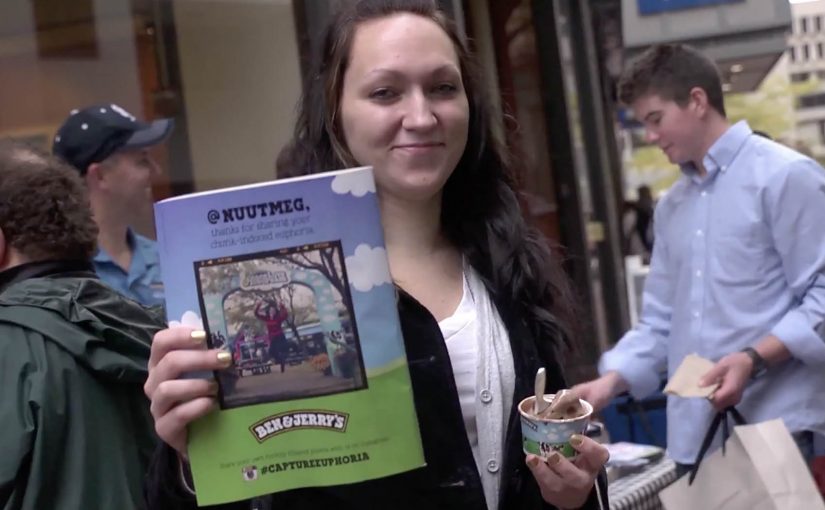
Ben & Jerry’s jumps onto the Instagram wave with a photo contest that challenges fans to capture their “euphoria” towards the brand. Winners from around the world are then featured in special Ben & Jerry’s advertising, including local print, bus station placements and billboards that appear near their homes.

The mechanic: a hashtag that turns into local visibility

The idea is straightforward. Fans post Instagram photos that represent “euphoria” and tag them with #captureeuphoria. Ben & Jerry’s curates a set of winners, then brings those images into the real world by placing them as local advertising close to where the photographer lives.

This is hyperlocal out-of-home (OOH) as a reward. Instead of giving people a generic prize, the campaign gives recognition that is geographically personal.

Recognition-based rewards are the better default when the goal is to deepen community, not just spike entries.

The real question is whether your reward shows up in the participant’s physical world, not just their feed.

In global FMCG marketing, the strongest social contests create an offline payoff that feels personal, not promotional.

Why it lands: recognition beats “stuff”

Most contests promise products, vouchers, or a one-time win. This one promises status. Your photo becomes the ad. Your community becomes the audience. That flips the usual relationship between brand and fan, and it makes participation feel less like a transaction and more like belonging.

Extractable takeaway: A social contest gets more powerful when the payoff is not only online. It is something the participant can physically encounter in their own neighborhood.

What Ben & Jerry’s reinforces by calling it “euphoria”

By anchoring the idea to a feeling rather than a product shot, the campaign invites more creative submissions and a wider interpretation of what “Ben & Jerry’s moments” look like. The brand gets a stream of fan-made images that reflect joy and personality, and the best of it becomes media.

What to steal for your next community-first contest

  • Reward participation with identity, not only incentives. Public recognition can outperform discounts when the brand has true fans.
  • Make the submission format native. A hashtag plus a photo is a low-friction action people already understand.
  • Close the loop in the real world. If you can turn online creation into offline visibility, the story becomes more memorable.
  • Keep the brief emotionally clear. “Capture euphoria” is an instruction people can interpret without overthinking.

A few fast answers before you act

What is Ben & Jerry’s #CaptureEuphoria?

It is an Instagram photo contest where fans post images tagged #captureeuphoria, and selected winners have their photos featured in local advertising near where they live.

Why is the offline ad placement the key twist?

Because it turns participation into public recognition. The reward is visible, personal, and rooted in the winner’s own community.

What makes this different from a standard user-generated content (UGC) contest?

Instead of only reposting winners online, it converts fan content into out-of-home and print media, which raises the perceived value of being selected.

What should a brand be careful about with hashtag-based submissions?

Moderation and curation. If the hashtag stream is unfiltered, off-brand or disruptive content can hijack the gallery effect.

How do you measure success for a contest like this?

Track volume and quality of submissions, unique participants, sentiment, earned reach from reposting, and the lift in brand engagement during the campaign window.

Magnum Pleasure Hunt: AR bonbons in Amsterdam

Earlier on in April Magnum launched the second edition of its hit online game Magnum Pleasure Hunt. To extend the campaign further, a real time mobile augmented reality game takes the hunt to the streets of Amsterdam.

The game is currently ongoing and participants between April 22nd and April 29th can use a special mobile app to hunt down 150 chocolate bonbons hidden across 9 locations in Amsterdam, described in some write-ups as centered around the city’s Nine Streets area. The one who claims the most bonbons wins a free trip to New York, while the rest are rewarded with the new Magnum Infinity ice cream.

Why this is a smart extension of a digital hit

The original online game is built for reach and replay. The Amsterdam version adds scarcity and locality: the same “collect the bonbons” mechanic, but tied to time, place, and physical movement, which makes participation feel more like an event than a link.

In European FMCG launches, location-based AR hunts work best when the rules are obvious in seconds and tiered prizes make “one more try” feel worth it.

The real question is whether your AR layer gives people a reason to move now, not just a new way to look at the same brand world.

What the AR layer adds to the experience

The AR layer keeps the mechanic simple, but changes the context by making the hunt visible in public and limited to specific dates and locations.

Extractable takeaway: When you take a proven digital mechanic into the street, pair it with a short window and clear rewards so participation feels like an event, not an app demo.

  • Instant purpose. You are not browsing a branded world. You are on a hunt with a clear target.
  • Real-world urgency. Limited dates and specific locations make the challenge feel live.
  • Social proof by default. People playing in public become the campaign’s moving media.

A quick comparison to Vodafone Buffer Busters

I find the Magnum mobile game to be a toned down version of the Vodafone Buffer Busters game that ran in Germany last September. Either way, this is the right direction. More brands should treat augmented reality as a medium of engagement, not a gimmick.

What to copy from Magnum’s Amsterdam hunt

  • Make the first action obvious. People should understand the goal and the first tap in seconds.
  • Limit the window. A short time period turns “I’ll try it later” into “I should go now.”
  • Use rewards that scale. A big winner prize plus smaller payoffs keeps both competitive and casual players engaged.

A few fast answers before you act

What is Magnum Pleasure Hunt Across Amsterdam?

It is a time-limited mobile augmented reality game that moves Magnum’s “collect the bonbons” mechanic from the web to real locations in Amsterdam.

How do players participate?

Players use a mobile app while out in the city to find and collect virtual bonbons placed at specific locations during the campaign window.

What makes it different from the online Pleasure Hunt?

The online version is a digital-only chase. The Amsterdam version adds time and place, turning the hunt into a real-world activity with location-based stakes.

Why are prizes so central to this format?

Because the effort is physical. A clear top prize plus smaller “everyone gets something” rewards keep motivation high across both competitive and casual players.

What is the key design lesson for AR brand games?

Keep onboarding friction low. If people cannot understand the goal and the first action immediately, they will not start, especially outdoors.

Ben & Jerry’s: Fair Tweets

How can an ice cream maker use social media to help provide farmers a fair income across the globe. Ben & Jerry’s positions itself as a Fairtrade-first mover in ice cream, then takes on the challenge with a deceptively simple Twitter utility called Fair Tweets.

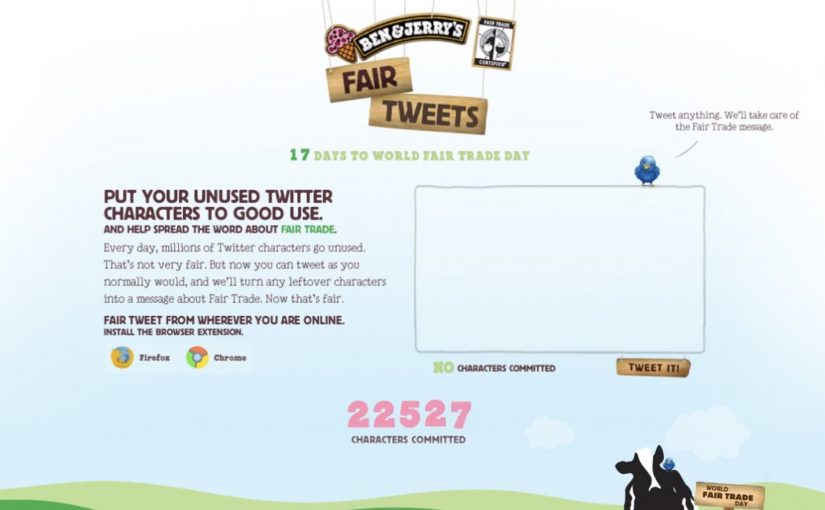
The idea is to let followers donate their unused tweet space to the cause. “Unused social media space” here means the leftover characters inside a tweet that does not hit the then-standard 140 character limit. Fair Tweets fills those remaining characters with an advocacy message that promotes World Fair Trade Day (May 14) and Fair Trade issues more broadly.

Turning leftover characters into a donation mechanic

The mechanism is a lightweight interface that behaves like a plug-in for your behavior. You tweet as normal. The system automatically appends a Fair Trade message into the empty character space you did not use. It is a small “opt-in constraint” that converts millions of tiny, personal broadcasts into consistent campaign impressions. By “opt-in constraint,” I mean a voluntary limit the user accepts, so the campaign can add a message without hijacking their voice.

In global consumer brands with always-on social channels, this pattern scales because it turns everyday posting into distributed, opt-in media inventory.

The real question is whether you can piggyback on an existing habit without hijacking what people meant to say.

In brand-led cause marketing, the fastest way to earn participation is to reduce effort to one familiar action inside a channel people already use daily.

Why it lands

It does not ask people to change who they are on Twitter. It asks them to keep tweeting, while quietly upgrading the payload. This pattern is worth copying only when the appended message stays clearly secondary to the user’s own voice. The constraint is the hook. It makes the act feel clever rather than preachy, and it turns participation into a visible badge that friends can copy in seconds.

Extractable takeaway: If you want a cause message to spread without feeling like an ad, attach it to a behavior users already repeat, then “tax” only the slack in that behavior. The slack is where adoption hides.

What to steal for your next social utility

  • Exploit a real constraint. The character limit is not a creative brief. It is a platform rule that makes the idea instantly understandable.
  • Make the value exchange obvious. Users give you what they were going to waste anyway, then they get an identity signal for supporting the cause.
  • Keep the activation single-step. One click, one tweet, done. Every additional step kills the multiplier.
  • Design for imitation. The best proof is not a campaign site. It is seeing friends do it in-feed.

A few fast answers before you act

What is the Fair Tweets idea in one line?

It automatically fills the unused characters in a tweet with a Fair Trade message, so normal tweeting becomes lightweight cause promotion.

Why does “unused characters” work as a donation model?

Because it feels free. Users are not giving money or time. They are donating spare capacity inside something they were already doing.

What makes this approach different from a hashtag campaign?

A hashtag asks users to change their message. Fair Tweets rides along with any message, which increases participation without forcing people into campaign language.

What is the biggest risk when brands copy this pattern?

Over-automation. If the appended message feels spammy, repetitive, or hijacks the user’s voice, people will stop using it and may resent the brand.

How do you write the appended message so it feels shareable?

Keep it short, clearly optional, and visibly additive to the user’s tweet. If it reads like a branded footer or repeats too aggressively, it stops feeling like a badge and starts feeling like spam.