
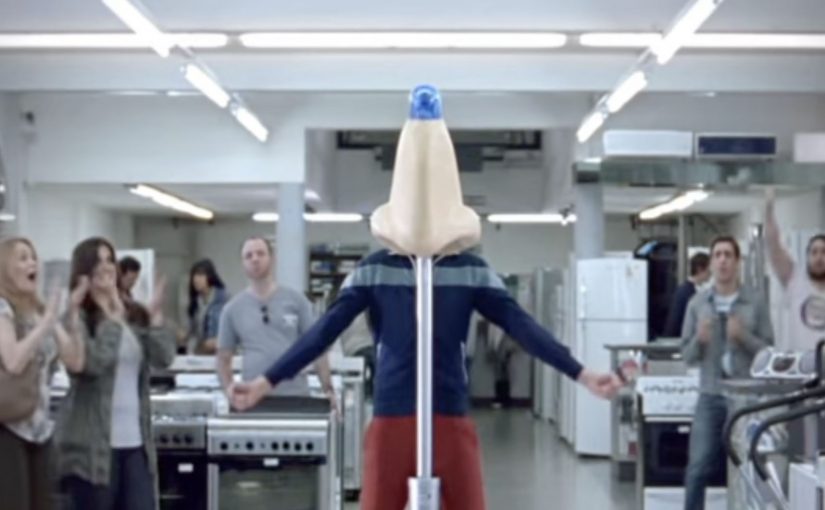
BGH: Big Nose Discount

BGH Air Conditioners in Argentina wanted to promote their new line of silent air conditioners. So agency Del Campo Nazca Saatchi & Saatchi came up with a whacky integrated campaign called “Big Nose”.

Together they created the Nose-O-Meter, an in-store device capable of measuring noses. If your nose was big enough to touch the sensor, an alarm would go off and you could win a 25 percent discount.

How the Nose-O-Meter mechanic works

The mechanism is a simple, physical test that turns a product message into a game. Try your luck in-store. Hit the sensor with your nose. Trigger the alarm. Unlock the discount. Online, visitors could upload a profile picture to see if their nose might qualify, and the site pointed shoppers to the nearest Nose-O-Meter location.

That works because a visible pass-or-fail moment makes the product story easy to grasp, repeat, and film in seconds.

In Latin American appliance retail, in-store stunts that turn a functional claim into a public, repeatable challenge can generate attention without needing heavy media spend.

Why it lands

It uses an instantly readable visual proxy. A “silent” product is hard to demonstrate in a store, but a loud alarm creates a memorable contrast that people talk about. The absurdity lowers the barrier to participation, and the discount gives a clear reason to play rather than just watch.

Extractable takeaway: When your benefit is hard to demo, build a playful proxy people can physically perform. Then attach a real reward so the joke converts into action.

What the campaign is really trying to do

The real question is whether a silly retail mechanic can make a hard-to-demonstrate product benefit talkable enough to drive store traffic and sales.

This is awareness plus retail movement. The Nose-O-Meter creates footfall and talk value. The online upload tool extends reach, adds a low-friction entry point, and helps direct people into stores where the discount can close the sale.

Retail activation cues worth borrowing

  • Turn the claim into a test. A measurable moment is easier to film, share, and repeat.
  • Design for spectators as well as players. Public stunts work when watching is entertaining and playing is simple.
  • Use a two-step funnel. Lightweight online interaction that drives to a physical conversion point.
  • Make the reward meaningful. A real discount keeps the activation from feeling like a pure gimmick.

A few fast answers before you act

What is Big Nose in one sentence?

An integrated BGH campaign where a Nose-O-Meter measures your nose in-store, and if it hits the sensor you win a 25 percent discount.

Why include an online photo upload tool?

It lets people self-check and engage remotely, then nudges them toward the nearest in-store device where the discount is actually won.

How does this connect to “silent” air conditioners?

It avoids a technical demo and instead creates a talkable stunt that carries the brand name and offer into conversation, then relies on the discount to drive purchase consideration.

What makes this more than a pure gimmick?

The mechanic ties the joke to a concrete retail reward, so participation has a practical payoff rather than ending as a laugh with no next step.

What is the main risk with humor-led retail activations?

If the mechanic is unclear or the reward feels small, people will watch and laugh but not convert. Clarity and payoff have to be immediate.

Carrefour: Escaping shopping carts

A shopping cart appears where it should not be. It is spotted racing through neighbourhood streets, then turning up abandoned in unlikely corners of Rome. People start talking because the “protagonist” is absurdly familiar. The cart is the symbol of value, and now it is behaving like it has a mind of its own.

Saatchi & Saatchi Milan built this mystery for Carrefour Italia to support the rollout of 106 new Carrefour Markets in Lazio, grounded in the brand’s “Positive every day” positioning. The creative idea is simple. Value for money is an appeal people struggle to resist. So the carts become the carriers of that temptation.

The activation is designed as a two-phase integrated campaign. Here, “integrated” means the same narrative runs in parallel across multiple channels, so each touchpoint adds another “sighting” or a step of explanation. First, it seeds sightings and curiosity across multiple channels at the same time. Then it resolves the story by revealing where all those carts are heading.

A teaser built like a local urban legend

The first phase plays like breaking news. A live-feeling street presence. Transit placements. News-style content. Online video. Each touchpoint adds another “sighting” so the mystery grows without needing complex explanation.

The choice of protagonist matters. A shopping cart is instantly readable, and it already carries the promise of savings. When you animate that object, you turn a pricing message into a narrative people retell.

Solving the mystery without breaking the spell

The second phase keeps the same media system but shifts the objective. It moves from “have you seen it” to “here is where it is going.” The reveal connects the runaway-cart story to the new Carrefour Market openings, so the attention converts into a clear destination and a clear reason.

In large-scale retail launches, integrated campaigns work best when one story can travel from street to screen to store without changing its meaning.

Why this lands for a retailer

This is value communication that does not feel like a leaflet. It uses curiosity, pattern recognition, and a small dose of humour to make people look twice. The pricing promise stays present, but it arrives through a chase, not a claim. The real question is whether your rollout story makes value feel like a discovery instead of a discount. For multi-location openings, a repeatable curiosity loop is a stronger starting point than a price-led announcement.

Extractable takeaway: If value is your promise, stage it as a simple, repeatable story people can retell, then make the store opening the payoff.

What to steal for your next multi-location rollout

  • Choose a protagonist that already means something. Everyday objects can carry brand meaning faster than mascots.
  • Design a two-step rhythm. Tease first, then resolve. Mystery creates attention. Resolution creates direction.
  • Let every channel play a specific role. Street for credibility. Transit for frequency. Online for amplification. Press for legitimacy.
  • Make the reveal point somewhere real. The story must end at the store door, not inside the ad unit.

A few fast answers before you act

What is “The Mystery of the Escaping Shopping Carts”?

It is an integrated Carrefour Italia campaign where shopping carts are staged as “escaping” across Rome to build curiosity, then the story resolves by linking the carts to new Carrefour Market openings in Lazio.

Why use shopping carts as the protagonists?

Shopping carts are universal retail symbols and naturally connected to value for money. Turning them into characters makes the savings message feel like a story rather than a promotion.

What does “integrated” mean in this campaign?

It means multiple media channels run in parallel and reinforce the same narrative. Each channel adds sightings, social proof, or explanation, so the mystery grows consistently across the city.

Why does a teaser-and-reveal structure work for retail openings?

Because it builds attention before asking for action. The teaser creates talk and curiosity. The reveal converts that attention into a clear destination, which fits the goal of driving visits to new locations.

What is the main risk with mystery-led retail campaigns?

If the reveal is weak or delayed, people feel tricked. The payoff has to be satisfying, and it must clearly connect the story to a real store or offer.

Yellow Pages: Hidden Pizza Restaurant

Yellow Pages has broken away from its traditional testimonial style in its Hidden Pizza Restaurant campaign. Created by Clemenger Proximity Melbourne, the campaign is part of Yellow Pages’ annual work designed to show potential advertisers how effective advertising in the Yellow Pages can be.

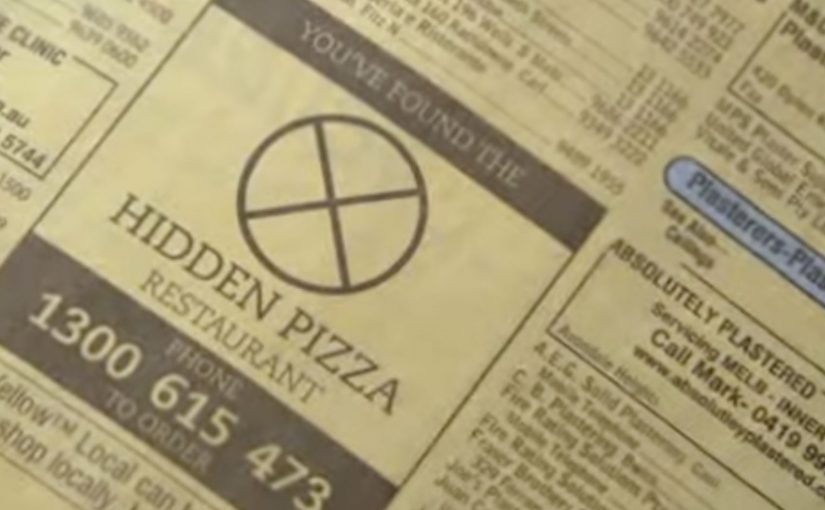
The idea is as direct as it is bold. Build a hidden pizza restaurant, then do not give customers its contact details. Instead, ask people to look for it the way they would any other business. While the restaurant is open, Clemenger Proximity is busy filming a series of TV ads, supported by print, radio and online executions.

A live proof stunt, not a promise

The mechanism is the message. The restaurant is real, the demand is real, and discovery is intentionally constrained. Reported coverage describes an initial tease via simple local seeding, then a single official path to the contact details. Find the listing in Yellow Pages, call, and receive the location.

In Australian small-business advertising, proof-based stunts like this can reframe a directory from “legacy media” into measurable demand generation.

Why the hunt sticks

It sticks because it converts a boring claim. “we help people find you”. into a public challenge with a reward. The lack of signage and the “go find it” instruction turns search behavior into entertainment, and the filming layer turns real customer effort into reusable evidence for advertisers.

Extractable takeaway: If your product is a utility people take for granted, create a short-lived live test where the only route to success runs through your product. Then document the outcome as proof, not persuasion.

What Yellow Pages is really selling

This is a credibility reset. In practice, that means replacing a weak category claim with a live, public proof that advertisers can understand in seconds.

The real question is whether Yellow Pages can still prove it creates demand when the business itself gives people almost nothing to work with.

The campaign is aimed at advertisers who doubt the channel. By engineering the toughest possible conditions. a business with hidden contact details. Yellow Pages turns its core value into a dramatic, easily explained case. Reported results from award and trade write-ups cite thousands of people successfully finding the restaurant, with a majority doing so through Yellow Pages.

What to steal from Hidden Pizza Restaurant

  • Design a test with an unfair constraint. The constraint is what makes the proof meaningful.
  • Make the behavior the headline. “People found it anyway” is the story.
  • Film real participation. Authentic effort beats polished testimonial scripts.
  • Keep the rule explainable. “Look for it like any other business” is instantly repeatable.
  • Let one channel own the solve. If discovery is the claim, discovery must be the mechanic.

A few fast answers before you act

What is the Hidden Pizza Restaurant campaign?

A Yellow Pages campaign that created a real hidden pizza restaurant and challenged people to find it using Yellow Pages, then documented the results through an integrated rollout.

Why hide the contact details?

To create a clean test of discoverability. If people can still find the business, the directory’s value becomes visible and provable.

What makes this more convincing than testimonial ads?

It replaces opinions with behavior. People either find it or they do not. The footage shows the finding happening.

What is the biggest risk in a stunt like this?

Leakage. If the address spreads through uncontrolled channels, the test loses clarity and the proof becomes disputable.

How can a smaller brand apply the same logic?

Create a short, controlled challenge where your product is the only legitimate path to the reward, then publish the documented outcome as evidence.