imlovinit24 in Ho Chi Minh City: Motobike Drive-Thru as a Gift
In March, McDonald’s launched imlovinit24. It was framed as “24 gifts in 24 cities in 24 hours”, designed to make the brand feel present in real life, not just in feed. McDonald’s reported more than 40,000 #imlovinit mentions during the activity, described as roughly 850 times the daily average. The push was described as trending globally on Facebook and Twitter, and as the first time McDonald’s reached the top ten worldwide conversation volume on Twitter.
Rio’s “Melting” Ice Coupon: A Giveaway with a Timer
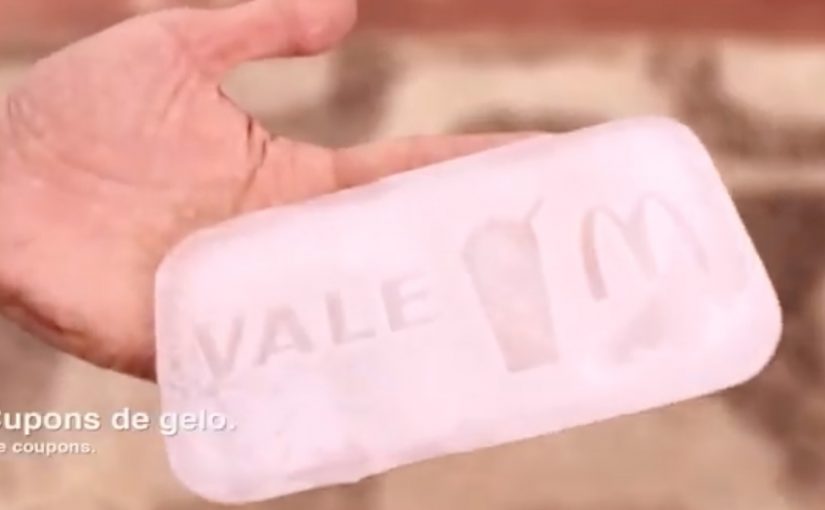
In the video, beachgoers in Rio de Janeiro get a surprise in the form of a slot machine. Press the button, get a chance to win a McDonald’s treat. To qualify, the participant completes a tiny social task, like taking a selfie or doing a quick dance. Winners receive a redeemable ice coupon that has to be rushed to the nearest McDonald’s before it melts. The reward is simple, but the countdown turns the giveaway into a story.
Where the shareability is engineered
Both activations run on the same engine. A clear action in public. A visible reward. A moment that finishes fast enough to feel impulsive. An activation is a time-bound experience designed to trigger participation and earned media. Because the instruction is self-explanatory and the payoff is immediate, people do it without needing persuasion, and bystanders can capture it without missing the punchline.
Extractable takeaway: If the action, reward, and ending are visible in one glance, people will participate without a pitch and record without a script.
The Rio mechanic adds two multipliers. Light social risk (selfie or dance) and time pressure (redeem before it melts). Because the challenge raises arousal and the timer makes the outcome feel scarce, the participant has a reason to perform now, and the observer has a reason to record now. That is the mechanism-to-virality bridge. It is the set of design choices that convert a simple mechanic into behavior people want to record and share.
The Ho Chi Minh City activation flips convenience into a “gift” that fits local mobility behavior. When the participation layer matches how people already move through the city, friction drops, completion rises, and the experience feels native rather than imported.
In global quick service restaurant marketing, the most effective experiential work turns a discount into a public moment that is easy to complete and obvious to film.
The real question is whether your activation creates a camera-ready moment people can finish in one breath and carry straight to a store.
What the brand intent looks like in practice
These are the kinds of activations worth doing when you need a giveaway to become a story that still pulls behavior toward stores.
Both ideas use a giveaway to buy more than reach. They create a short, filmable social proof moment that travels, while still pulling behavior toward stores. Rio hard-wires the visit via redemption. Ho Chi Minh City reframes drive-thru as a celebratory experience, which makes “convenience” feel like brand generosity instead of pure transaction.
Five moves to lift without copying the stunt
- Make the mechanic legible in three seconds, without instructions, staff explanations, or signage paragraphs.
- Keep participation frictionless. One button, one action, one outcome.
- Make the reward feel earned through a tiny challenge, not a form, scan, or registration flow.
- Use urgency only when it is visible and intuitive. “Melting” works because the timer needs no explanation.
- Localize the participation layer, not the slogan. Build around real movement patterns, real places, and real habits.
A few fast answers before you act
Are these the same campaign?
No. They are two distinct McDonald’s activations tied to the broader #imlovinit idea, each with its own mechanic and film.
What is the core mechanic in Rio?
A slot-machine-style interaction plus a small social challenge, followed by a time-limited reward. The “melting” coupon forces immediate action and makes the moment worth filming.
What is the core mechanic in Ho Chi Minh City?
A motobike drive-thru activation framed as a “gift” inside the imlovinit24 concept of delivering 24 gifts in 24 cities in 24 hours.
What is the repeatable execution lesson across both?
Design a public moment with a self-explaining action, an immediate payoff, and a story that is obvious on camera without narration or context.
How do you adapt this without copying McDonald’s?
Keep the structure, not the props. Use one obvious public action, one immediate reward, and one reason to act now. Then fit the participation layer to how people already move through the place you are targeting.