
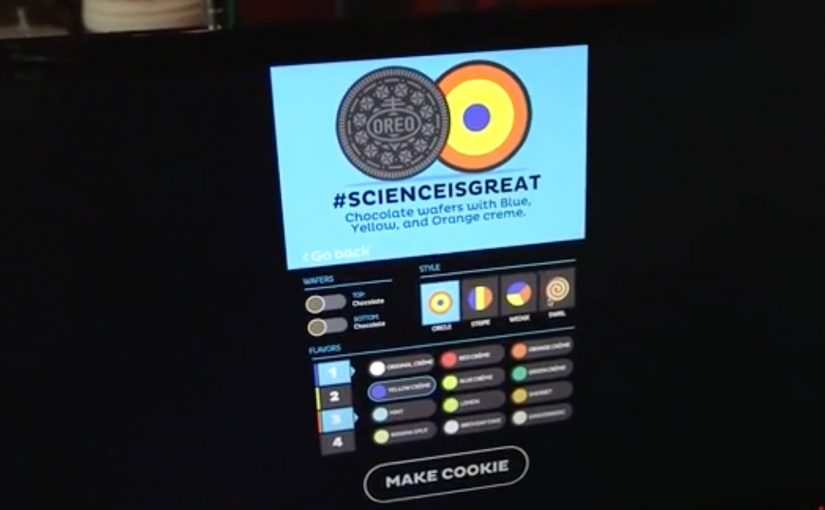
Oreo Twitter Powered Vending Machine

SXSW 2014 has just wrapped up, and Oreo was running a Twitter-powered vending machine that turned what is trending on Twitter into custom Oreo flavours and colours. Here, “Twitter-powered” means live Twitter activity drives the customisation rules the machine applies before dispensing.

How the Twitter-powered machine behaves in the moment

The installation listens to what people are talking about right now, translates that live signal into a tangible product variation, and delivers immediate gratification. It feels less like a branded demo and more like a real-time “trend to treat” pipeline.

In consumer-brand event marketing, the hard part is making a live social signal feel physical fast enough to matter.

Why this works as a live brand experience

The strength is the conversion loop. Social conversation becomes the input. A physical machine becomes the output. The novelty is not just that it is connected. It is that it makes the connection visible and edible in front of a crowd. Because the cause and effect is visible in the cookie itself, people can understand what changed immediately.

Extractable takeaway: Social-to-physical ideas travel when the mapping from input to outcome is obvious and fast. If people cannot explain the cause and effect in one sentence, the activation will not scale beyond the moment.

The real question is whether your activation turns a live signal into a payoff that is legible to bystanders and rewarding to participants.

If the mapping is not instantly clear and the output is not immediate, skip the “social-to-physical” build and invest in a simpler loop.

Steal the ‘trend to treat’ loop

  • Pick one live signal. Use a single, public input people already understand in the moment.
  • Make the mapping obvious. Show exactly what changed and tie it directly to what the person receives.
  • Design for throughput. Keep steps minimal so the line moves and the crowd can watch cause and effect.
  • Instrument the loop. Track usage and wait time so you can compare impact against other event spend.

A few fast answers before you act

What is a Twitter-powered vending machine?

It is a connected vending machine that uses Twitter activity as an input signal. In this case, trending topics influence the Oreo customisation, then the machine dispenses the result.

Why do brands build installations like this at events?

They compress awareness, participation, and sharing into a single experience. People see it, try it, and talk about it in the same moment, which amplifies the reach beyond the venue.

What makes “social-to-physical” activations effective?

The mapping has to be obvious and fast. People should immediately understand what they did, what changed, and what they received. The tighter the loop, the more it feels like magic instead of tech.

How do you keep this from feeling gimmicky?

Anchor the change in something people can see instantly, and make the output desirable enough that bystanders want to try it next. If the “why” is not visible in the product, it reads as a demo.

What should you measure if you run a similar idea?

Measure throughput and dwell time at the installation, social lift during the activation window, content volume and quality created by attendees, and the cost per meaningful interaction compared with other live formats.
Coca-Cola Turkey: Invisible Vending Machine

Since the time I started writing this blog, I have come across many innovative vending machines. Some I featured right here on Ramble.

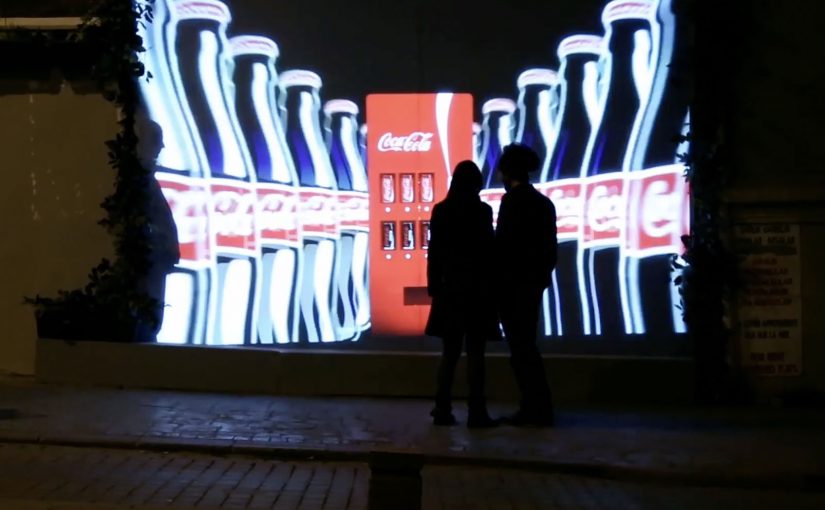
Now to add to this collection, here is an invisible vending machine from Coca-Cola Turkey that becomes visible only when couples walk by. The machine was created specially for Valentine’s Day (last week) and was installed in Istanbul to spread happiness Coca-Cola style.

A vending machine you cannot see until the right moment

The trick is the reveal. What looks like a normal stretch of wall becomes a vending interface only when two people approach together. That instant transformation creates a micro-scene, and the micro-scene pulls in everyone nearby.

In consumer brand activations, public installations work best when the interaction is obvious, fast, and shareable without instruction.

How the interaction is described to play out

  • Invisible by default. The unit blends into the wall and does not present itself as a machine.
  • Couples trigger the reveal. When two people pass together, the interface lights up and becomes visible.
  • Personal moment, not just a dispense. In coverage at the time, the machine asks for names and then produces two personalised cans.

Why it lands

This is not “another vending machine story”. It is a street-level surprise that creates a small, romantic spotlight for a couple, and a quick bit of theatre for everyone else. The invisibility is not a gimmick. It is a pacing device that makes the reveal feel like a reward. The real question is whether the experience creates a transformation that bystanders can explain in one sentence.

Extractable takeaway: If you want people to stop, watch, and retell an activation, build a visible transformation into the experience. A before-and-after moment is easier to share than a static stunt.

What Coca-Cola gets out of the Valentine framing

Valentine’s Day provides the social permission for public sweetness, names, and sentiment. For the brand, it is a clean link back to togetherness and “sharing happiness”, while turning a sample into a story people can repeat without being prompted.

Retail theatre patterns worth borrowing

By “retail theatre” I mean designing a retail moment as a small piece of live, shareable experience, not just a dispense or transaction.

  • Hide the interface until it matters. Visibility can be part of the reward, not just a prerequisite.
  • Keep the trigger legible. People should understand why it happened in one glance, or they will not mimic it.
  • Design for bystanders. The couple is the participant. The crowd is the media channel.
  • Personalise lightly. Names, messages, or small custom outputs feel intimate without needing heavy data.

A few fast answers before you act

What is the “invisible vending machine” concept?

A vending machine that stays hidden until a couple approaches, then reveals itself and delivers a Valentine-themed Coca-Cola moment.

Why make the machine “invisible” at all?

It creates a sharp reveal, and that reveal is the shareable payload. People remember transformations more than static installations.

What is the simplest way to replicate the effect?

Use a clear proximity trigger plus lighting and screen content that turns on instantly, and ensure the “why it appeared” is immediately understandable.

What is the biggest execution risk?

If the trigger is inconsistent or unclear, people will not repeat the behaviour and the crowd will not form. Reliability matters more than complexity.

What should you measure beyond views?

Dwell time, participation rate per hour, bystander clustering, social mentions generated on site, and any lift in nearby sales during the activation window.

Coca-Cola: The Sing For Me Machine

As part of its global “Open Happiness” campaign, Coca-Cola has set up interactive vending machines in various parts of the world. In Singapore, consumers could hug for a Coke. In Korea, they could dance for a Coke.

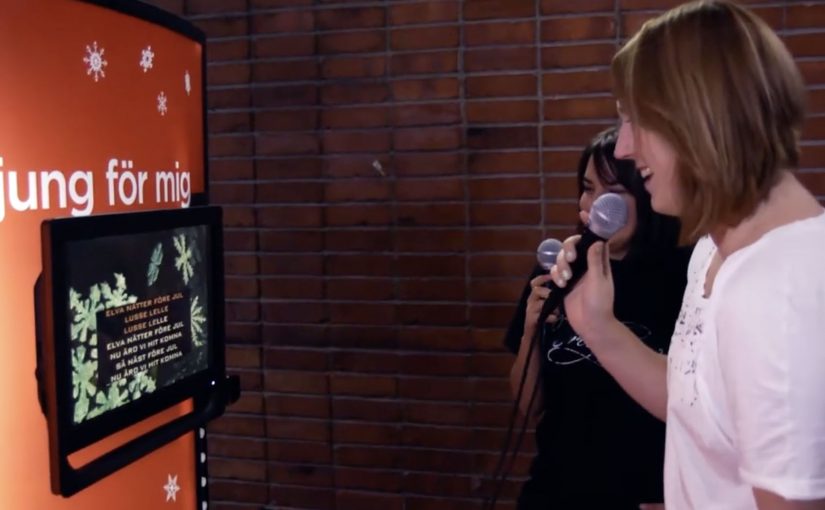
And now in Stockholm they can sing for a Coke. The vending machine has been placed at the Royal Institute of Technology with the sign “Sing For Me” in the front.

When sampling becomes a public performance

The mechanism is simple: the machine replaces money with a human gesture. That “gesture for reward” model means the action itself becomes the price of entry. Dance moves in one market. A song in another. The reward is immediate, and the moment is automatically social because other people can see it. That swap works because it turns a private purchase into a visible act, giving the crowd a reason to watch, react, and join in.

In global FMCG sampling and brand experience work, “gesture for reward” machines turn distribution into participation by design.

The real question is whether the action is easy enough to trigger participation without making people shut down in public. The smart part of this format is not the free Coke, but the public behavior it creates around the sample.

Why it lands

This works because it makes the brand promise legible without explanation. A vending machine is normally transactional and forgettable. A performance-triggered machine is a small event, and the crowd reaction becomes part of the product. The setting helps too. A campus is full of friends, cameras, and people willing to try a slightly silly thing in public.

Extractable takeaway: If you swap payment for a simple public action, you turn sampling into a story people can witness, film, and retell. That social proof travels farther than the product ever could on its own.

The machine is one of a number of Happiness Machines Coca-Cola has deployed around the world since 2009.

What to borrow from performance sampling

  • Pick one obvious trigger: the instruction must be understood in one glance.
  • Make the reward instant: the dispense moment is the emotional payoff.
  • Design for bystanders: the format should recruit a crowd naturally.
  • Localize the gesture: keep the same principle, but choose a culturally comfortable action.
  • Capture reactions: real laughs and hesitation are the proof that the idea works.

A few fast answers before you act

What is the “Sing For Me” machine?

It is a Coca-Cola vending machine that dispenses a free Coke when people sing to it, turning a product handout into a public, participatory moment.

Why does “sing for a Coke” work as a mechanic?

Singing is visible and socially contagious. Once one person does it, others gather, react, and often try it themselves.

How is this connected to the broader “Happiness Machine” idea?

It follows the same pattern: replace payment with a feel-good interaction, then let real reactions become the distribution layer.

Where does this format work best?

High-footfall environments with social density, like campuses, events, malls, and transit hubs, where bystanders quickly become an audience.

What is the biggest risk with performance-for-reward activations?

If the action feels embarrassing or culturally off, participation drops. The trigger must feel playful, safe, and easy to attempt in public.