
DHL: DHL Is Faster Trojan Parcels

A courier from UPS, TNT or DPD walks through a busy city centre carrying a large, plain-looking parcel. A few minutes later, the same box is effectively doing outdoor advertising for DHL, with a bright message reading: “DHL is Faster.”

Turning competitors into media

DHL’s large network of offices, trucks and employees is a straightforward speed story, but saying it loudly in a traditional ad campaign is expensive. So DHL worked with German trojan campaign specialists Jung von Matt/Neckar to make competitors unknowingly promote DHL as the fastest parcel delivery service. In this context, a trojan campaign hides the brand message inside a neutral object or someone else’s distribution until it reveals itself in public.

The mechanism: temperature reveals the punchline

Large, inconspicuous parcels were created and sealed with a thermo-sensitive foil. When cooled in refrigerators, the parcels appeared black, hiding the message. UPS, TNT and DPD were then asked to deliver these parcels to difficult but central city locations. Exposed to warmer street temperatures during delivery, the parcels shifted colour and revealed the words “DHL is Faster.”

A “trojan” mechanic in marketing is a message that travels inside a neutral object or someone else’s distribution, then reveals itself at the moment of maximum visibility.

In competitive European parcel logistics, a proof-by-demonstration stunt can move “we’re faster” from claim to spectacle without buying classic media.

Why this lands

It works because the reveal happens in public and in motion, exactly where speed matters, and it borrows credibility from the awkward fact that a rival courier is doing the carrying. The stunt also makes the comparison feel earned rather than asserted, because the message appears as a consequence of the journey.

Extractable takeaway: If your advantage is hard to believe as a headline, design a mechanism where the environment exposes the proof, and let the proof show up at the exact point where the audience can “see the claim happen.”

What DHL is really buying

The real question is how to turn a functional speed claim into a public proof people can instantly understand and retell.

This is less about humiliating competitors and more about reframing the category. It turns delivery speed into a street-level moment that people can film, retell, and instantly understand, while the brand pays for production rather than for repeated media placements.

What to steal from DHL’s reveal design

  • Build a reveal. Hide the message until the moment the audience is already watching.
  • Use context as a trigger. Temperature, light, movement, location. Let the world “activate” the story.
  • Put the proof on the distribution. The carrier becomes the billboard, not a separate ad unit.
  • Make the explanation obvious at a glance. If it needs a voiceover, the stunt is too clever.

A few fast answers before you act

What is the “DHL is Faster” stunt?

It’s a trojan-style activation where rival couriers deliver parcels that reveal “DHL is Faster” as they warm up in city conditions.

How does the reveal work?

The parcels are wrapped in a thermo-sensitive foil that looks dark when cooled, then changes to expose bright lettering when the parcel warms during delivery.

Why call it a trojan campaign?

Because the message travels hidden inside a neutral-looking object and is distributed by someone else, then reveals itself at the most visible moment.

What brand point does this communicate?

Speed and network scale, reframed as a live demonstration rather than a paid claim.

What’s the main risk with this kind of idea?

Brand backlash if the stunt feels mean-spirited or deceptive, and operational complexity if the reveal is inconsistent or hard to understand in the wild.
Mercedes-Benz: Tweet Fleet Parking on Twitter

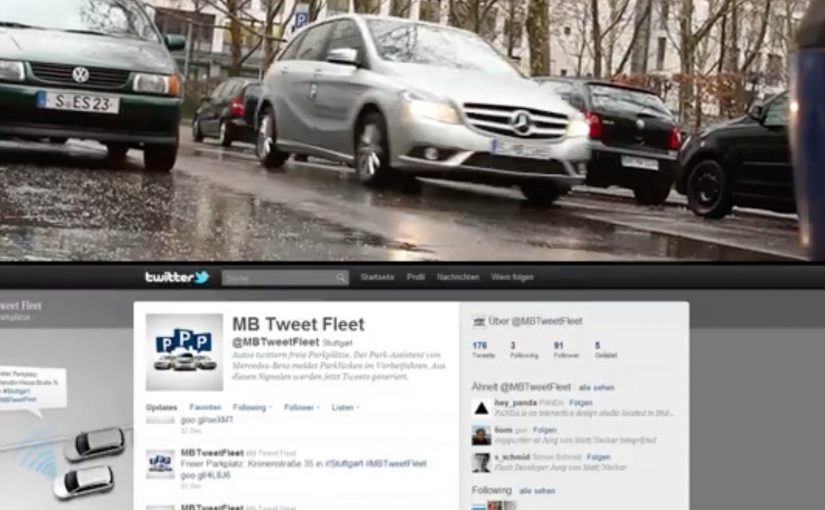
The “Active Parking Assist” from Mercedes-Benz recognizes empty parking spaces by simply passing them. That brought ad agency Jung von Matt/Neckar to the idea that if the car knows where the empty parking spaces are, then everybody could also be informed.

So just before Christmas when parking spaces were hard to find, they launched the Mercedes-Benz Tweet Fleet with its Active Parking Assist that tweeted empty parking spaces in downtown Stuttgart.

The MBTweetFleet cars (the Tweet Fleet vehicles running the setup) automatically generated the tweets with GPS data via Arduino an onboard electronic and a PHP Relay. People could then follow @MBTweetFleet to find empty parking spaces near them on Twitter and be navigated there by the linked Google map.

Why this idea is stronger than it looks

The cleverness is not “tweeting”. The cleverness is turning a capability that already exists inside the car into a public utility. That flips a product feature into a service people can use immediately, without buying anything first. The real question is how you turn a private product signal into a public utility people can act on in seconds.

Extractable takeaway: If you can expose a reliable product signal as a live feed in a channel people already use, you can create immediate utility that beats a feature demo.

  • Signal becomes service. The car detects something useful. The system shares it.
  • Real-time context. Parking availability is only valuable when it is current.
  • Distribution is native. Twitter is a lightweight channel for fast, location-based updates.

The technical stack is simple, but the integration is the point

GPS plus an onboard controller plus a relay layer is not the story. The story is that data moves from sensing to publishing with minimal friction. Because publishing is automatic and immediate, the service stays relevant long enough for someone to navigate to it. That is what makes it feel “live”.

  1. Detect. Active Parking Assist identifies an empty space while driving.
  2. Locate. GPS attaches coordinates.
  3. Publish. An automated tweet shares the spot publicly.
  4. Act. People navigate using the linked map.

In European city centers, connected experiences win when they reduce search friction in the moment, not when they add more messaging.

In urban mobility and smart-city moments, public utility beats brand messaging when the value is immediate, local, and easy to act on.

What to take from this if you build connected experiences

  1. Start with a real pain point. Holiday parking pressure is a perfect use case.
  2. Make the feature externally visible. Utility grows when it helps non-owners too.
  3. Choose a low-friction channel. Where people already are beats “download our app”.
  4. Design for immediacy. Real-time value requires real-time delivery.

A few fast answers before you act

What is Mercedes-Benz Tweet Fleet?

It is a campaign in Stuttgart where Mercedes-Benz used Active Parking Assist to detect empty parking spaces and automatically tweet their locations so people could find and navigate to them.

Why does Active Parking Assist enable this?

Because it can recognize empty parking spaces as the car passes them, creating a reliable signal that can be shared.

How were the tweets generated?

The cars generated tweets automatically using GPS data, an Arduino-based onboard electronic component, and a PHP relay.

How did people use the service?

They followed @MBTweetFleet on Twitter and used the linked map in tweets to navigate to nearby empty spaces.

What is the transferable lesson?

If a product can sense something valuable in the real world, you can turn that sensing into a public utility by publishing it in a channel people already use.

Jung von Matt: Trojan Art Director

Jung von Matt is looking for talent again, this time art directors. Staying true to its creative reputation, the agency devised a cheeky way of recruiting from the same places competitors recruit from.

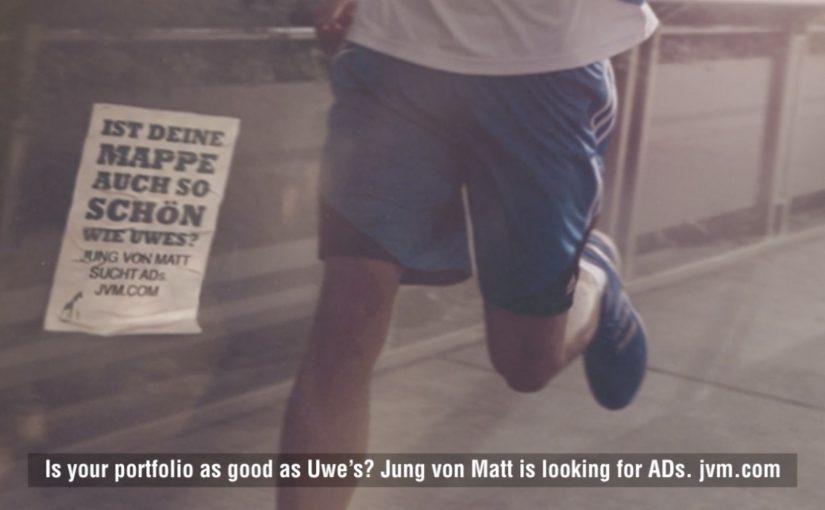
This time the “Trojan horses” were 15 well-known photographers whose work is regularly shown to top creative agencies in Germany. Here, “Trojan horses” means recruitment messages hidden inside portfolio work that creative departments already review. Jung von Matt’s job message was integrated into the photographers’ portfolios. An inscription on a bus. A graffiti on a wall. A stitchery on a pullover. The job ad appears inside the work, right where art directors and creatives are already paying attention.

Recruitment as a stealth placement inside creative culture

The mechanism is elegant. Instead of pushing job ads outward, the agency inserts them into a trusted distribution channel. Photographers’ portfolios are already a legitimate reason to visit creative departments. By embedding the hiring message into those images, the job ad arrives with credibility and surprise built in.

In agency recruitment, the most effective messages often travel through peer-to-peer channels where creative people already look for inspiration.

Why it lands

It respects the audience. Art directors do not want HR language. They want ideas. The recruitment message shows up as an idea. The “spot it” moment also creates a small status game. If you notice it, you feel like an insider, which is exactly the emotion you want associated with joining a top creative shop. This is a smart recruitment idea because it proves the agency’s creative standard in the act of recruiting.

Extractable takeaway: If you recruit creative talent, do not only describe the culture. Deliver the culture as a recruiting experience. The medium should prove the message.

What Jung von Matt is really doing here

Beyond hiring, this is reputation maintenance. The campaign reinforces the belief that the agency thinks differently, even about recruitment. The real question is whether your recruiting message proves the kind of culture and craft the role promises. It also targets a very specific context. The moment when competitors are reviewing portfolios and looking for talent. That is when the message is most likely to be acted on.

What to borrow from this recruitment play

  • Place your message in a trusted channel. Borrow the legitimacy of a format your audience already values.
  • Integrate, do not interrupt. Embedding the ad inside the creative work makes it feel like discovery, not spam.
  • Make the message audience-native. Speak in the language of the craft, not corporate templates.
  • Target the decision moment. Put the offer where hiring intent already exists.
  • Keep it simple. One clear role, one clear next step, no clutter.

A few fast answers before you act

What is the “Trojan Art Director” idea in one sentence?

It is a recruitment tactic where Jung von Matt embeds job messages inside photographers’ portfolio images that are regularly shown to top agencies, reaching art directors in-context.

Why are photographers’ portfolios a powerful distribution channel?

Because they are already viewed by creative departments and talent decision-makers. The audience is qualified and attention is high.

What makes this feel credible rather than gimmicky?

The message is integrated into real creative work and appears in a context where creativity is the currency. That makes the format match the audience expectation.

What is the main risk with stealth recruiting?

It can be perceived as hostile or disrespectful by peers if the tone is too aggressive. The balance is “cheeky” rather than “petty.”

How do you measure success for a recruitment stunt like this?

Qualified applications for the specific role, referral volume from the creative community, and whether employer brand perception improves among the target talent pool.