
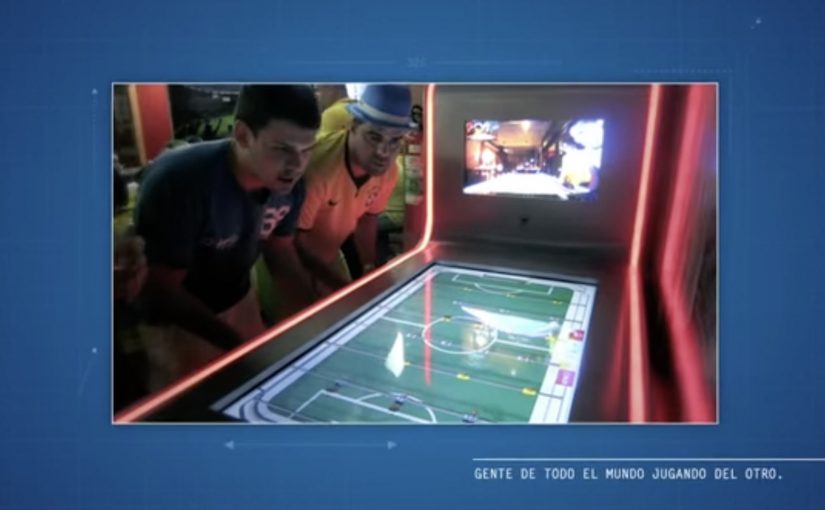
Quilmes: Mitigol

Quilmes and their agency +Castro reinvented the classic game of foosball. In its new version they enabled Argentinians and Brazilians to play each other in real time through a custom made digital foosball table.

Dubbed “Mitigol”, the activation turns foosball into a cross-border live match. One half of the table was placed in Argentina and the other half in Brazil. During the game, players could see their opponent via special in-built video cameras that further enhanced the real time experience of the game. As a prize, Quilmes gave away free beer.

How Mitigol works

The mechanism is a physical game with a digital bridge. A custom table syncs the ball and player movement across distance, while embedded cameras add face-to-face presence so it feels like a real match rather than a remote demo.

In sports and event-led marketing, shared-play installations can turn rivalry into participation because they give fans something to do together, not just something to watch.

Why it lands

This works because it makes a national rivalry tangible without needing a screen-first experience. Foosball already has competitive tension built in, so the cross-border connection raises the stakes instantly. The cameras then do the emotional work by proving the opponent is real, right now, reacting in real time.

Extractable takeaway: When you want “real time” to feel meaningful, do not rely on the word. Add one physical interaction that people already understand, then layer in live presence so the distance becomes the headline.

What Quilmes is really buying

The real question is how to turn passive rivalry into a shared act people want to join.

Beyond novelty, Mitigol is a closeness story. It borrows the energy of an event moment and converts it into a branded experience where the fan is the performer, not the spectator. The prize is just the nudge that keeps the line moving and the competition sharp.

What to steal from Mitigol

  • Start with a familiar game. If the rules are known, participation spikes.
  • Make distance visible. The split-table concept is the idea. Do not hide it.
  • Add live presence. Cameras or live feedback make “remote” feel human.
  • Reward the behavior you want. Small, immediate prizes keep throughput high.

A few fast answers before you act

What is Mitigol?

It is a custom foosball table experience that connects two locations so players in different countries can play the same match in real time.

Why split the table across Argentina and Brazil?

Because the physical split makes the cross-border rivalry concrete. It is instantly legible as “we are playing each other right now”.

What role do the built-in cameras play?

They add live presence and reaction, which makes the experience feel like a real opponent rather than a remote simulation.

What is the simplest way to copy the principle?

Take a familiar physical activity, connect it across distance with tight synchronization, then add a live human layer so the interaction feels personal.

What should you measure for an activation like this?

Participation volume, repeat play, dwell time, and how often spectators convert into players once they see it in action.
KLM: Live High Five

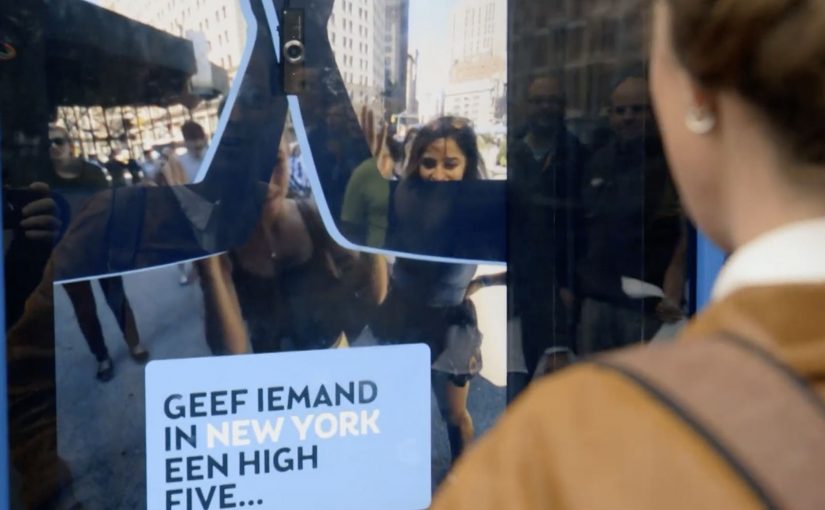
On 28 August, KLM connects hundreds of people in Amsterdam and New York via a live interactive video display, letting strangers on the streets of two cities come face to face.

It echoes the kind of “city to city” street connection seen before, such as the French railway (SNCF) linking Lyon and Brussels.

How the high five contest works

The twist is competitive: the connected pairs are asked to high five each other through the screens. For every successfully timed high five, participants win two tickets to New York or Amsterdam.

In global travel marketing, adding a clear participatory mechanic, meaning a simple action anyone can attempt without instruction, turns a “nice moment” into a repeatable behavior people recruit others into.

Why a high five is the right interaction

A high five is universally understood and visually obvious at distance. It is also time-bound, which creates tension. People lean in. They coordinate. They try again. That retry loop, the quick cycle of attempt, miss, adjust, and try again, is where energy builds and the crowd becomes part of the content.

Extractable takeaway: Pick an interaction that is instantly readable to bystanders, time-bound, and designed to invite visible retries. That is how the crowd becomes the amplification.

What KLM is really buying here

This is a route brand idea, meaning a story that makes a specific connection between two places feel tangible, disguised as play: KLM makes the transatlantic connection feel immediate, human, and winnable. The real question is whether your activation makes distance feel collapsible in under five seconds. This is the right kind of public interactivity when your promise is connection between places. The prize is valuable, but the real asset is the public proof that the brand can engineer connection between two cities in a way passers-by can instantly grasp.

Patterns to borrow for your own city-scale activation

  • Use one gesture everyone knows. The simpler the action, the more strangers will attempt it without instruction.
  • Add a timing challenge. Time-based coordination creates drama and repeat tries.
  • Make the reward match the story. Here, tickets reinforce the “two cities” premise.
  • Design for crowds. The best interactions are legible to bystanders, not just participants.

A few fast answers before you act

What is KLM Live High Five in one line?

A live video street installation connecting Amsterdam and New York where timed high fives between cities unlock travel tickets.

What is the key mechanism?

Two public screens link strangers in real time, then convert the connection into a simple, repeatable contest action.

Why does the high five mechanic work so well?

It is universal, physical, and instantly readable. The timing requirement creates suspense and encourages repeated attempts.

What is the biggest execution risk?

If timing feedback feels laggy or unclear, people stop retrying. The interaction needs instant, visible confirmation so the crowd stays invested.

What is the transferable lesson?

If your idea is “connection”, make people physically coordinate across distance and reward the moment with a prize that matches the narrative.

Mitsubishi: Test Drive From Your Browser

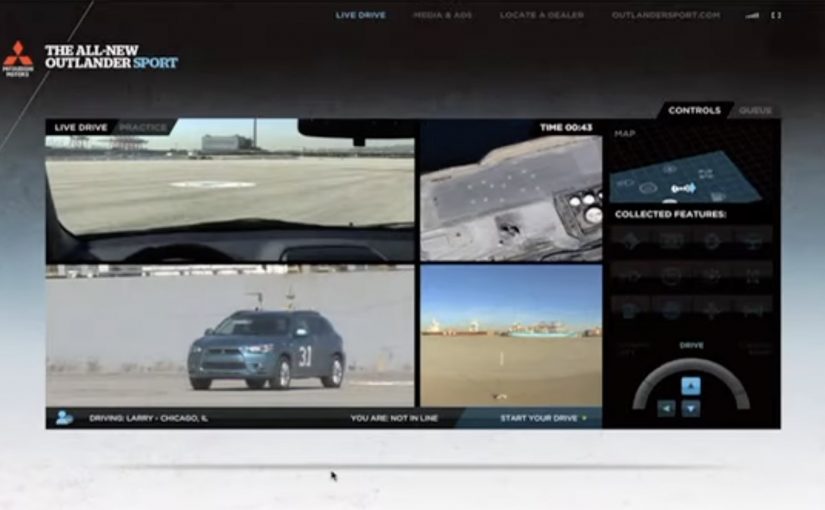
The future of test driving a car is here. 180/Los Angeles has hooked up the Mitsubishi Outlander Sport to a unique system allowing people to test drive it through their browser.

The interactive element, with the claim from the agency that it is the world’s first online test drive, is the first in a series of launch components in an integrated campaign that is running through January.

Working with production company B-Reel, 180 and Mitsubishi have developed a remote control system that will allow prospective buyers to take the Outlander Sport for a drive on a closed course, over the web.

Multiple cameras, in-car servos and GPS mapping, with the help of a robotics engineer, will keep the Outlander Sport on-course and responsive to online drivers’ commands.

Starting October 15th you can sign up (US residents only) for the test drive at www.outlandersport.com.

How the remote test drive is staged

The mechanism is a tight loop between live video and machine control. You watch the car from multiple camera angles. Your browser inputs translate into steering and pedal actions via servos. GPS mapping and safety logic keep the vehicle constrained to a closed course while still feeling responsive.

In automotive launches, reducing “dealership friction”, the time, travel, and commitment people associate with a showroom visit, is a reliable way to move people from curiosity to consideration.

Why it lands

This works because it reframes a test drive as an event. It is not only “learn about the car”. It is “drive it now” from wherever you are. That live control loop matters because the moment people see the car respond to their own inputs, the demo stops feeling like content and starts feeling like proof. The closed-course constraint does not weaken the idea. It actually signals seriousness, safety, and engineering intent.

Extractable takeaway: If you can let people control a real-world object remotely, even within strict guardrails, you turn a product demo into a personal story. That story is easier to share and harder to forget than a standard video.

What the campaign is really selling

Beyond features, this sells confidence in the brand’s relationship with technology. The real question is whether the launch gives people a reason to move from passive viewing to active participation. It also creates a strong reason to register and show up at a specific time. That turns passive awareness into an active lead moment without forcing an immediate dealership visit.

Steal this pattern

  • Make the product controllable: remote control, configurators, live demos. Anything that turns viewers into participants.
  • Use guardrails, not free-for-all: closed courses and constraints can increase trust and reduce risk while keeping the thrill.
  • Design for “I have to try this”: the premise should be understandable in one sentence and irresistible in the next.
  • Pair novelty with capture: registration and scheduling turn a stunt into measurable demand.
  • Ship proof, not promises: let the mechanism do the persuasion instead of piling on claims.

A few fast answers before you act

What is the “test drive from your browser” concept?

It is a remote driving experience where a real Mitsubishi Outlander Sport is driven on a closed course while participants control it over the web and watch via multiple cameras.

How does it stay safe and on-course?

The setup combines in-car servos, GPS mapping, and production controls that keep the vehicle constrained to a defined route while still responding to user commands.

Why do this instead of a normal video or configurator?

Because control changes attention. A controllable demo creates involvement, and involvement creates memory and sharing.

Is “world’s first online test drive” the important part?

It is the headline hook. The transferable value is the format: a real product experience delivered remotely with live feedback.

What is the main marketing benefit?

It turns awareness into action. People register, show up, and participate. That makes the launch measurable and builds intent without requiring an immediate dealership visit.